Art As Advocacy: Using Every Gift I’ve Been Given
By Edwin Freeman Photos: Edwin Freeman I’ve worn a lot of hats over the years: actor, producer, author, recording artist, and now foundation leader. People sometimes ask how all of those pieces fit together, and the truth is they were never separate to me. Every medium I’ve worked in, film, documentary, music, the written word, has been a vessel for the same message. Art is not just entertainment, it’s a tool. It can document truth, it can heal, it can organize a community, and it can reach a young person who won’t respond to a lecture but will respond to a song or a story. When I stepped into roles like Notorious and Marvel’s Luke Cage, I was still asking myself the same question I ask now: what does this piece of work do for the people watching it? The Freeman Foundation for the Arts is really the natural next chapter, taking everything I learned in front of the camera and behind the pen and turning it into infrastructure that serves artists and young people directly. The Foundation itself isn’t a production company, it’s a nonprofit that uses arts as advocacy. We build programs that help artists address the social issues affecting their communities, express themselves authentically, and channel that expression into a positive contribution where they live. My documentary work has carried that same conviction. Modern Day Slavery: From Plantations to Prisons exists because there’s a direct line between the plantation economy and the prison economy in this country, and most people have never been asked to sit with that history in a way that connects the dots. Silence is a form of complicity. Beats & Lyrics: The Essence of Rap comes from a different place emotionally, it’s a celebration, but it’s rooted in the same conviction: that our stories deserve to be told with depth and dignity, not flattened into stereotype. Both films are advocacy work to me. I don’t separate the artistry from the purpose. That same philosophy is the foundation of Hip-Hop Harmony. The program is built on a simple belief, that young people already have the tools for emotional intelligence inside of them, they just need a language to access it. Hip-hop, music, movement, and storytelling become that language. We build our curriculum around the five core competencies of Social-Emotional Learning: self-awareness, self-management, social awareness, relationship skills, and responsible decision-making. The foundation underneath all of it is restorative practice. We use the restorative circles model as the actual structure of our sessions, students and instructors sitting together as equals, a talking piece moving around the circle, everybody getting the space to speak and be heard without judgment. That circle is where the SEL competencies actually get lived out, not just discussed. When a kid writes sixteen bars about what they’re actually feeling and shares it in the circle, that’s self-awareness work happening in real time. When another student listens, responds, and holds space for someone else’s story, that’s social awareness and relationship skills being practiced, not just taught. Restorative circles also give us a built-in way to address conflict and harm inside the program itself. Instead of defaulting to punishment, we bring people into the circle to repair and rebuild. It’s ancient, it’s communal, and it happens to align perfectly with what hip-hop has always been, a cypher. Hip-Hop Harmony currently serves NYC public schools across all five boroughs, and this school year we’re expanding into Metro-Atlanta and Florida. That growth means the model works and it travels. New York gave me the blueprint, five boroughs, five different cultures, one shared need for young people to have an outlet that respects their intelligence and their creativity. Atlanta holds a personal significance for me too, I lived there in the early 2000s and released music out of that city, so watching Hip-Hop Harmony take root in Metro-Atlanta feels like a full circle moment. Florida is a new frontier, and I’m approaching it the same way I approached NYC: build relationships with the educators and administrators who are on the ground every day, and let the program meet the specific needs of that community rather than dropping in a one-size-fits-all curriculum. People ask me how I define “uplifting fallen humanity” through the arts. To me, fallen humanity isn’t a permanent condition, it’s a season. Every person, every community, goes through seasons where they lose touch with their own light. Art is one of the most powerful ways to remind people of who they are. I’ve seen a student who couldn’t sit still in a traditional classroom transform when he’s given a mic and a beat. I’ve seen incarcerated men and women in Modern Day Slavery speak with more clarity and humanity about their circumstances than most policymakers do. That’s the work. Uplift isn’t charity, it’s recognition. It’s saying, I see the fullness of who you are, and h
 Black News
By Edwin Freeman
Photos: Edwin Freeman
I’ve worn a lot of hats over the years: actor, producer, author, recording artist, and now foundation leader. People sometimes ask how all of those pieces fit together, and the truth is they were never separate to me. Every medium I’ve worked in, film, documentary, music, the written word, has been a vessel for the same message. Art is not just entertainment, it’s a tool. It can document truth, it can heal, it can organize a community, and it can reach a young person who won’t respond to a lecture but will respond to a song or a story.
When I stepped into roles like Notorious and Marvel’s Luke Cage, I was still asking myself the same question I ask now: what does this piece of work do for the people watching it? The Freeman Foundation for the Arts is really the natural next chapter, taking everything I learned in front of the camera and behind the pen and turning it into infrastructure that serves artists and young people directly. The Foundation itself isn’t a production company, it’s a nonprofit that uses arts as advocacy. We build programs that help artists address the social issues affecting their communities, express themselves authentically, and channel that expression into a positive contribution where they live.
My documentary work has carried that same conviction. Modern Day Slavery: From Plantations to Prisons exists because there’s a direct line between the plantation economy and the prison economy in this country, and most people have never been asked to sit with that history in a way that connects the dots. Silence is a form of complicity. Beats & Lyrics: The Essence of Rap comes from a different place emotionally, it’s a celebration, but it’s rooted in the same conviction: that our stories deserve to be told with depth and dignity, not flattened into stereotype. Both films are advocacy work to me. I don’t separate the artistry from the purpose.
That same philosophy is the foundation of Hip-Hop Harmony. The program is built on a simple belief, that young people already have the tools for emotional intelligence inside of them, they just need a language to access it. Hip-hop, music, movement, and storytelling become that language. We build our curriculum around the five core competencies of Social-Emotional Learning: self-awareness, self-management, social awareness, relationship skills, and responsible decision-making.
The foundation underneath all of it is restorative practice. We use the restorative circles model as the actual structure of our sessions, students and instructors sitting together as equals, a talking piece moving around the circle, everybody getting the space to speak and be heard without judgment. That circle is where the SEL competencies actually get lived out, not just discussed. When a kid writes sixteen bars about what they’re actually feeling and shares it in the circle, that’s self-awareness work happening in real time. When another student listens, responds, and holds space for someone else’s story, that’s social awareness and relationship skills being practiced, not just taught. Restorative circles also give us a built-in way to address conflict and harm inside the program itself. Instead of defaulting to punishment, we bring people into the circle to repair and rebuild. It’s ancient, it’s communal, and it happens to align perfectly with what hip-hop has always been, a cypher.
Hip-Hop Harmony currently serves NYC public schools across all five boroughs, and this school year we’re expanding into Metro-Atlanta and Florida. That growth means the model works and it travels. New York gave me the blueprint, five boroughs, five different cultures, one shared need for young people to have an outlet that respects their intelligence and their creativity. Atlanta holds a personal significance for me too, I lived there in the early 2000s and released music out of that city, so watching Hip-Hop Harmony take root in Metro-Atlanta feels like a full circle moment. Florida is a new frontier, and I’m approaching it the same way I approached NYC: build relationships with the educators and administrators who are on the ground every day, and let the program meet the specific needs of that community rather than dropping in a one-size-fits-all curriculum.
People ask me how I define “uplifting fallen humanity” through the arts. To me, fallen humanity isn’t a permanent condition, it’s a season. Every person, every community, goes through seasons where they lose touch with their own light. Art is one of the most powerful ways to remind people of who they are. I’ve seen a student who couldn’t sit still in a traditional classroom transform when he’s given a mic and a beat. I’ve seen incarcerated men and women in Modern Day Slavery speak with more clarity and humanity about their circumstances than most policymakers do. That’s the work. Uplift isn’t charity, it’s recognition. It’s saying, I see the fullness of who you are, and here’s a tool to help you express it.
My three books trace a personal arc: enlightenment, renewal, and awakening. That inward journey is what informs my outward work with young people, because I couldn’t teach what I hadn’t lived. Enlightenment came out of some of the roughest terrain of my own life, and writing it forced me to be honest about what I’d survived. Renewed is about what comes after you’ve done that inner work, the rebuilding. Awake is about staying conscious once you’ve been renewed, because it’s easy to fall back to sleep. When I sit in a classroom with a Hip-Hop Harmony student, I’m not asking them to do anything I haven’t done myself. I tell them, your rough terrain isn’t the end of your story, it’s the material for your next chapter.
To a young person who doesn’t yet believe their voice matters, I say this: your voice was never in question, it’s the microphone that’s been missing. Nobody is born without a voice. What happens is that life, and sometimes systems that were never built with them in mind, teach young people to shrink. My job, and the job of every instructor in Hip-Hop Harmony, is to hand back the microphone. We don’t tell students what to say. We give them the tools, the beat, the pen, the stage, and we get out of the way. Once a young person hears their own words land in a room and sees people listen, something shifts. They stop asking for permission to exist loudly.
I want the young people who come through Hip-Hop Harmony to leave as catalysts, not bystanders. I don’t need every student to become an artist. I need them to leave knowing how to name what they feel, how to manage themselves under pressure, how to see somebody else’s humanity even when they disagree with them, and how to make a decision that reflects their values instead of a reaction. That’s a young person who can walk into any room, a classroom, a job, a family conflict, and be a stabilizing, positive force. That’s what a positive catalyst looks like to me, someone who changes the temperature of a room just by being grounded in who they are.
Looking ahead, I want Hip-Hop Harmony to be a national model for how arts-based SEL can work at scale, in public schools, without stripping out the culture that makes it resonate with our young people. New York, Metro-Atlanta, and Florida are the beginning, not the ceiling. Beyond that, I want The Freeman Foundation for the Arts to keep building out programs that give artists real support, resources, and platforms to address the social issues in their own communities and to express themselves fully. The mission has never changed since the first project I put my name on: use every gift I’ve been given, acting, producing, writing, music, to help somebody else find their way back to their own light.
So whatever your art form is, use it. You don’t have to wait for a stage or a movie set. A verse, a painting, a conversation where you tell the truth, that’s advocacy too. The world doesn’t need more spectators. It needs more people willing to be a positive catalyst wherever they stand.
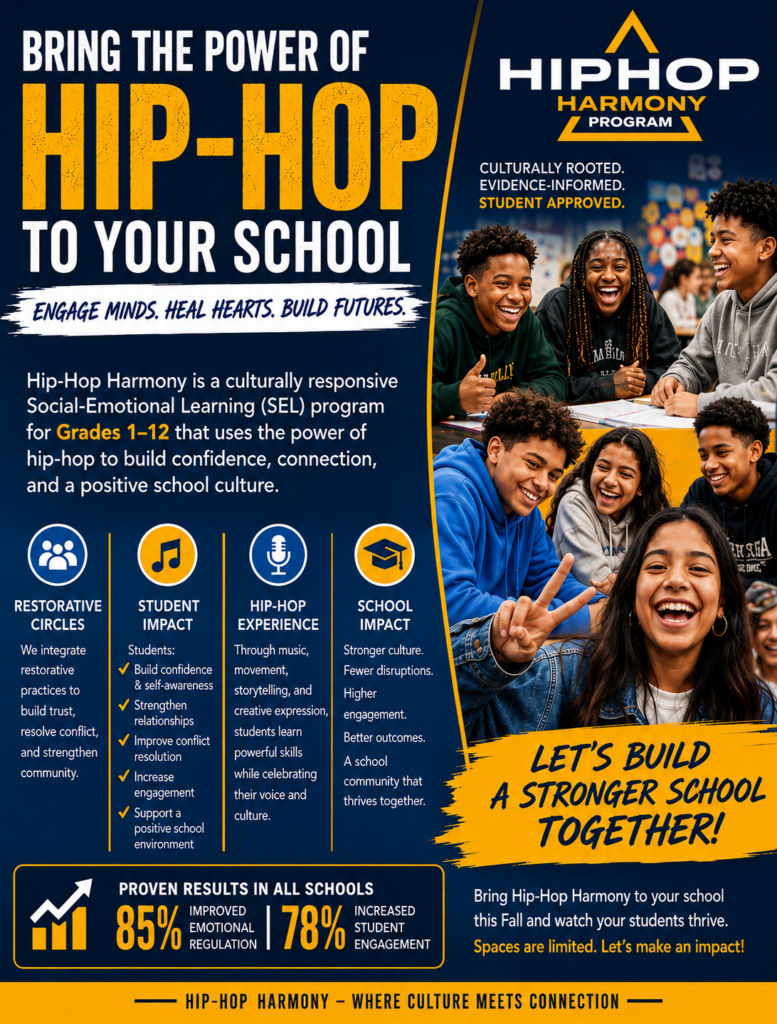
The Freeman Foundation for the Arts and Hip-Hop Harmony are actively expanding into public schools across the Metro-Atlanta area and Florida this school year. For more information, visit thefreemanfoundationforthearts.org