How Dangote Refinery’s $49 billion valuation compares with global refining giants
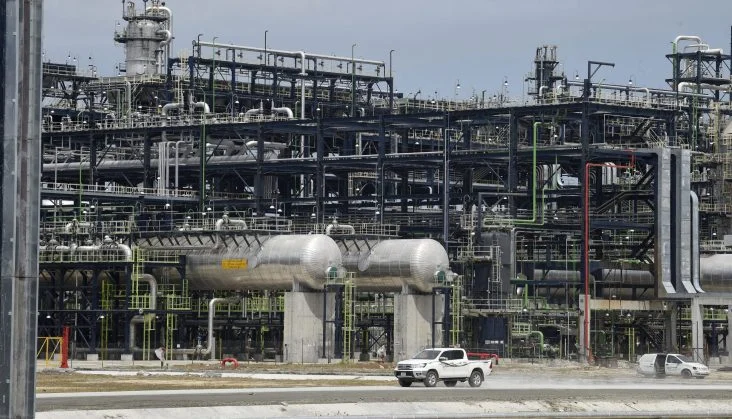
Dangote Refinery is entering Nigeria’s capital market with an implied valuation of about $49 billion, a figure that puts Africa’s biggest refinery at a significant premium to several listed refining companies with similar or larger processing capacity.
 Black News

Dangote Refinery is entering Nigeria’s capital market with an implied valuation of about $49 billion, a figure that puts Africa’s biggest refinery at a significant premium to several listed refining companies with similar or larger processing capacity.
- Dangote Refinery is entering Nigeria’s capital market with an implied valuation of about $47.6 billion, offering 4.1 billion shares at ₦525 each.
- The refinery's valuation far exceeds comparable companies like HF Sinclair and Turkey's Tüpraş, despite similar refining capacities.
- Investors are paying a premium due to expectations of major expansion and rapid scaling ahead.
- Dangote reported a significant turnaround in profitability for 2026 and is planning a $14.3 billion expansion to double capacity by 2029.
The refinery is offering 4.1 billion shares at ₦525 each, implying an equity valuation of about ₦63 trillion, or $47.59 billion, according to Reuters.
The Financial Times has rounded the figure to about $49 billion. Dangote is seeking to raise at least $1.6 billion from the offer, which represents about 3.3% of the refinery.
One useful benchmark is HF Sinclair, a US refining company operating refineries across the country.
DON'T MISS THIS: More than $7 million poured into Dangote Refinery’s $1.6 billion IPO within its first hour
Its consolidated crude capacity is 678,000 barrels per day, close to Dangote’s current 700,000 bpd, but its market capitalisation was about $19.15 billion on September 10, 2026.
That means Dangote’s implied valuation is roughly 2.5 times HF Sinclair’s market value despite their broadly comparable current refining capacity.
Turkey’s Tüpraş provides another comparison. The country’s largest refining company operates four refineries with a combined capacity of 30 million tonnes a year, equivalent to approximately 603,000 barrels per day.
DON'T MISS THIS: ₦2.15 trillion is on the table for Nigerians as Dangote Refinery sounds the gong on 4.1 billion new ordinary shares
It processed 28.1 million tonnes of crude and semi-finished products in 2025, equivalent to roughly 565,000 barrels per day. Its market capitalisation stood at about $16.4 billion on September 11, 2026, according to market data based on S&P Global Market Intelligence.
Why investors are paying a premium for Dangote
The comparison does not mean Dangote is simply more expensive than its peers. Unlike HF Sinclair and Tüpraş, investors are being asked to price in a major expansion and a rapidly scaling business.
Dangote reported $1.82 billion in net profit in the first half of 2026, compared with a $476 million loss for 2025. It is also planning a $14.3 billion expansion which would reach the same headline capacity as Reliance Industries’ Jamnagar refinery complex in India, currently the world’s largest single-site refinery.
The expansion, targeted for completion by 2029, is expected to add another 700,000 bpd capacity at an estimated cost of $14.3 billion.
DON'T MISS THIS: Dangote could add $23 billion to his fortune and join the World’s richest elite
The prospectus says the investment will be carried out in phases, with capital spending tied to engineering, procurement and construction milestones rather than requiring the full amount upfront.
That future capacity is critical to understanding the nearly $48 billion valuation. Dangote is not being valued solely on what its refinery produces today; investors are also being asked to price in higher production, earnings and cash generation from its planned expansion.
The test for shareholders will therefore be whether Dangote can sustain its recent profitability, secure enough crude at competitive prices and execute the expansion quickly enough for future earnings to justify the premium built into the IPO valuation.