How Trump Lost The Iran War In Less Than 6 Months
By Harrison Mann|Zeteo Photos: Wikimedia Commons Donald Trump is far from the only U.S. president to lose a pointless war in the Middle East. But because of his insistence on continuously redefining the terms of victory, he may be the first president to lose the same war three times – and in just six months, no less. The initial regime change operation in Iran was doomed from the start – no amount of bombing and assassinations was ever going to produce an Iranian Delcy Rodríguez who could hand Trump the keys to the country. When regime change faltered in the first week of the war, Washington and Tel Aviv appeared to pursue the more realistic and even more horrifying objective of regime collapse, bombing infrastructure and fomenting unrest to turn Iran into a chaotic failed state. Israel’s Benjamin Netanyahu was more enthusiastic about this approach than Trump, who seemed to abandon it after failing to persuade Iranian Kurdish groups to launch a likely-suicidal uprising, though the language of regime collapse has resurfaced to explain the administration’s sporadic, quixotic attempts at economic warfare. The April ceasefire would signal Trump’s tacit admission that bombing could neither replace nor destroy the Iranian state. But for most of the past six months, Trump has been fighting to force open the Strait of Hormuz. This is the war to lower gas prices, the war to undo the consequences of the war, or, to be more precise about the president’s objectives, the war to forget about Iran as quickly as possible with minimal embarrassment. This war was also definitively lost months ago, when the initial, intense February-April “40-day war” failed to prevent the Iranian government from attacking regional shipping. After another four months of Trump threats, half-hearted bombing runs, and not one but two U.S. blockades of Iran, Tehran’s military exercises formal authority over at least a third of the ships transiting the Strait. Plus, it now regularly shoots at “unauthorized” ships with impunity. The consequences of attacking Iran were, to a certain extent, well-understood within the administration: now-fired Director of National Intelligence Tulsi Gabbard cautioned that regime change was unrealistic, and that Tehran would close the Strait of Hormuz and retaliate against America’s Gulf partners. And Chairman of the Joint Chiefs of Staff General Dan Caine warned about limited air defense munitions and the risk of U.S. casualties. But Trump was never warned about a development that apparently surprised his Cabinet and certainly surprised me. That is, Tehran would simply defeat Washington and Tel Aviv on the battlefield. A Strategic and Tactical Failure Regime change – Trump’s first war – was always a fantasy. But in early March I was genuinely concerned that Trump and Netanyahu might well “win” the second war by methodically destroying Iranian state capacity until the country devolved into a humanitarian catastrophe or runaway internal conflict like the civil wars in Libya or Syria. After all, during the June 2025 strike on Iranian nuclear sites, U.S. and Israeli aircraft easily blew through – and blew up – Iran’s air defenses and bombed the best-defended facilities in the country. What was different this time? In the first weeks of the war, the Iranian military peeled away regional air defense networks with missile and drone barrages that depleted hard-to-replace interceptors and knocked out early-warning radars. That helped the Iranian military hit strategic refueling and command-and-control planes on the tarmac and force the evacuation of over a dozen bases, including the regional U.S. Air Force headquarters in Qatar, which limited the range and frequency of U.S. and Israeli bombing missions. Knocking out the regional U.S. Navy headquarters in Bahrain limited resupply to ships like the beleaguered USS Lincoln. And crucially, instead of replacing the higher-end air defense systems destroyed in the June 2025 war, the Iranian military appears to have relied on networks of shoulder-fired MANPADs, which have shorter ranges but are much harder to detect. These are the systems that shot down at least one U.S. fighter; their prevalence prevented the U.S. military from ever achieving “air dominance” and likely deterred U.S. aircraft from overflying some parts of the country. While a repeat of the June 2025 U.S.-Israeli strikes might have been possible against some targets, those required extensive preparation and over 100 aircraft – not replicable at scale against Iran’s entire military (or civilian) infrastructure. Tehran further protected its own key offensive capabilities – missiles and drones – by keeping them protected and concealed underground, and rapidly repairing damaged facilities. And so despite the Trump administration’s own barrage of press conferences claiming the total destruction of the Iranian military, Tehran never lost the ability to seriously threaten the Stra
 Black News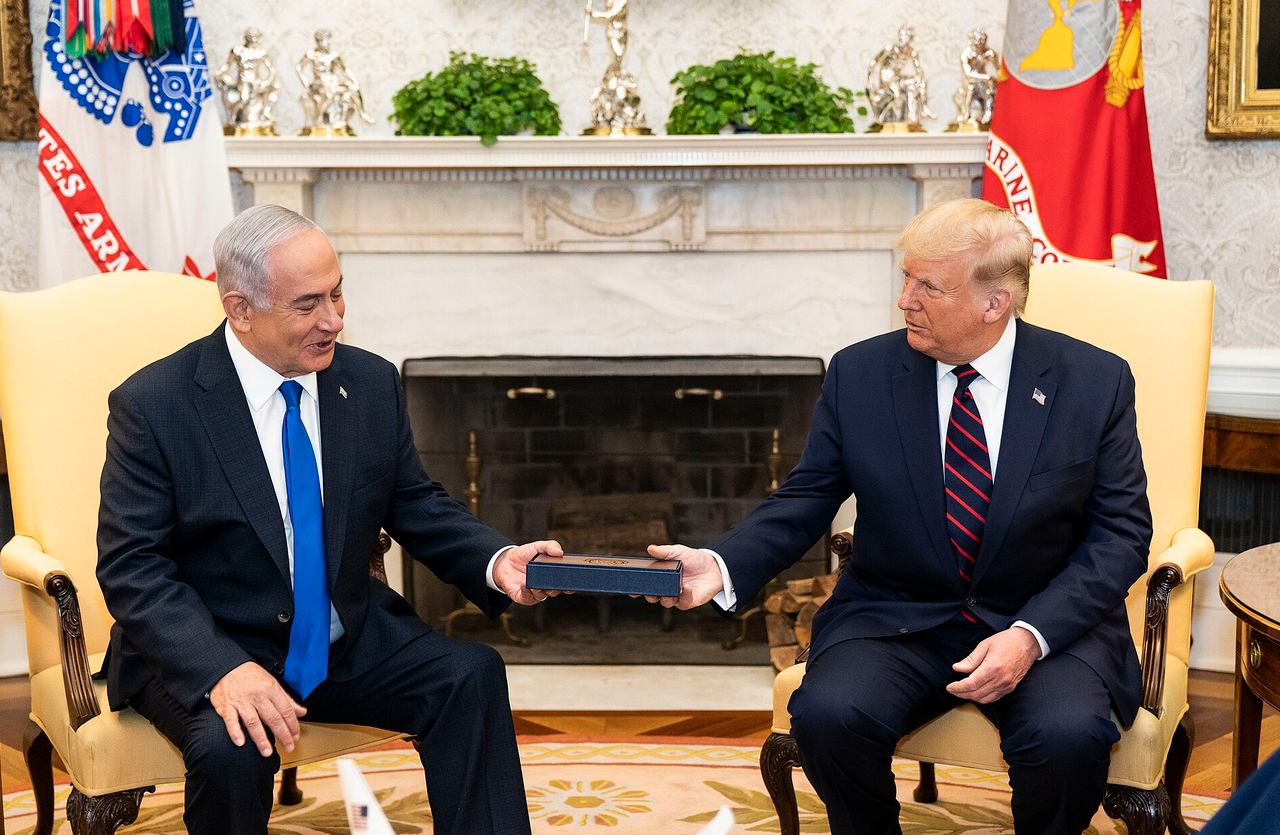

By Harrison Mann|Zeteo
Photos: Wikimedia Commons
Donald Trump is far from the only U.S. president to lose a pointless war in the Middle East. But because of his insistence on continuously redefining the terms of victory, he may be the first president to lose the same war three times – and in just six months, no less.

The initial regime change operation in Iran was doomed from the start – no amount of bombing and assassinations was ever going to produce an Iranian Delcy Rodríguez who could hand Trump the keys to the country. When regime change faltered in the first week of the war, Washington and Tel Aviv appeared to pursue the more realistic and even more horrifying objective of regime collapse, bombing infrastructure and fomenting unrest to turn Iran into a chaotic failed state. Israel’s Benjamin Netanyahu was more enthusiastic about this approach than Trump, who seemed to abandon it after failing to persuade Iranian Kurdish groups to launch a likely-suicidal uprising, though the language of regime collapse has resurfaced to explain the administration’s sporadic, quixotic attempts at economic warfare. The April ceasefire would signal Trump’s tacit admission that bombing could neither replace nor destroy the Iranian state.
But for most of the past six months, Trump has been fighting to force open the Strait of Hormuz. This is the war to lower gas prices, the war to undo the consequences of the war, or, to be more precise about the president’s objectives, the war to forget about Iran as quickly as possible with minimal embarrassment. This war was also definitively lost months ago, when the initial, intense February-April “40-day war” failed to prevent the Iranian government from attacking regional shipping. After another four months of Trump threats, half-hearted bombing runs, and not one but two U.S. blockades of Iran, Tehran’s military exercises formal authority over at least a third of the ships transiting the Strait. Plus, it now regularly shoots at “unauthorized” ships with impunity.
The consequences of attacking Iran were, to a certain extent, well-understood within the administration: now-fired Director of National Intelligence Tulsi Gabbard cautioned that regime change was unrealistic, and that Tehran would close the Strait of Hormuz and retaliate against America’s Gulf partners. And Chairman of the Joint Chiefs of Staff General Dan Caine warned about limited air defense munitions and the risk of U.S. casualties.
But Trump was never warned about a development that apparently surprised his Cabinet and certainly surprised me.
That is, Tehran would simply defeat Washington and Tel Aviv on the battlefield.
A Strategic and Tactical Failure

Regime change – Trump’s first war – was always a fantasy. But in early March I was genuinely concerned that Trump and Netanyahu might well “win” the second war by methodically destroying Iranian state capacity until the country devolved into a humanitarian catastrophe or runaway internal conflict like the civil wars in Libya or Syria. After all, during the June 2025 strike on Iranian nuclear sites, U.S. and Israeli aircraft easily blew through – and blew up – Iran’s air defenses and bombed the best-defended facilities in the country. What was different this time?
In the first weeks of the war, the Iranian military peeled away regional air defense networks with missile and drone barrages that depleted hard-to-replace interceptors and knocked out early-warning radars. That helped the Iranian military hit strategic refueling and command-and-control planes on the tarmac and force the evacuation of over a dozen bases, including the regional U.S. Air Force headquarters in Qatar, which limited the range and frequency of U.S. and Israeli bombing missions. Knocking out the regional U.S. Navy headquarters in Bahrain limited resupply to ships like the beleaguered USS Lincoln. And crucially, instead of replacing the higher-end air defense systems destroyed in the June 2025 war, the Iranian military appears to have relied on networks of shoulder-fired MANPADs, which have shorter ranges but are much harder to detect. These are the systems that shot down at least one U.S. fighter; their prevalence prevented the U.S. military from ever achieving “air dominance” and likely deterred U.S. aircraft from overflying some parts of the country. While a repeat of the June 2025 U.S.-Israeli strikes might have been possible against some targets, those required extensive preparation and over 100 aircraft – not replicable at scale against Iran’s entire military (or civilian) infrastructure.
Tehran further protected its own key offensive capabilities – missiles and drones – by keeping them protected and concealed underground, and rapidly repairing damaged facilities.
And so despite the Trump administration’s own barrage of press conferences claiming the total destruction of the Iranian military, Tehran never lost the ability to seriously threaten the Strait of Hormuz or other countries in the region. While some in the administration clearly understood the risks of attacking Iran, it’s not clear if it ever occurred to them – or the Pentagon itself – that the most powerful military in the world would be unable to find and destroy their adversary’s most potent weapons. This is a story of institutional hubris, not just Trump’s foibles.
The Fourth War That Might Never End
Resisting the U.S. and Israeli militaries for 40 days gave Iran’s surviving leaders newfound confidence in their ability to shape events through warfare. At the same time, Trump’s duplicity and erratic behavior made negotiations look increasingly like a fool’s errand. That’s why Tehran insists on internationally recognized authority over the Strait of Hormuz: It’s the closest it can get right now to an insurance policy against future U.S. or Israeli attacks. It’s also an acknowledgment that Iran’s leaders may not be able to win the one war they have been fighting for the past six months – the war to convince a president with a tenuous grasp on reality that he’ll be best served cutting his losses and abandoning Iran altogether. The longer this war drags on, the higher the odds that Tehran will resume attacks against U.S. forces and partners to see if Trump gets the point this time.
Iran Unleashed?
The war needlessly killed thousands of Iranians, 18 U.S. troops, and threw the globe into economic turmoil, but hawkish critics of the war like neocon Robert Kagan, echoing concerns heard not infrequently from Democrats, have lamented that the war leaves Iran “unleashed” in the region. “Iran unleashed” sounds scary until you remember how trying to keep it on a “leash” turned out, even before the current war. Sanctioning Iran and enforcing its pariah status for decades immiserated Iranians while empowering repressive leaders. Starting a new proxy war with Iran by backing Saudi Arabia’s war in Yemen created a humanitarian crisis and catapulted the Houthis from a little-known local rebel group into a minor regional power that now also disrupts shipping in the region. And, of course, the Iranian threat has long been used to justify unconditional U.S. military support for Israel, an argument the Biden administration doubled down on during the Gaza genocide.
As for Iran’s nuclear program, it has always been most effectively constrained by diplomacy, which will now need to include reassuring Iran’s leaders that Washington and Tel Aviv are not actively trying to assassinate them – no small feat. Though, as Kagan points out, Hormuz has proven a more effective deterrent than enriched uranium ever was, so the war might, in a roundabout way, create space for Tehran to deprioritize its nuclear program, at least in the short term.
The U.S. military presence in the Middle East has always been fundamentally destabilizing. Decades of intervention and pitting the authoritarians and zealots we like against the authoritarians and zealots we don’t like have done little to improve life in the United States and far more harm than good for people in the Middle East. We should not lament that Tehran and its neighbors are preparing to normalize their relationships, Gulf states are trying security arrangements that don’t rely on Washington, and that regional leaders are generally preparing for a future defined by fewer made-in-USA explosions. But we can wish that we’d arrived at the inevitable “end of the American Middle East,” as George Washington University professor Marc Lynch has aptly termed this moment, deliberately and peacefully. Instead, Trump will be leaving at gunpoint, with a trail of bodies behind him.

Harrison Mann is a former US Army major and executive officer of the Defense Intelligence Agency’s Middle East/Africa Regional Center who resigned in protest of his office’s support for Israel’s war in Gaza under the Biden administration. He is currently with the group Win Without War and recently became a Zeteo contributor.