A View of Qusra
Today's settler violence in the West Bank can be traced directly to the 2005 disengagement from Gaza. The post A View of Qusra appeared first on Moment Magazine.
 Black News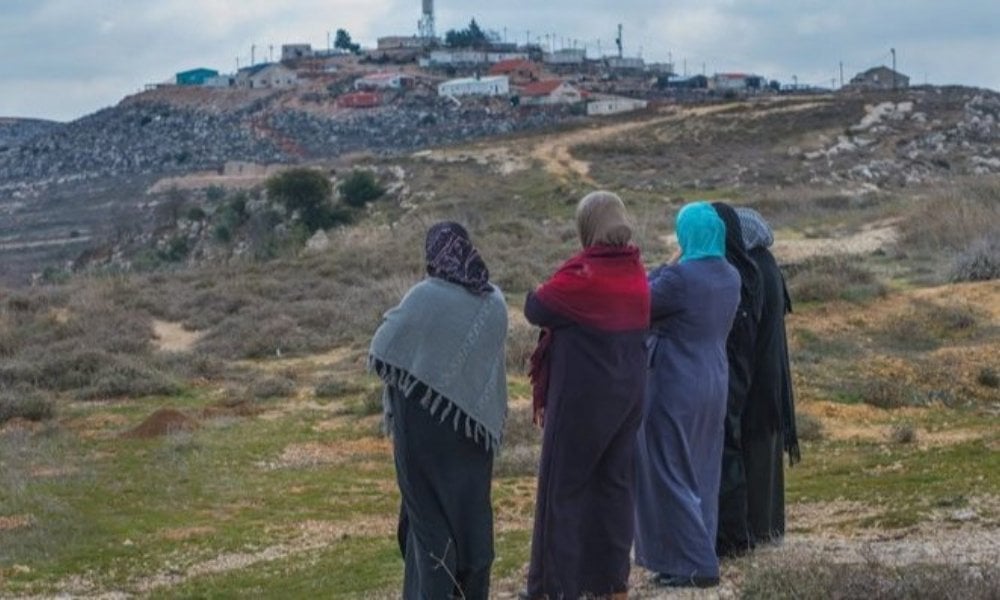
“Aliza” breathes deeply, attempting to hold back tears as she reads the headlines on her phone about the more than 100 young settlers who, on September 28, had rioted in order to prevent Palestinians from returning to their homes in the West Bank village of Jalud as ordered by Israel’s High Court of Justice. The rioters blocked roads; set fire to houses, other buildings and vehicles; wounded several Palestinians; and hurled rocks toward security forces, injuring three Israel Border Police officers, according to the IDF.
Aliza, who refuses to give her real name, lives in a settlement established decades ago near Jerusalem in accordance with government policy. Her son lives in a hilltop community of about 20 young adults, most of them men, deep in the West Bank. It’s an area where Israeli settlement is forbidden according to the Oslo Accords and is illegal under Israeli law. She refuses to give his name because, she says, “I know my son and his friends on the hilltop are involved in the most violent actions against Palestinians, and my son may have killed innocent people.”
Her son is 22, yet Aliza believes the roots of this violence go back to a time before he was born, to the summer of 2005, when Israel evacuated some 6,000 settlers from 21 settlements in the Gaza Strip and then completely razed the area. The government referred to this operation as the “disengagement.”
Most of the settlers in the Gaza Strip at that time belonged to the National Zionist movement, which is now led by right-wing extremist minister of finance Betzalel Smotrich. Encouraged and supported by Israel’s governments for decades, the Gaza settlers believed they were preventing the establishment of a Palestinian state, thus guaranteeing Israel’s security and bringing the redemption of the Jewish people in their ancestral, divinely promised homeland.
When then Prime Minister Ariel Sharon, known to be a fervent supporter of the settler movement, first proposed the disengagement, which the settlers would later dub the “expulsion,” the settler leadership did not believe he would carry it out. But since public opinion was in favor of the disengagement, they decided to act to try to say that opinion. Advocating for legal, nonviolent resistance, they organized highly dramatic mass demonstrations. Youths were bused into the Gaza Strip from all over the country and encouraged to barricade themselves in homes, synagogues and public buildings; rabbis and teachers encouraged them to cry and pray fervently for the annulment of the “evil decree.” Some settlers even pinned the infamous yellow star the Nazis forced Jews to wear on their own clothing.
“We did not know rabbis were teaching a vicious form of Judaism based on hatred, revenge and death.”
“Like so many others, I barricaded myself in a synagogue and cried endlessly because our rabbis told us that God would hear our tears,” Aliza recalls. And when the expulsion did happen, Aliza says she was “devastated—by the raw emotions, by the fear and mostly by the betrayal by the State of Israel of our most precious value, the settling of the land. I thought I must reject the State of Israel and even considered illegal activities, like setting up settlements like my son is doing.”
As she grew older, her views tempered. “I still believe that the expulsion was wrong, but I am loyal to the state and believe that the settlement movement is an integral part of Israeli society. We will eventually redeem the Land of Israel, but only through legal means.”
Unlike Aliza, the more radicalized evacuees and settlers, among them rabbis and educators, continued to believe they were betrayed by the leaders and rabbis of the mainstream settler movement, because they did not fight hard enough to prevent their expulsion; by the army, because it carried out what they viewed as the illegal orders of the state when it forcibly evacuated the settlers; by the State of Israel, because if preferred democracy over redemption of the Jewish people; and by a religious framework that promised them that God would answer their prayers.
Over time, these radicalized rabbis, leaders and educators made deliberate and successful efforts to take on prominent roles in the educational system. Samuel J. Hyde, a fellow at the Jewish People Policy Institute (JPPI), an independent think tank based in Jerusalem, writes that radical settlement leaders twisted “Jewish tradition into an abominable chimera, mixing biblical literalism, ethnonationalism and theological obsessions.” Their creed, Hyde writes, is similar to that of evangelical Christians, and their “ultimate aim is to dismantle Israel’s democratic and secular public sphere and replace it with a halachic theocracy.”
Aliza says she was unaware of just how dominant their teachings had become. “Like our parents, my husband and I sent our children to settlement schools and encouraged them to participate in settlement youth movement activities, and now I regret that. We did not know rabbis were teaching a vicious form of Judaism based on hatred, revenge and death. They believe protecting the land of Israel is more important than any other commandment. They don’t even observe the Sabbath anymore, driving into villages, lighting fires and doing other things forbidden by Jewish law in the name of redemption. Now, these kids listen to no one except these radical rabbis who encourage their horrible behavior.”
Life on a hilltop settlement
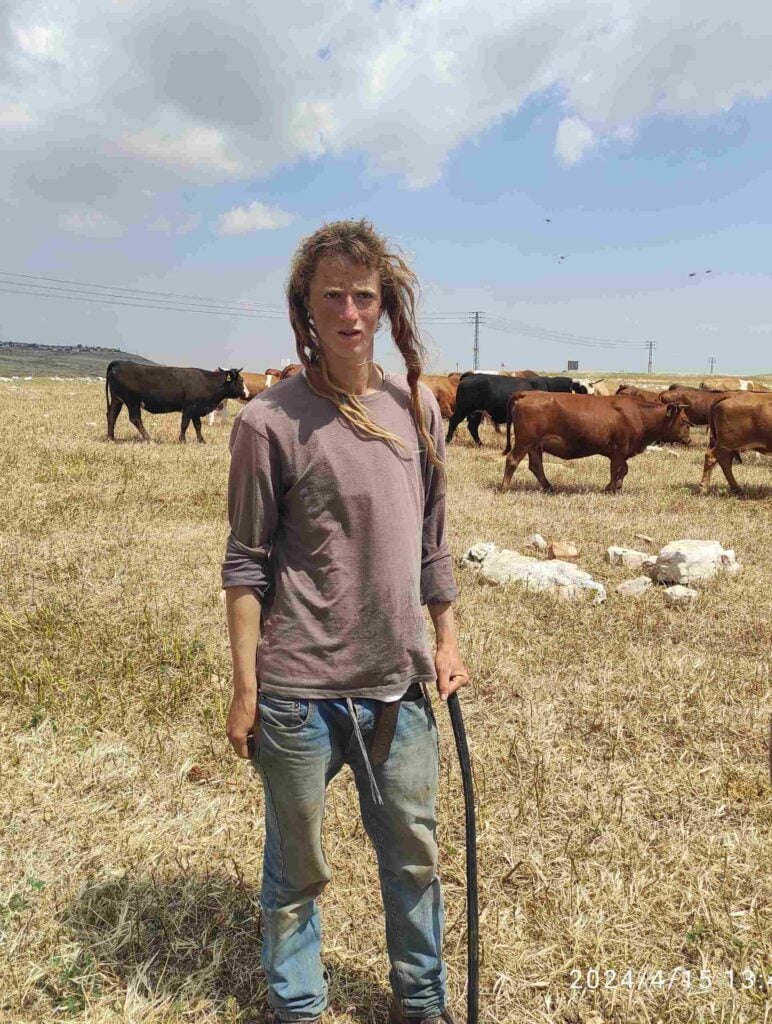
Hilltop Youth trespasses in a private Palestinian field April 2024. By יורם שורק – Own work, CC0
According to Maj. Gen. Avi Blut, who heads the IDF’s West Bank Command, around 300 young men, along with perhaps a dozen young women, live in the hilltop settlements. Almost all of them are under the age of 25, and some are thought to be minors who have dropped out of school and have been involved in other criminal activities. Blut estimates 70 are “hardcore fanatics,” whom he refers to as “terrorists.” These are the ones, he says, who are responsible for the most severe violence, which is not only directed against Palestinians but also against the state and its institutions, including against schools, health clinics, soldiers and human rights workers.
Citing UN data, The Jerusalem Post reports that 64 West Bank Palestinians “have been killed and 5,173 injured by Israeli forces and settler groups in 2025-26 alone.” Yesh Din, a human rights group that tracks settler violence, reported that as of August, 62.6 percent of the acts of violence against Palestinians it has recorded took place in Area A and Area B, which are ostensibly under Palestinian control, and include the killing of livestock, arson to property and fields, cutting of power and water lines to Palestinian villages, and taking over Palestinian homes, trapping their owners inside and holding them as hostages.
In response, Great Britain has imposed sanctions on West Bank goods, and other European nations are following. U.S. Ambassador to Israel Mike Huckabee called the attacks on the village of Qusra, where a Palestinian-American man resides, “acts of terror.” Soon after the radical settlers set fire to a mosque and left graffiti on a nearby building reading, “Huckabee, regards from the ‘terrorists.’” Hilltop settlers regularly update their social media channels, detailing how many Arabs they have wounded or killed, how many vehicles they have burned, how many homes they have set fire to, how many olive trees they have uprooted and how many livestock they have slaughtered.
“The violence against Arabs is meant to show everyone, especially the state, the IDF and other Jews, that we are in charge, that we are pure and just, and that we will bring redemption to the Jewish people.”
Avihu, 27, attended schools and youth movement activities similar to Aliza’s son. He lived on an illegal hilltop outpost in the West Bank for over a year, participating, he admits, in the most violent activities, including shooting Palestinians. He refuses to give his real name for fear of being arrested or inviting revenge from his former fellow-settlers because he did not return.
He left the outpost a year and a half ago when he developed a serious illness. He spent many months in medical care and today is studying for an undergraduate degree in Jewish studies. He says he still supports the hilltop youths’ goals and methods and has not returned only because of his health.
According to Avihu, the hilltop settlement where he lived with about 25 other young men does not have electricity or running water; the men tend sheep and grow olives and other crops mentioned in the Bible and live on a subsistence diet. “The sunsets and sunrises are amazing, you can see almost the entire land of Israel. I can imagine what it will be like when there are no more Arabs here. Everyone has a deep sense of purpose. It is very romantic and very enticing to the young men who live there,” he says.
“Everyone hates all Arabs, of course,” he continues, “but that isn’t our main point. The State of Israel is the problem. The violence against Arabs is meant to show everyone, especially the state, the IDF and other Jews, that we are in charge, that we are pure and just, and that we will bring redemption to the Jewish people.”
The role of the IDF
In a briefing in May, Maj. Gen. Blut declared he would not be surprised if the Palestinians in the West Bank soon exploded into violence as well—a situation he says the IDF would be ill-equipped to handle, as it is “already spread too thin on too many fronts.” Blut warned that while Palestinian terrorism had declined significantly, there remained “one match that could ignite everything in an instant—nationalist crime,” a reference to the violence by the hilltop settlers.
At the same time, Blut acknowledged that the army could put an end to the settler violence, but it would entail use of force. Acknowledging that settlers are subject to the same military law that applies to Palestinian residents, he admitted that terrorism by Jews and Palestinians is handled very differently. Blut argued that force should be applied to Palestinian terrorists but not to Jews—even though Blut himself has referred to these Jews as terrorists. “Jewish terrorist activity is different from a sociological point of view,” he said, but refused to explain even when asked.
Blut’s simultaneous warning regarding the dangers of the violence and refusal to use force to put an end to it reflect ambivalence within the army’s highest ranks. In fact, despite Blut’s declarations, the IDF not only does not prevent settler violence, it often encourages and even abets it. It is not unusual to see soldiers praying with settlers, drinking coffee with them, shaking their hands and slapping their backs. A soldier was recently filmed shooting a Palestinian man in the leg for no apparent reason, while ignoring the settlers who were encroaching on Palestinian-owned land, the military acknowledged to Haaretz. Several times, military authorities have declared an area a “closed military area” and evicted human rights activists, while allowing the settlers to enter and run around the area freely and even violently attack the activists.
In its decision on a petition filed by three residents of Jalud, a village near Qusra, the court sharply criticized the Israeli military and police for failing to prevent the settler attacks and the families’ expulsion, as well as for failing to take sufficient action to bring those responsible to justice. Such attacks “contravene the fundamental moral values and principles of the State of Israel as a Jewish and democratic state” and violate the principles central to Jewish heritage and the prophets of the Bible, the court decision read.
And recently more than 300 reservists signed a petition sent to the IDF’s chief of staff, condemning the military’s failure to “arrest the leaders of nationalist terror and root it out.”
What is behind the IDF’s reluctance to take firmer action? Part of the answer goes back, as with the hilltop settlers themselves, to the disengagement from Gaza in 2005. The Israeli military carried out the operation swiftly and efficiently, without major dissension in its ranks. The settlement leadership had not expected this and concluded that settlers did not have the numbers in military command positions to prevent the implementation of the political decision. To correct this, they aggressively expanded their educational institutions to raise a generation of highly motivated combat soldiers and officers who would fill the IDF’s highest command echelons.
According to Professor Yagil Levy, head of The Institute for the Study of Civil-Military Relations at the Open University, the settler movement promoted “an agenda that includes the military’s commitment to the settlement enterprise and prevention of future evacuation of new and veteran settlements.”


Many of the soldiers serving in the West Bank, including in the higher echelons, like Blut himself, who is a resident of a settlement, are either friends of the hilltop youths or friends and colleagues of their parents. They are caught between their social identities and military commands.
Meanwhile, right-wing politicians are actively exacerbating the situation. In the case of Qusra, for example, the IDF did not receive an order to allow the settlers to continue to attack the village—but neither were they instructed to evacuate or arrest the rioters. Extremist members of Netanyahu’s coalition have also supported settler violence and visit hilltop settlements regularly. Diaspora Affairs Minister Amichai Chikli has called illegal settlements “strategic points” and “the spearhead of Zionism.” Others have called for the establishment of another 100 outposts in areas nominally under the control of the Palestinian Authority (according to the Oslo Accords, which are nominally still in effect).
And when Blut appealed, along with the State Prosecutor’s Office, the defense minister’s decision not to renew a restraining order against a settler and far-right activist suspected of sexually abusing a Palestinian during a violent raid, Defense Minister Yisrael Katz fired Blut on TV. Katz later reversed that decision (which had no legal bearing), but Blut will be replaced in 2027 due to pressure from right-wing figures who have criticized the commander for speaking out against the violence.
Critics have speculated that senior IDF officers concerned about their careers are hesitant to take action against Israeli assailants because of right-wing political pressure.
Is a Change in the Offing?
Numerous settler leaders have denounced the violence. In May, a group of rabbis and leaders from Gush Etzion, a bloc of settlements near Jerusalem, widely disseminated a pamphlet emphasizing their “desire to strengthen the settlement movement,” which is “threatened by the unrestrained violence.” Similarly, Rabbi Dr. Benjamin Lau, a charismatic leading educator and head of the Human Rights and Judaism in Action project at the Israel Democracy Institute, wrote on his Facebook page, “We must never retreat from the Land of Israel, and we will struggle and continue to struggle until we settle the entire Land…we must never hurt the IDF soldiers. The sole goal of the violence is to bring the Arabs to an explosion point to create legitimization for a full war in Judaea and Samaria. This is not our way.”
Professor Levy believes a “major deal” is taking shape, according to which the IDF would be required to take a harder line against violent settlers and provide enhanced security for Palestinians and others, such as human rights activists. At the same time, the IDF will refrain from removing or dismantling, including the illegal hilltop settlements.
Under this arrangement, “revenge is not being blocked. Rather, it is changing its form into an institutionalized practice,” warns Levy. “This change may lead to a more disciplined army, but not to a more restrained one, and it will certainly lead to an even less moral one.”
Contemplating this “deal,” Aliza once again is wary. “I wish it were enough. I do not believe the mainstream settlement movement is illegal or violent, and I want it to flourish. But I fear it may be too late for young men like my son, who have been fiercely indoctrinated.” She sighs and adds, “I fear for my son’s life and for Israeli society.”
(Top image credit: Peter Biro/EU/ECHO, CC BY 2.0)
The post A View of Qusra appeared first on Moment Magazine.