Ceuta: When a Wave of Crossings Becomes a Political Test for Europe
Analytical ReportIn a matter of days, Ceuta shifted from a quiet Spanish city on the Moroccan coast into the epicenter of a crisis whose consequences reach far beyond its narrow borders. Tens of thousands of young people converged on the city, swimming or walking in, marking the largest mass crossing the region has seen since […] ظهرت المقالة Ceuta: When a Wave of Crossings Becomes a Political Test for Europe أولاً على African Percentions.
 Black News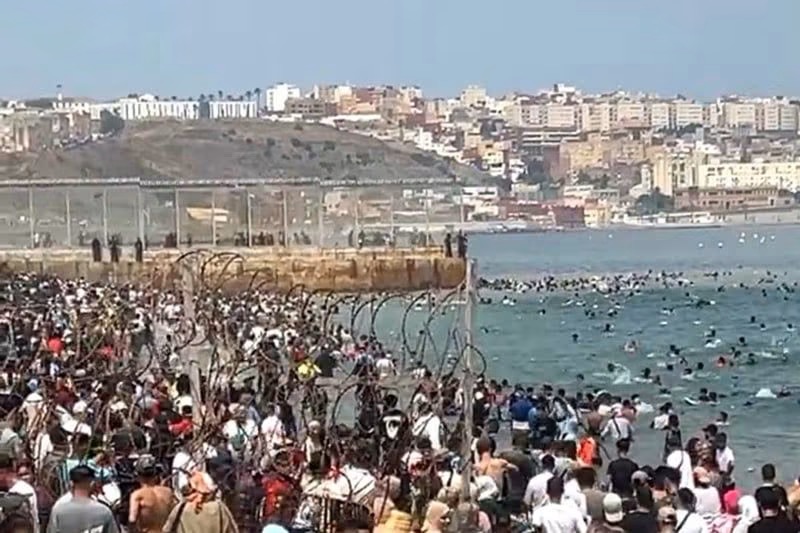

Analytical Report
In a matter of days, Ceuta shifted from a quiet Spanish city on the Moroccan coast into the epicenter of a crisis whose consequences reach far beyond its narrow borders. Tens of thousands of young people converged on the city, swimming or walking in, marking the largest mass crossing the region has seen since 2021. What matters most, though, is not the scale of the numbers alone, but what this moment exposes: the fragility of southern Europe’s migration management system, the strained relationship between Rabat and Madrid, and a renewed European rift over who should shoulder the burden of the EU’s external borders.
Conflicting figures reflect the initial chaos
The episode began with roughly 1,500 people swimming to Spanish shores, before the number unexpectedly multiplied within a single day. Official bodies themselves gave diverging estimates: Ceuta’s governor put the figure at around 60,000 crossings — more than half the city’s population — while Spain’s Interior Ministry offered a lower estimate of about 49,000 in just 24 hours. That discrepancy alone signals how unprepared authorities were, and how little reliable tracking existed at the height of the event.
Madrid later announced that around 69,500 people had been returned to Morocco, while between 3,000 and 5,000 remained in the city — a situation local authorities still refuse to describe as normalized, given the continued strain on reception facilities.
Minors: the crisis’s most vulnerable link
Of all the details in this crisis, one figure stands out as the clearest sign of administrative collapse: 862 unaccompanied minors currently sheltered in the city, against an official capacity of just 29 spots — an overload of roughly 2,872%. That number reflects more than a logistical bottleneck; it reopens a sensitive legal file. Spain’s Supreme Court had ruled in January 2024 that the 2021 return of minors from Ceuta to Morocco was unlawful, for lack of the individual legal safeguards each child was owed. Authorities now face a double bind: grossly inadequate shelter capacity on one hand, and judicial constraints limiting rapid returns on the other.
A rising death toll amid uncertainty
Alongside the administrative crisis, the human toll kept climbing. Initial reports cited 57 bodies recovered on the Spanish side and 11 deaths confirmed by Morocco’s Interior Ministry, before later Spanish media reports raised the figure to 88 bodies recovered from the sea. This shifting count, even as Rabat says it continues working with Madrid to verify identities and nationalities, underscores how difficult it is to establish a reliable death toll in a crossing of this scale and disorder.
Militarizing the border as an immediate response
The security response was swift and unfolded on both sides of the border. On the Spanish side, Ceuta’s authorities requested army support for police forces, and the Interior Ministry announced additional troop deployments to back the Civil Guard; a 500-meter floating barrier was also completed at the Tarajal border crossing to curb maritime crossings. On the Moroccan side, water-cannon trucks were deployed at the city’s entrances. Both countries announced tighter security coordination to swiftly return those who had entered illegally — a sign that bilateral cooperation, despite its recurring tensions, remains the only workable framework for containing this kind of crisis on the ground.
A domestic political rift: who failed to see it coming?
Domestically, the crisis triggered a political battle between Spain’s government and the opposition. The conservative Popular Party accused the government of ignoring intelligence warnings, while the government denied receiving any report warning of a crisis of this magnitude, with its spokesperson calling the event “unprecedented” and something “no one anticipated.” Prime Minister Pedro Sánchez took a sharper tone, describing what happened as “an attack on national sovereignty” — a phrase carrying a dual purpose: reassuring domestic public opinion while avoiding direct criticism of Morocco, whose cooperation on returning migrants and fighting smuggling networks he praised in the same breath.
From a bilateral crisis to a European fracture
Politically, the more troubling development is that the crisis did not stay confined to the Spanish-Moroccan relationship — it spilled directly into the heart of the European debate over the Schengen zone. Italy, through its foreign minister and Deputy Prime Minister Matteo Salvini, called for suspending Spain’s Schengen membership, later announcing an actual suspension of the agreement’s application with Madrid. Finland backed Italy’s position, arguing that countries unable to protect their external borders should not remain within the open Schengen space. France took a more cautious approach, tightening controls along its border with Spain without adopting the suspension rhetoric. Madrid pushed back firmly: its foreign minister called Italy’s statements “unacceptable,” insisting that Spain expects genuine solidarity from its European partners rather than “political one-upmanship.” This split exposes a deep fragility in the EU’s burden-sharing mechanism whenever a single member state faces an exceptional migration surge.
Root causes: unemployment, frustrated aspirations, and entangled geopolitical pressures
This crisis did not emerge from nowhere. Morocco’s unemployment rate stood at 13% in 2025, and the Moroccan Economic, Social and Environmental Council has noted that roughly 1.5 million young people aged 15 to 24 are entirely outside the labor market — a demographic pool that could fuel future crossing waves. But an economic reading alone doesn’t fully explain the phenomenon. Regional analysts note that Morocco faces pressure from two directions: from Spain and the EU, demanding tighter control over African migrants transiting through its territory, and from its own citizens who themselves dream of reaching Europe — all while some observers argue Rabat isn’t receiving the support this role warrants, especially given how the issue intertwines with other files like Western Sahara and the status of Ceuta and Melilla. There’s also a social dimension worth noting: Morocco ranks among Africa’s relatively wealthier countries, yet the desire to migrate to Europe has become, for a wide swath of its youth, more a psychological fixation than a matter of survival — fed by constant comparison with what “others have” rather than an appreciation of what is locally available.
Conclusion: a crisis destined to recur until its causes are addressed
What happened in Ceuta is not an isolated incident that closes once things outwardly return to “normal.” It is a symptom of a multi-layered structural failure: crisis-management systems unequipped for sudden surges, legal gaps in handling unaccompanied minors, a structural rift within the European space over how border burdens are shared, and deep-rooted economic and social causes within Morocco itself that remain unaddressed. As long as these four layers go untreated simultaneously, a repeat of the Ceuta scenario — in different forms, and perhaps at other border points — remains a likelihood, not an exception.
ظهرت المقالة Ceuta: When a Wave of Crossings Becomes a Political Test for Europe أولاً على African Percentions.