Here Is The Story Behind Every African Country’s Name.
Three African Countries Share a Name That Literally Means “The Burnt People.” Those countries are Guinea, Guinea-Bissau, and Equatorial Guinea, and no, none of them chose that name for themselves. It started as Guiné, a word Portuguese traders adopted from the Berber Ghinawen, “the burnt people,” a term North African traders used for the Black [...]
 Black News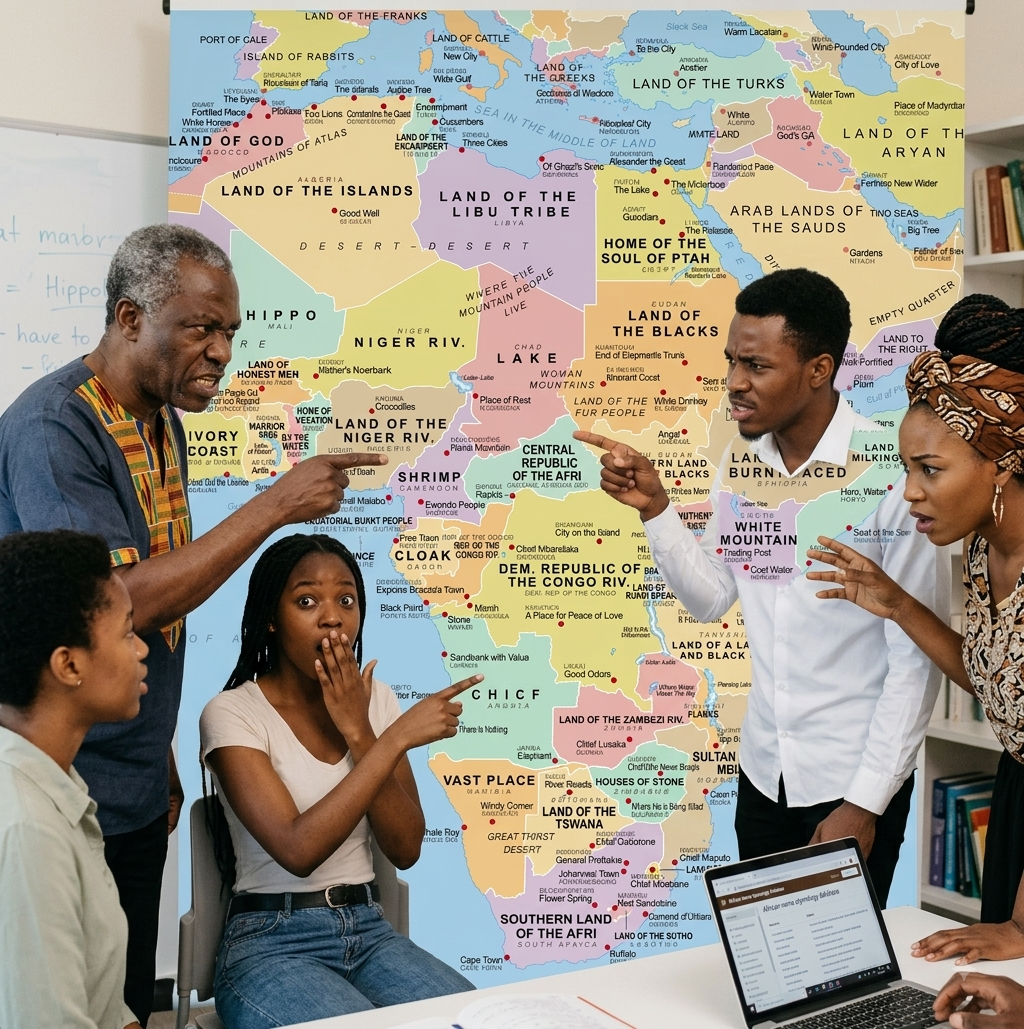

Three African Countries Share a Name That Literally Means “The Burnt People.”
Those countries are Guinea, Guinea-Bissau, and Equatorial Guinea, and no, none of them chose that name for themselves. It started as Guiné, a word Portuguese traders adopted from the Berber Ghinawen, “the burnt people,” a term North African traders used for the Black populations they encountered south of the Senegal River.
Portuguese chroniclers were already using it by 1453. By 1481, the King of Portugal had folded it straight into his own royal title, Senhor da Guiné, “Lord of Guinea.” A phrase built to sort human beings by skin color became a stretch of coastline’s name, then three separate countries kept it after independence, each one still standing on a word that was never theirs to begin with.
That’s the thing about African country names. Half of them fossilized a description nobody today would think to write down, and this one is being worn by three countries at once, not just one.
Once you know that, you cannot look at a map of Africa the same way again. Fifty-four countries. Fifty-four names. Some formed around rivers and coastlines. Some came from kingdoms that ruled empires long before Europe drew borders. Some were mistranslated, half-heard, or invented by men who never set foot past the shore. And some were chosen decades later, on purpose, by nations that had just won the right to name themselves.
This is the version of the map nobody teaches you in school.
ALSO READ: 10 Most spoken African Languages in Africa
The Names Written by Outsiders
Start with the coast, because that’s where the guessing happened fastest.
Cameroon is the cleanest case. Portuguese sailors pulled a net full of prawns out of the Wouri River, couldn’t think of anything better to call it, and named it Rio dos Camarões, “river of shrimp.” Four centuries and three languages later, that offhand fishing note is still the root of a nation’s name.
Sierra Leone comes from Serra Leoa, Portuguese for “lion mountains.” Nobody agrees on why. Maybe it was the thunder rolling off the peninsula’s hills, maybe the silhouette of the mountains against the sky. Either way, someone stood on a ship deck, looked at land they didn’t understand, and reached for the most dramatic word they had.
Gabon has an even stranger origin. The name traces to gabão, a Portuguese word for a hooded cloak, because a sailor looked at the Komo estuary and thought it resembled one. A piece of clothing became a country.
Sudan tells a different kind of story. It comes from the Arabic Bilād as-Sūdān, “land of the Blacks,” a phrase used across centuries of trans-Saharan trade and scholarship to describe the vast region south of the desert. Unlike the Portuguese coastal names, this one wasn’t a guess from a passing ship. It was how an entire region was mapped and understood from within its own trading world, long before Europeans arrived to draw lines through it.
Algeria works the same way, just one city removed. The name comes from Algiers, and Algiers comes from the Arabic Al Jazā’ir, “the islands,” a reference to a small cluster of islets that once sat off the city’s harbor before later landfill absorbed them into the coastline. The islands are gone. The name outlived the geography that produced it.
And then there’s Kenya, which might be the best proof that naming was never a precise science. British colonizers, trying to record the name of the mountain the Kikuyu called Kirinyaga, “mountain of brightness,” relied on a Kamba guide to pronounce it. He rendered it closer to “Kii-nya.” The English heard “Kenya,” wrote it down, and the mishearing stuck so completely that it outlasted the empire that made the mistake. When the country chose its name at independence, it kept the error on purpose, because a word that belonged to no single ethnic group was more useful than a word that belonged to one.
Put those six side by side and a pattern emerges. Long before colonial borders existed, and often for a long while after, Africa’s map was being written by outsiders describing what they saw, or thought they heard, in languages the land itself didn’t speak.
ALSO READ: 12 Surprising African Countries That Allow Dual Citizenship By Marriage
Some Names Are Not Descriptions. They’re Declarations.
Then there’s the other kind of name. The kind a country chooses for itself, on purpose, after deciding it’s done being described by someone else.
Burkina Faso is the clearest example on the continent. In 1984, under Thomas Sankara, Upper Volta became Burkina Faso, a name built from Mooré and Dioula that translates roughly to “land of upright people.” Not a river. Not a coastline. A statement of character, chosen by a government that wanted its name to say something about who its people were, not where a Portuguese boat happened to dock.
Zimbabwe works the same way, reaching backward instead of forward. The name comes from Dzimba-dza-mabwe, “houses of stone,” a direct reference to Great Zimbabwe, the monumental stone city built by Bantu-speaking Africans between the 11th and 15th centuries. When a colonial-era Rhodesia became Zimbabwe at independence, the new name did more than remove a colonizer’s surname. It pointed straight at proof that African civilization built empires in stone before anyone else showed up to name them.
Ghana did the same thing. At independence in 1957, the newly formed nation didn’t just need a name, it needed a lineage. So it borrowed the name of the ancient Ghana Empire, a medieval West African kingdom famous for gold and trade, even though the empire’s actual territory sat hundreds of miles from the modern country’s borders. The message mattered more than the geography: independence wasn’t a beginning. It was a return.
The Great Post-Independence Rename
This is the part of the story that gets lost in trivia lists. Renaming a country was never just a cosmetic update. It was one of the first acts of sovereignty a new nation could perform, a way of saying: the empire is gone, and so is its paperwork.
| Former Name | Current Name | Year Changed | What Changed |
|---|---|---|---|
| Gold Coast | Ghana | 1957 | Named for the ancient Ghana Empire, not the resource extracted from it |
| Upper Volta | Burkina Faso | 1984 | Chosen under Thomas Sankara to reflect national identity, not a river’s upper course |
| Rhodesia | Zimbabwe | 1980 | Rejected Cecil Rhodes’ name for a reference to Great Zimbabwe’s stone ruins |
| Northern Rhodesia | Zambia | 1964 | Renamed for the Zambezi River, cutting the last tie to Rhodes |
| Bechuanaland | Botswana | 1966 | Adopted a name honoring the Tswana people |
| Basutoland | Lesotho | 1966 | Named for the Basotho people and their language |
| Nyasaland | Malawi | 1964 | Took its name from the historic Maravi kingdom |
| Dahomey | Benin | 1975 | Renamed for the Bight of Benin, itself named for the “Home of Vexation” empire in modern Nigeria, unrelated to the country wearing its name today |
| South-West Africa | Namibia | 1990 | Named for the Namib Desert upon independence from South African administration |
| Swaziland | Eswatini | 2018 | Changed to the Swazi-language name meaning “land of the Swazis” |
| French Sudan | Mali | 1960 | Named after the medieval Mali Empire |
| Spanish Guinea | Equatorial Guinea | 1968 | Renamed to reflect its position on the equator, independent of the region called “Guinea” by colonial powers |
Some of these renamings rejected a colonizer’s name outright, the way Rhodesia became Zimbabwe. Others reached even further back, past the colonial period entirely, to reclaim the name of an empire that ruled centuries before Europe arrived, the way French Sudan became Mali. Different strategies, same instinct: a country’s name is the first thing it says about itself, and for a long stretch of history, African nations didn’t get to choose what that sentence was.
Morocco Has Two Names, and They Don’t Agree
Morocco is the one country on this map that starts an argument every time it comes up, and the argument is almost always the same one, restaged by people who don’t realize they’re both right.
“Morocco,” the name English speakers use, traces back to Marrakesh, the historic capital, and from there to an Amazigh phrase often rendered as amur n ukuc, “land of God” or “sacred land.” That name arrived in English the long way, filtered through Berber, then Arabic, then Spanish and French, each language bending the sound slightly before it landed where it is now. It’s a real etymology, well documented, and it describes exactly one thing: the exonym, the name outsiders gave the place.
But that is not the name Moroccans use for their own country. In Arabic, Morocco calls itself Al-Maghrib, and Al-Maghrib means something else entirely: “the place where the sun sets,” or simply “the West,” from the Arabic root gharaba, to set. It’s the same root behind the wider term Maghreb, used for the whole stretch of Northwest Africa west of Egypt. This isn’t a competing theory about the same word. It’s a completely different word, built from a completely different root, describing the country from the inside instead of the outside.
Which is exactly why the two keep colliding online. Post a map claiming “Morocco means land of God” and Moroccan readers will correct it within minutes, and they’ll be right, because their country’s real name means sunset, not sanctity. But the map isn’t lying either, because it was never talking about Al-Maghrib. It was talking about “Morocco,” a word Morocco itself doesn’t use.
Most countries get one name and one story. Morocco got two, built from two different languages, describing two different ideas, and somehow both of them are still standing.
Why a Map Can Still Make People Feel Something
There’s a reason this kind of story travels further than a straightforward history lesson would. It’s personal before it’s academic.
People want to know what the name they grew up saying actually means. Whether it came from a kingdom, a mistranslation, a sailor’s bad guess, or a government’s deliberate choice to stop being described by someone else. That curiosity isn’t trivia. It’s one of the fastest doors into history there is, because it starts with something you already thought you knew.
And Africa’s map rewards that curiosity more than most. Look closely enough and you find empire, resistance, language, and pride sitting on top of each other in a single word. Guinea still carries a description it was never asked whether it wanted. Cameroon still carries a joke about shrimp. Zimbabwe still carries proof of stone cities Europe didn’t believe existed. Burkina Faso still carries a promise about the kind of people its citizens intend to be.
The map was never just geography. It was always an argument about who gets to do the naming.
The Full Reference
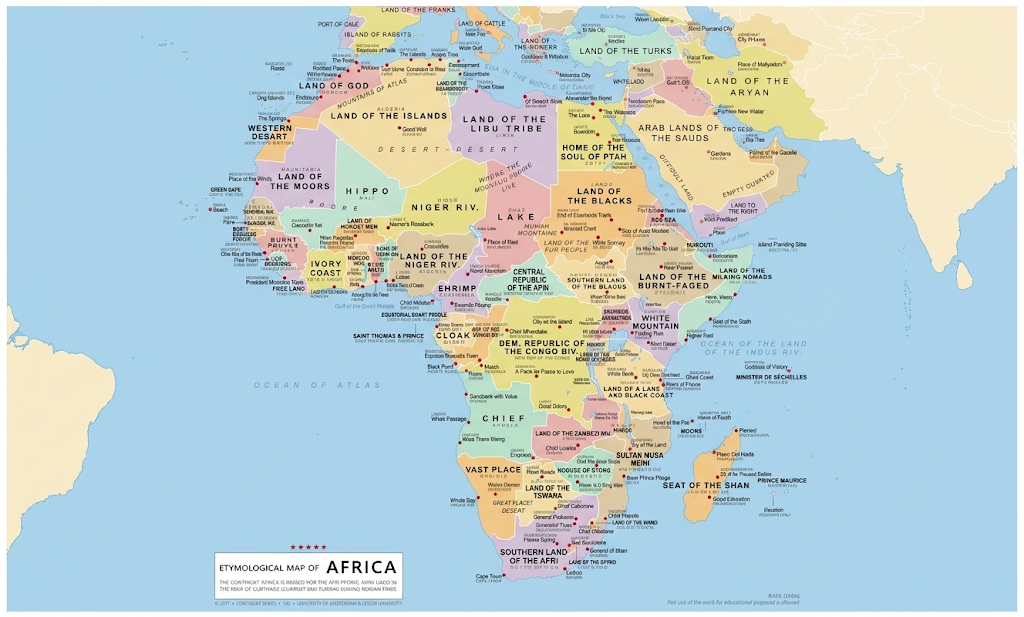
Most African country names come from one of four sources: a colonial-era description or mistranslation, a pre-colonial kingdom or empire reclaimed at independence, a river or geographic feature, or a name kept unchanged since before European contact. Roughly a dozen countries formally renamed themselves after independence; the rest kept the names they already had, whether those names were colonial, indigenous, or some mix of both. Here’s every country, one table: what its name literally means, what it was called under colonial rule if that applies, whether it renamed itself at independence, and why.
| Country | What the Name Means | Colonial / Former Name | Renamed at Independence? | Why (renamed) or Why Not (kept the name) |
|---|---|---|---|---|
| Algeria | “The Islands” — from Arabic al-Jazā’ir, referring to islets once off the Algiers harbor | French Algeria | No | Kept the name at independence (1962); it derives from the city of Algiers rather than reading as an imposed colonial label |
| Angola | “Land of Ndongo” — Portuguese mistranslation of ngola, a royal title of the Ndongo kingdom | Portuguese West Africa | No | Kept the name at independence (1975); despite Portuguese origin, it traces to an African royal title rather than a colonizer’s name |
| Benin | “[Land beside] the Bight of Benin” — the coastal stretch named for the historic Benin Empire (in modern Nigeria) | Dahomey | Yes | Renamed 1975; “Dahomey” named only the historic southern kingdom, so a neutral coastal name was chosen to represent the whole modern state |
| Botswana | “Country of the Tswana” — after the dominant ethnic group | Bechuanaland | Yes | Renamed 1966 at independence, honoring the Tswana people directly rather than the British colonial spelling |
| Burkina Faso | “Land of Honest Men” — Mooré burkina (“upright, incorruptible”) + Dioula faso (“homeland”) | Upper Volta | Yes | Renamed 1984 under Thomas Sankara as a deliberate statement of national character, replacing a name that only described the Volta River’s upper course |
| Burundi | Named for the pre-colonial Kingdom of Burundi, ruled by mwamis (kings) | Ruanda-Urundi (Belgian mandate) | Yes | Took the name at independence in 1962 upon splitting from Rwanda, reclaiming the historic kingdom’s name |
| Cabo Verde | “Green Cape” — Portuguese Cabo Verde, named for a mainland cape it faces | — | No | Kept the name at independence (1975); in 2013 the government requested “Cabo Verde” replace the English translation “Cape Verde” in all languages |
| Cameroon | “Shrimp” — from Portuguese Rio dos Camarões, “Shrimp River,” named for the Wouri River’s ghost shrimp | German Kamerun / French Cameroun / British Cameroons | No | Kept the name through independence and the 1961 reunification of French and British territories |
| Central African Republic | Self-descriptive, from its position on the continent | Ubangi-Shari | Yes | Renamed 1960 at independence; the geographic name replaced the colonial-era river-based territorial name, though it remains a descriptive rather than reclaimed indigenous name |
| Chad | “Lake” — from Lake Chad, Kanuri tsade, “big space of water” | Part of French Equatorial Africa | No | Kept the name at independence (1960); already rooted in an indigenous (Kanuri) word rather than a colonial label |
| Comoros | “Moons” — from Arabic Jazā’ir al-Qamar, “Islands of the Moon” | — | No | Kept the name at independence (1975) |
| Democratic Republic of the Congo | “[Land beside] the Congo River,” from the Kongo kingdom’s Bakongo people | Congo Free State → Belgian Congo → Zaire (1971–1997) | Yes (multiple times) | Renamed to Zaire in 1971 under Mobutu’s “Authenticité” campaign to erase colonial naming; renamed back to Democratic Republic of the Congo in 1997 after Mobutu’s fall, rejecting his regime’s naming choice |
| Republic of the Congo | “[Land beside] the Congo River,” as above | Middle Congo (Moyen-Congo) | No | Kept “Congo” at independence (1960), rooted in the pre-colonial Kongo kingdom’s name rather than a purely colonial label |
| Côte d’Ivoire | “Ivory Coast” — from the historic ivory trade along its coast | — | Partial | In 1985 the government requested that all countries use the French form “Côte d’Ivoire” rather than translating it, to standardize the name internationally |
| Djibouti | Disputed — possibly from a Somali/Afar phrase, or simply named for the capital city; etymology not firmly settled | French Somaliland → French Territory of the Afars and the Issas | Yes | Adopted at independence (1977); the earlier colonial names either credited France directly or named only the territory’s two main ethnic groups |
| Egypt | “Home of the ka of Ptah” — via Greek/Latin from an alternate name for ancient Memphis | — | No | The English name predates and survived British occupation (1882–1922/1952); Egyptians themselves use Misr, an older Semitic name |
| Equatorial Guinea | Adds “Equatorial” (self-descriptive, its position near the equator) to the same “burnt people” root shared by Guinea and Guinea-Bissau | Spanish Guinea | Yes | Renamed 1968 at independence to distinguish it geographically from the wider Guinea region, though it kept the underlying colonial-era name rather than replacing it entirely |
| Eritrea | “Land of the Red Sea” — Italian form of Greek erythros, “red” | Italian Eritrea | No | Kept the Italian colonial-era name at independence from Ethiopia (1993), unusually retaining a name coined by the colonizer rather than replacing it |
| Eswatini | “Land of the Swazis” in siSwati | Swaziland | Yes | Renamed 2018 by royal decree to use the Swazi-language name and avoid confusion with Switzerland |
| Ethiopia | “Land of the Burnt-Faced” — from Greek Aithiopia | — | No | Never formally colonized (aside from Italian occupation, 1936–41); kept its ancient name throughout |
| Gabon | “Cloak” — from Portuguese gabão, describing the shape of the Komo River estuary | — | No | Kept the name at independence (1960) |
| Gambia | Named for the Gambia River, from Mandinka/Portuguese roots | British Gambia | No | Kept the name at independence (1965) |
| Ghana | “Warrior King” — a royal title of the medieval Ghana Empire | Gold Coast | Yes | Renamed 1957 (Africa’s first sub-Saharan independence), reaching back to the prestige of the ancient empire rather than keeping a name describing a resource extracted by colonizers |
| Guinea | “The Burnt People” — from Berber Ghinawen, adopted by the Portuguese as Guiné to describe the Black African peoples south of the Senegal River | French Guinea | Partial | Dropped “French” at independence (1958) but kept the underlying colonial-era racial descriptor itself as the country’s name |
| Guinea-Bissau | Same root as Guinea, “the burnt people,” with the capital “Bissau” added for distinction | Portuguese Guinea | Yes | Renamed at independence (1974), adding the capital’s name because “Guinea” alone was already claimed by the Republic of Guinea (independent since 1958) |
| Kenya | From Kikuyu Kirinyaga (“Mountain of Brightness,” Mt. Kenya), mispronounced by a Kamba guide to British colonizers as “Kii-nya” | British East Africa | No | Kept the mispronounced colonial-era name deliberately at independence (1963) because, unlike an ethnic-language name, it belonged to no single ethnic group |
| Lesotho | “Land of the Sesotho speakers” | Basutoland | Yes | Renamed 1966 at independence to reflect the Basotho people and their language |
| Liberia | “Land of the Free” — from Latin liber | — | No | Founded in 1822 as a settlement for freed African-American slaves; the name was chosen at founding, not inherited from European colonization |
| Libya | From an ancient Egyptian/Greek name for the Libu, a Berber tribe west of Egypt | Italian Libya | No | Italy revived the ancient name for its colony in 1934; kept at independence (1951) rather than replaced |
| Madagascar | Disputed — possibly a European mishearing of “Mogadishu” via Marco Polo’s writings, not derived from the Malagasy language | — | No | Kept the name at independence (1960); the Malagasy endonym is Madagasikara |
| Malawi | Disputed — possibly Chichewa for “flames” (describing sunrise on Lake Malawi), or from the historic Maravi kingdom | Nyasaland | Yes | Renamed 1964 at independence, replacing a name based on the colonial-era term for the lake with a reference to the pre-colonial Maravi kingdom |
| Mali | Named for the medieval Mali Empire | French Sudan | Yes | Renamed 1960 at independence, reclaiming a prestigious pre-colonial African empire’s name |
| Mauritania | From Latin Mauritania, “land of the Moors” | French colonial territory (same name) | No | Kept the name at independence (1960) |
| Mauritius | Named for Prince Maurice of Nassau by Dutch settlers in 1598 | — | No | Kept the name through French and British rule and at independence (1968), unusually retaining a direct colonial-era honorific |
| Morocco | English exonym traces to Marrakesh, from Amazigh amur n ukuc, “land of God.” The country’s own Arabic name, Al-Maghrib, separately means “the place where the sun sets” | — | No | Kept both names; “Morocco” is the exonym used in English, “Al-Maghrib” is the name Moroccans use for their own country |
| Mozambique | From Mussa Bin Bique (also rendered Musa Al Big), an Arab trader/ruler whose name was given to Mozambique Island, then extended to the mainland by the Portuguese | Portuguese East Africa | No | Kept the name at independence (1975); notably the name predates Portuguese arrival, tied to Indian Ocean trade networks rather than colonization itself |
| Namibia | Named for the Namib Desert, from Nama, “vast place” | German South West Africa / South-West Africa | Yes | Renamed 1990 at independence, replacing the administrative colonial label with an indigenous geographic feature |
| Niger | Named for the Niger River, from Tuareg egerew n-igerewen | French colonial territory (same name) | No | Kept the name at independence (1960) |
| Nigeria | Coined in 1897 by British journalist Flora Shaw, from “Niger” + “-ia” | — | No | Kept the name at independence (1960); notable as a case where the name itself originated during the colonial period and was retained rather than replaced |
| Rwanda | Named for the pre-colonial Kingdom of Rwanda | Ruanda-Urundi (Belgian mandate) | Yes | Took the name at independence (1962) upon splitting from Burundi, reclaiming the historic kingdom’s name |
| São Tomé and Príncipe | Named by Portuguese explorers for Saint Thomas (arrived on his feast day) and for the Portuguese crown prince | — | No | Kept the name at independence (1975) despite its explicitly colonial and religious origin |
| Senegal | Disputed — commonly cited as Wolof sunuu gaal, “our canoe,” though the Senegal River’s name may predate this folk etymology | — | No | Kept the name at independence (1960) |
| Seychelles | Named for Jean Moreau de Séchelles, Louis XV’s Minister of Finance | — | No | Kept the name through French and British rule and at independence (1976), retaining a direct colonial-era honorific |
| Sierra Leone | “Lion Mountains” — from Portuguese Serra Leoa | — | No | Kept the name at independence (1961) |
| Somalia | From Samaale, a legendary common ancestor claimed by several Somali clans | Italian Somaliland / British Somaliland | No | The merged territories took the name “Somalia” at unification and independence (1960); rooted in Somali clan tradition rather than a colonial label |
| South Africa | Self-descriptive, from its position on the continent | Union of South Africa | No | The descriptive name was kept when the country left the Commonwealth and became the Republic of South Africa in 1961; this was a change in political status, not a renaming |
| South Sudan | Self-descriptive, the southern part of Sudan | — | No | Newly independent in 2011; chose a straightforward descriptive name reflecting separation from Sudan rather than a reclaimed historical name |
| Sudan | “Land of the Blacks” — from Arabic Bilād as-Sūdān, a name used by Arabic-speaking traders for the region, not self-applied by any single Sudanese people | Anglo-Egyptian Sudan | No | Kept the core name at independence (1956), dropping only the “Anglo-Egyptian” qualifier |
| Tanzania | A portmanteau of Tanganyika and Zanzibar, the two territories that united in 1964 | Tanganyika (mainland) / Zanzibar (islands), separately | Yes | The merged name was created specifically to represent the 1964 union of two previously separate independent states |
| Togo | From Togodo (modern Togoville), meaning roughly “the other shore” in Ewe; the former German colonial capital before Lomé | German Togoland / French Togoland | No | Kept the name at independence (1960) |
| Tunisia | From the capital Tunis, possibly linked to the Phoenician goddess Tanit | — | No | Kept the name at independence (1956) |
| Uganda | A Swahili-influenced adaptation of the pre-colonial Kingdom of Buganda | British Protectorate of Uganda | No | Kept the name at independence (1962); the colonial-era name was itself already an adaptation of an indigenous kingdom’s name |
| Zambia | Named for the Zambezi River | Northern Rhodesia | Yes | Renamed 1964 at independence, deliberately rejecting the name of British colonizer Cecil Rhodes |
| Zimbabwe | “Houses of Stone” — from Shona dzimba-dza-mabwe, referencing the Great Zimbabwe ruins | Rhodesia / Southern Rhodesia | Yes | Renamed 1980 at independence, rejecting Cecil Rhodes’ name and pointing to proof of pre-colonial African stone-building civilization |
Common Questions About African Country Names
Why did some African countries change their names after independence? For most, a new name was a way to reject a colonial-era label and either reclaim a pre-colonial kingdom’s name, as Ghana and Mali did, or choose something that reflected national identity on their own terms, as Burkina Faso and Zimbabwe did.
Which African country’s name means “Land of the Blacks”? Sudan. The name comes from the Arabic Bilād as-Sūdān, used for centuries by Arabic-speaking traders to describe the region south of the Sahara.
What does Ghana mean? “Warrior King,” a royal title from the medieval Ghana Empire. Modern Ghana borrowed the name at independence in 1957, even though the historic empire’s territory was centered hundreds of miles away.
Why does Morocco have two different name meanings? “Morocco” and “Al-Maghrib” are two separate names for the same country, from two separate languages. “Morocco” is the English exonym, tracing to Marrakesh and an Amazigh phrase for “land of God.” Al-Maghrib is the name Moroccans use for their own country, and it means “the place where the sun sets.”
Did every African country change its name at independence? No. Roughly a dozen did, including Ghana, Zimbabwe, and Namibia. Most kept the name they already had, whether that name was colonial in origin, like Nigeria, or predated colonization entirely, like Ethiopia.
Which country’s name surprised you the most? Drop it in the comments.