The anti-tourism guides revealing Lisbon’s true, radical heart
We Hate Tourism Tours — The Portuguese capital sees millions of people visit a year, against a backdrop of political turbulence and a housing crisis fuelled by short term holiday lets. Jack Burke meets the crew subverting their city’s perception, while bringing lesser seen stories and monuments to light.
 Black News


We Hate Tourism Tours — The Portuguese capital sees millions of people visit a year, against a backdrop of political turbulence and a housing crisis fuelled by short term holiday lets. Jack Burke meets the crew subverting their city’s perception, while bringing lesser seen stories and monuments to light.
We meet in Praça da Alegria at 8:30am on a Saturday morning. Seven of us climb into the unmarked van: a couple from Calgary, a woman from Tennessee, a painfully polite student from St Louis, two Australians who booked on because the name made them laugh, and me. Nobody, I suspect, is here for another guide with a microphone and a laminated umbrella.
“What kind of tour is this?” asks Nuno, our driver, as he pulls away into Lisbon traffic. He immediately answers his own question. “Every day is different. I just grab you guys and we go.”
An hour later we’re winding through the eucalyptus above Sintra, ignoring the coaches crawling towards Pena Palace and ducking instead into Biester Palace, an eccentric 19th century mansion that looks as though a millionaire Freemason won the lottery twice. Every room is dripping with Templar symbolism, faux mysticism and nouveau riche theatrical excess. Nuno wanders between rooms telling stories that veer effortlessly from Portuguese kings to skateboarding, surfing to the dictatorship, before bundling us back into the van.
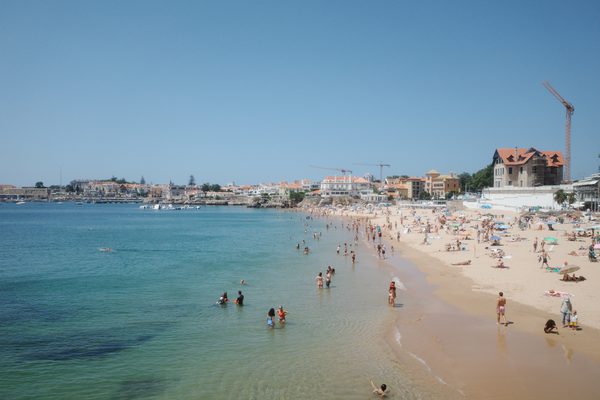
By lunchtime we’re in Cascais. White villas shimmer above the Atlantic. Someone disappears for a swim, someone else orders oysters, and nobody seems entirely sure whether this is still a guided tour.
That’s because it isn’t. Not really. It’s more like spending the day with the most opinionated friend you know. And that, more or less, is the business model.
We Hate Tourism Tours was founded in Lisbon in 2010 by Bruno Gomes.
Back in 2008, before Lisbon was the sort of place airlines advertised as a long weekend destination, Bruno found himself doing exactly what Nuno was doing with us, except for free. American friends, English friends, friends of friends; if people came to visit, he’d throw them in his car and spend the day showing them the places he actually liked, the bars he drank in, the beaches he surfed, the corners of the city that rarely appeared in guidebooks.
“I hate tourism tours,” he remembers telling one American friend who suggested he should start charging for it. “I hate tour guides. I don’t want to be one. I just want to share the things I love about my city and the things I hate.”
We Hate Tourism. The name stuck.
When he finally registered the company in 2010, he kept it exactly as it was, much to the chagrin of the local businesses official. 16 years on he still finds himself explaining that they don’t hate tourists at all. They hate the tourist industry, or at least the version of it that mistakes a city for a product and the people who live there for part of the scenery.
It’s easy to forget now, wandering the medieval streets clogged with the footsteps of several thousand disgorged cruise ship passengers, where boutique hotels spawn like rabbits and every second shop sells either tinned sardines or minimalist ceramics, that Lisbon wasn’t always Europe’s latest obsession. For decades it was the city people skipped on the way to somewhere else.
“The truth is that the city was falling apart,” Bruno says. “It looked like San Francisco and Havana [put] together.”
Portugal was desperately poor. Buildings were collapsing. Whole streets stood half empty. The crumbling romantic façades that tourists now photograph had black mould creeping down them. Young people, meanwhile, were leaving in extraordinary numbers.
Bruno was one of them. Like so many Portuguese of his generation, he was educated, spoke multiple languages, and eventually reached the same conclusion as most of his friends: if you wanted a future, you probably had to find it somewhere else. He moved to London and lasted about a year.
“I remember thinking,” he says, “Even if I make a million, I’m not going to be happy here.”
So, Bruno returned. At first, showing people around Lisbon was simply a way of paying the bills.

“I hate tour guides. I don’t want to be one. I just want to share the things I love about my city and the things I hate.”
Manu joined We Hate Tourism a decade later, arriving through Lisbon’s skateboarding and street-art scene. He possesses the unnerving ability to answer almost any question about modern Portugal by beginning somewhere entirely different. Ask him about Airbnb and he’ll start with the dictatorship. Ask about house prices and he’ll talk about Angola. Mention digital nomads and, before long, you’re discussing the 1998 World Expo. Which, according to Manu, was Portugal’s moon landing. “I was 16,” he tells me. “I remember thinking: ‘We’ve made it.’”
For a country that had spent much of the 20th century looking inward under Salazar’s dictatorship, Expo ’98 was meant to announce Portugal’s arrival as a modern European nation. The derelict eastern docks became the gleaming Parque das Nações. The metro expanded. New bridges and stations appeared. For a while it felt as though the future had arrived all at once.
The feeling didn’t last. Portugal has a habit, Manu says with a shrug, of arriving just as the party is ending.
The 2008 financial crash hit particularly hard. Portugal needed an international bailout. Public spending collapsed and wages stagnated. And then, in a move so unbelievable that I had to find the tape on YouTube, the Portuguese prime minister, pressed on what young Portuguese should do if there was no work at home, suggested they leave and make use of free movement within the European Union.
Today, a country of around 10 million people has another 2.6 million citizens living abroad. Decades of emigration, much of it by younger, highly educated Portuguese, have altered the country’s demographic and political balance. Portugal is older than it might otherwise have been, and the frustrations that remained behind are varied: low wages, expensive housing, weak public services and a sense that the country’s brightest prospects are elsewhere. Average gross monthly pay is roughly €1,550 in Portugal, compared with €2,450 next door in Spain.
Into that discontent has stepped the far-right party Chega. For decades, Portugal appeared largely immune to the populist right advancing elsewhere in Europe. Then in 2024, exactly 50 years after the Carnation Revolution ended the dictatorship, Chega won 50 seats in parliament. A year later it won 60, overtook the Socialists and became the country’s official opposition.
You see their posters around all over the place – its leader and frontman André Ventura gazing handsomely off into the middle distance, with a caps lock call to arms: SALVAR PORTUGAL. More often than not, somebody has already added a small moustache in Sharpie.
Bruno often says that We Hate Tourism was founded by “the sons of the crisis”. Manu has another word for them: Malamados. The unloved. A generation who did everything they had been asked to do, only to discover their reward was an EasyJet flight out of the country.
“The talent left,” Bruno says simply. “We were just the fools and the artists who stayed.”
And just as Portugal was telling its brightest young people to leave, the rest of the world suddenly decided it wanted to come.
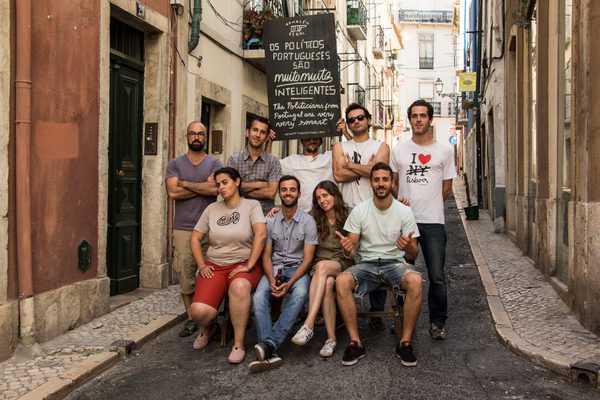
In 2014, as the country clawed its way out of the bailout, Lisbon tore up much of the bureaucracy around tourism and small businesses. Registering a company, Manu tells me, went from costing several months’ wages to something you could more or less do on your lunch break. Tour-guide licences were liberalised. Investors were welcomed. Airbnb arrived. After years of watching young people leave, money began flowing back into the city.
For a while, it felt miraculous. Families whose buildings had been crumbling for decades could finally afford to renovate them. Empty properties filled, restaurants opened, bars multiplied. In 2005, visitors spent around five million nights in Lisbon’s hotels; two decades later, that number was 15 million. Friends returned from London with savings and started businesses. Digital nomads poured into the city, drawn by the promise of sunshine and affordability. Lisbon acquired that rare, intoxicating feeling every city dreams of: that something exciting was happening, and that if you moved quickly enough you might catch it. Manu calls it the “Nirvana period”.
We Hate Tourism tours continued to grow, feeding the desires of visitors after a more curated, local experience. Word of mouth built the company in those early years, alongside flyers and posters taped up around town. American families doing the classic European summer circuit started flying into Lisbon for a single day just to take the tour. The one real friction was tipping. Portuguese custom treats it as presumptuous, close to an insult, and Manu remembers becoming, in the eyes of some locals, “a greedy pig” for accepting what visitors offered him.
By 2018 the company had an office at LX Factory, a sugar refinery and printworks shuttered after the 1974 revolution and reopened decades later as a hub for artists and small entrepreneurs, before the shopping units caught up with that too.
The trouble, Bruno argues, wasn’t that tourism came. It was the speed. “We lost whole neighbourhoods,” he says. “It felt like outside money bought entire streets.”
The mood began to shift. Rents kept climbing. Locals began disappearing from the historic centre. If you weren’t earning from tourism, you increasingly found yourself paying for somebody else who was. The same reforms that had rescued Lisbon after the crisis were reshaping it so quickly that people barely recognised the neighbourhoods where they had grown up.
So many people arrived looking for Lisbon that they began to erase it.

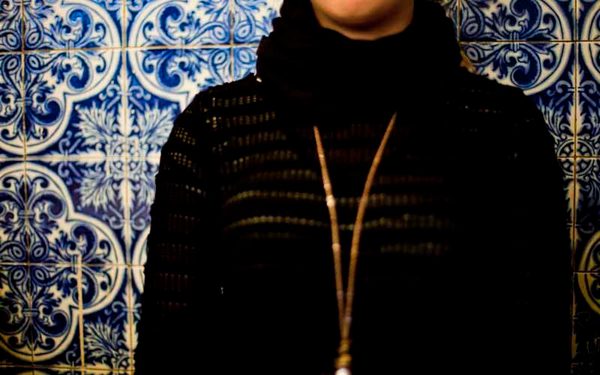

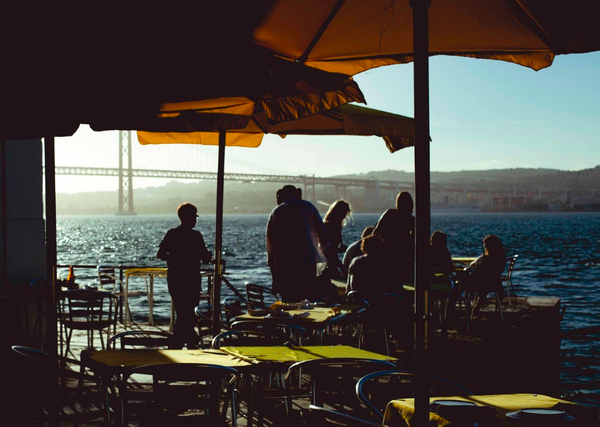

If there’s any consolation, it’s that Bruno believes Lisbon has survived this sort of thing before.
He grew up watching the city empty out, then fill up again. He is an Alfacinha, a Lisbon local, raised in the heart of the old town. He remembers when nobody wanted to come here. He has watched tourism rescue neighbourhoods that had been neglected for decades, and then watched the same neighbourhoods begin to disappear beneath the weight of that success. He talks about it less like a culture war than another turn of a wheel. “I imagine Lisbon falling again,” he tells me. “The city will hollow itself out. Tourism will collapse or break. Then something better will come out of it. It's how we've always evolved.”
During the pandemic the business collapsed almost overnight, shrinking from more than a dozen guides to just Bruno and one partner. They sold nearly all the vans, survived on newsletters, an online shop and a small group of loyal customers who kept buying T-shirts and prints each month simply because they wanted the company to exist when the world reopened.
Today, We Hate Tourism offers six ways into Lisbon, all variations on the original idea: no scripts, no megaphones and no more than six people. The OG tour still runs through Sintra and Cascais; the walking tour takes on the historic centre. There’s a We Hate Landmarks tour, and a B-Side that heads into the industrial and working-class outskirts. You can join the guides for dinner in the places they actually eat or, if you’re a cruise-ship passenger, fire the proverbial flare gun and have a guide rush to rescue you from your coach convoy. The product remains difficult to standardise: a day with someone who knows the city well enough to abandon the plan.
Investors have suggested automation, outside capital and franchises in other cities. Bruno has refused. “You can’t franchise honesty,” the company’s website says. “We don’t scale – we deepen.”
Most of the company’s energy goes into Malamados, the loose collective of artists, photographers, designers and surfers that grew up around the tour company almost from the beginning. Surfboards, clothing, books, exhibitions. Whatever allows another person to keep making things in Lisbon without having to move to Berlin or London to do it. The tours, in a sense, subsidise everything else.
“That’s the goal,” Manu says. “Not to make a fortune. Just so we could make a living staying here. Since the country doesn’t love us back, we will create that love for ourselves.”
The fools stayed. The rest of us simply bought a ticket.
Jack Burke is a freelance journalist and sometimes chef. Follow him on Instagram.
Buy your copy of Huck 83 here.
Enjoyed this article? Follow Huck on Instagram and sign up to our newsletter for more from the cutting edge of sport, music and counterculture.
Support stories like this by becoming a member of Club Huck.