American Authoritarians–And SCOTUS Conservatives–Are Orchestrating Voter Suppression To Usurp Political Power
By William J. Barber, II and Jonathan Wilson-Hartgrove Photos: Wikimedia Commons When Lyndon Baines Johnson signed the Voting Rights Act on August 6, 1965, he remarked that it was “a triumph for freedom as huge as any victory that has ever been won on any battlefield.” Less than six months earlier, Johnson had addressed a joint session of Congress to call for voting rights legislation after Americans witnessed nonviolent marchers attacked by mounted police at the end of the Edmund Pettus Bridge in Selma, Alabama. Johnson returned to the US Capitol that August aware that the federal protections he was signing into law would make the United States a multi-ethnic democracy for the first time in its nearly 200-year history. Yes, US troops had defeated the Red Coats to win independence, put down a rebellion led by plantation elites, and helped defeat fascism in Europe. But as Commander in Chief, Johnson celebrated the moral movement’s successful struggle for the VRA as a triumph for freedom equal to those victories. Here was a hinge point in US history – a declaration in law that the promise of one person, one vote and equal protection under law would finally be made real through elections that allowed all Americans to be represented in their government. Wednesday, the extremist majority of the US Supreme Court sided with the opponents of the VRA who reject multi-ethnic democracy as a victory, stripping the protections of Section 2 that remained to defend majority minority districts after Section 5 of the VRA was gutted by the 2013 Shelby decision. Now, in the name of partisan advantage, the highest court in the land says it will allow legislatures to draw districts that deny Black and Brown voters the possibility of electing representatives of their choice. The intended result, as is clear to anyone who has observed elections in the South, is to restore Congressional delegations from Southern states that represent the white majority – a return to the past that will harm most people, including the poor and low-income white people who have benefited from legislation passed by more diverse legislatures over the past sixty years. This is the voting rights agenda of America’s authoritarian movement: restrict access to the ballot and rig elections so that reactionary forces can cling to power. It is this long-term strategy that reassures Republicans they can stand by Trump’s most unpopular policies and immoral actions without having to face electoral consequences. It is as cold and cruel as Jim Clark’s determination to defend Jim Crow, even when dressed up in the legalese of James Crow, Esquire. But we know a force more powerful than bombs and billy clubs. The vulnerability of today’s authoritarianism is apparent when we remember how the Voting Rights Act was won in the first place. Johnson was right that it was a “triumph for freedom,” but it wasn’t the result of a battle waged by politicians in Washington. The Voting Rights Act – often celebrated as a the “crown jewel” of the Civil Rights Movement – was won through the moral force of a nonviolent movement. Everyday people who decided to take direct action to challenge Jim Crow’s authoritarianism consciously embraced voter registration as nonviolent direct action. After leading sit-ins and the Freedom Rides, Diane Nash and James Bevel went to Dallas County, Alabama in 1963 and joined Amelia Boynton and the Dallas County Voter League to confront the violence of voter suppression, expose Sherriff Jim Clark’s brutality, and compel the nation to recognize voter suppression as a moral issue. They knew they were up against a brutal authoritarian regime. But they also understood the power of love in its most basic sense. All of Jim Clark’s horses and all of Jim Clark’s men could not defend a white Republic if the false moral narrative that propped up their legitimacy was exposed by a moral movement willing to refuse cooperation with evil and take direct action for the truth. Dr. King put out a call for clergy to come to Selma after Bloody Sunday. The moral authority of our deepest religious traditions offered its blessing to the marchers who’d been beaten. They were on God’s side, while Clark and his men were opposing them. Because a nonviolent movement sang, “We shall overcome,” in the face of authoritarian brutality, President Johnson could say it to Congress and believe they would pass the voting rights protections that Southern delegations had long resisted. Because the mainstream media continues to fixate on Trump’s antics, there’s been a great deal of attention since Easter on the President’s attacks against Pope Leo. But the story of the VRA helps us see why every authoritarian fears moral resistance. The strongest of strongmen is only as powerful as the myths that legitimize his authority. It’s why Trump – an ostentatiously immoral man before his foray into politics – has so obediently bowed to the demands of religious national
 Black News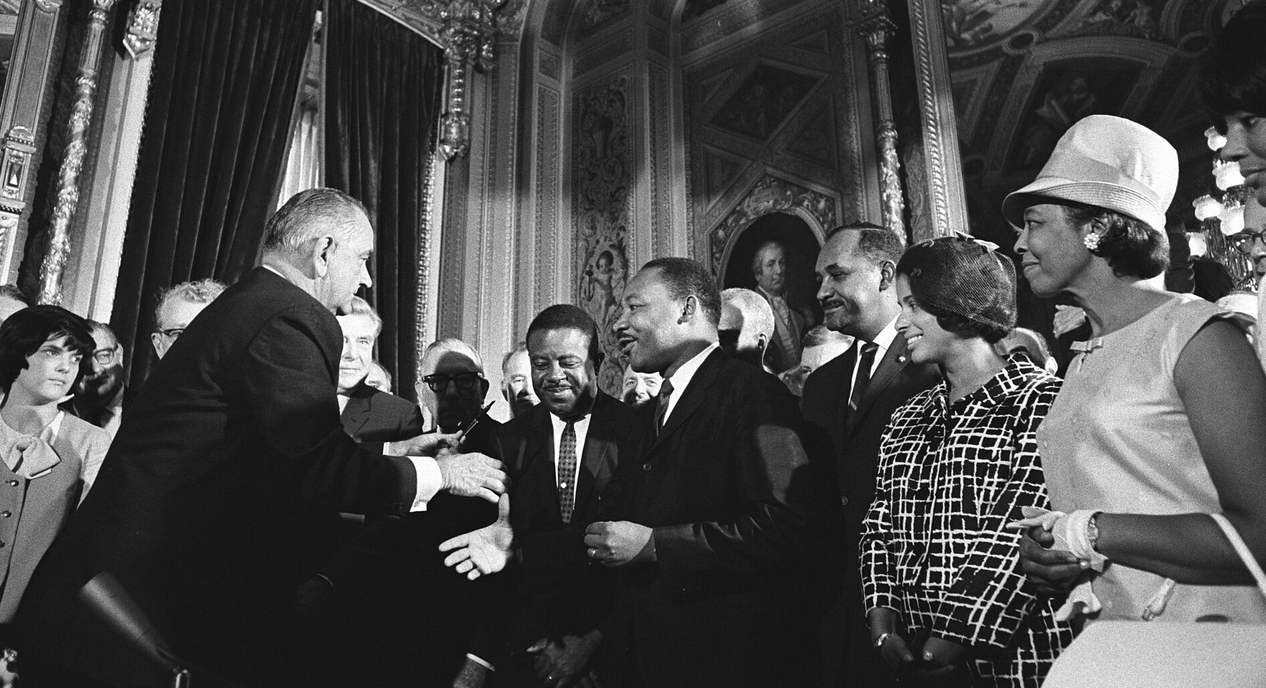
By William J. Barber, II and Jonathan Wilson-Hartgrove
Photos: Wikimedia Commons
When Lyndon Baines Johnson signed the Voting Rights Act on August 6, 1965, he remarked that it was “a triumph for freedom as huge as any victory that has ever been won on any battlefield.” Less than six months earlier, Johnson had addressed a joint session of Congress to call for voting rights legislation after Americans witnessed nonviolent marchers attacked by mounted police at the end of the Edmund Pettus Bridge in Selma, Alabama. Johnson returned to the US Capitol that August aware that the federal protections he was signing into law would make the United States a multi-ethnic democracy for the first time in its nearly 200-year history.

Yes, US troops had defeated the Red Coats to win independence, put down a rebellion led by plantation elites, and helped defeat fascism in Europe. But as Commander in Chief, Johnson celebrated the moral movement’s successful struggle for the VRA as a triumph for freedom equal to those victories. Here was a hinge point in US history – a declaration in law that the promise of one person, one vote and equal protection under law would finally be made real through elections that allowed all Americans to be represented in their government.
Wednesday, the extremist majority of the US Supreme Court sided with the opponents of the VRA who reject multi-ethnic democracy as a victory, stripping the protections of Section 2 that remained to defend majority minority districts after Section 5 of the VRA was gutted by the 2013 Shelby decision. Now, in the name of partisan advantage, the highest court in the land says it will allow legislatures to draw districts that deny Black and Brown voters the possibility of electing representatives of their choice. The intended result, as is clear to anyone who has observed elections in the South, is to restore Congressional delegations from Southern states that represent the white majority – a return to the past that will harm most people, including the poor and low-income white people who have benefited from legislation passed by more diverse legislatures over the past sixty years.
This is the voting rights agenda of America’s authoritarian movement: restrict access to the ballot and rig elections so that reactionary forces can cling to power. It is this long-term strategy that reassures Republicans they can stand by Trump’s most unpopular policies and immoral actions without having to face electoral consequences. It is as cold and cruel as Jim Clark’s determination to defend Jim Crow, even when dressed up in the legalese of James Crow, Esquire.
But we know a force more powerful than bombs and billy clubs.
The vulnerability of today’s authoritarianism is apparent when we remember how the Voting Rights Act was won in the first place. Johnson was right that it was a “triumph for freedom,” but it wasn’t the result of a battle waged by politicians in Washington. The Voting Rights Act – often celebrated as a the “crown jewel” of the Civil Rights Movement – was won through the moral force of a nonviolent movement. Everyday people who decided to take direct action to challenge Jim Crow’s authoritarianism consciously embraced voter registration as nonviolent direct action. After leading sit-ins and the Freedom Rides, Diane Nash and James Bevel went to Dallas County, Alabama in 1963 and joined Amelia Boynton and the Dallas County Voter League to confront the violence of voter suppression, expose Sherriff Jim Clark’s brutality, and compel the nation to recognize voter suppression as a moral issue.

They knew they were up against a brutal authoritarian regime. But they also understood the power of love in its most basic sense. All of Jim Clark’s horses and all of Jim Clark’s men could not defend a white Republic if the false moral narrative that propped up their legitimacy was exposed by a moral movement willing to refuse cooperation with evil and take direct action for the truth. Dr. King put out a call for clergy to come to Selma after Bloody Sunday. The moral authority of our deepest religious traditions offered its blessing to the marchers who’d been beaten. They were on God’s side, while Clark and his men were opposing them. Because a nonviolent movement sang, “We shall overcome,” in the face of authoritarian brutality, President Johnson could say it to Congress and believe they would pass the voting rights protections that Southern delegations had long resisted.
Because the mainstream media continues to fixate on Trump’s antics, there’s been a great deal of attention since Easter on the President’s attacks against Pope Leo. But the story of the VRA helps us see why every authoritarian fears moral resistance.
The strongest of strongmen is only as powerful as the myths that legitimize his authority. It’s why Trump – an ostentatiously immoral man before his foray into politics – has so obediently bowed to the demands of religious nationalists. Their laying on of hands and national days of prayer offer him legitimacy, just as white preachers did for the White Citizen Councils and State Sovereignty Commissions of the Jim Crow South. By attacking the Pope, Trump has tried to make the moral challenge to MAGA’s authoritarianism personal. But nonviolent movements expose the violence of systems. When people come to see that their basic values compel them to stop cooperating with evil, authoritarian regimes cannot last.
Moral authority isn’t about any individual personality. It’s about the values that the best of our traditions hold dear.
This is why, as terrible as Wednesday’s Supreme Court decision is, we know it is possible to meet it with the soul force of a movement that will vote like never before in US history. Today, as in the 1960s, registering and mobilizing voters to challenge authoritarianism is direct action. But the ballot is not the only tool of a nonviolent struggle. In the face of continued assaults on multi-ethnic democracy and the rule of law, a moral movement must bless every form of nonviolent resistance. Just as Dr. King called clergy to come to Selma in 1965 to bless and stand with the marchers assaulted on Bloody Sunday, today’s moral movement must stand with tomorrow’s strategic actions of economic withdrawal that our friends in the labor movement have planned for May Day.
Every escalation of our commitment to nonviolent action has the potential to grow the moral movement we need to win a Third Reconstruction. We cannot afford any self-deception. We face some difficult days ahead, and things are likely to get worse before they get better. We have no guarantee that nonviolence will result in victory tomorrow, or even in November. But we know that violence cannot win the world we want, and those who’ve gone before us have made clear – even against greater odds – that a moral movement can push us closer to the beloved community.
The Voting Rights Act did not become law in 1965 because Congress had argued its way to embracing a multi-ethnic democracy. A nonviolent moral movement exposed the violence of voter suppression. The blood of Selma’s martyrs cried out, and the people demanded voting rights protection.
The Supreme Court thinks it has the power to deny the moral authority of Amelia Boynton and John Lewis, Diane Nash and James Reeb, Jimmy Lee Jackson and Viola Liuzzo. But they are wrong.
The blood, sweat, and tears that were poured out in the Southern Freedom Movement’s nonviolent struggle for voting rights demand that we intensify and embolden our commitment to build a moral movement here and now.