A Tale Of Two Genocides: The West’s Hypocrisy In Gaza Desecrates Remembrance In Myanmar
By Alonso Gurmendi Photos: Wikimedia Commons Tuesday is Rohingya Genocide Remembrance Day, which marks the start of Myanmar’s brutal “clearance operations” in 2017 that forced 1.2 million Muslim Rohingya into Bangladesh and killed 30,000. As part of this remembrance, Western countries have taken concrete action to condemn and bring to an end Myanmar’s atrocities. On March 21, 2022, the United States formally determined that the attacks constituted genocide. The U.S. State Department conducted hundreds of interviews of Rohingya refugees and analyzed whistleblower reports by soldiers in order to ascertain whether Myanmar displayed the “intent to destroy” required by the Genocide Convention of 1948. The result of U.S. inquiries concluded that soldiers had received orders to “shoot at every sight of a person,” burn villages, and rape women. They also showed that soldiers repeatedly engaged in “racial slurs” against the Rohingya they attacked, particularly in mosques, and that they “bragged about their plans on social media.” The U.S. investigation also took issue with Myanmar targeting “women, children, and the elderly” and with the rhetoric by Myanmar authorities, which treated the Rohingya as an “unfinished job” that the government had to “solve.” The extent of these atrocities led The Gambia to institute proceedings against Myanmar at the International Court of Justice (ICJ) under the Genocide Convention, much like South Africa would later do with Israel. On Jan. 23, 2020, the ICJ issued an order for provisional measures, unanimously requiring Myanmar to take all measures to prevent genocidal acts against the Rohingya. On Nov. 15, 2023, Canada, Denmark, France, Germany, the Netherlands and the UK filed a Declaration of Intervention with the Court, setting out their understanding of how the Genocide Convention applied to these “clearance operations.” These six Western allies noted that the International Criminal Tribunal for Rwanda held that “contrary to popular belief, the crime of genocide does not imply the actual extermination of a group in its entirety.” In fact, these states said, “properly constructed,” genocide may be committed “by means other than killings.” Thus, genocide could occur when subjecting a population to “subsistence diet, systematic expulsion from homes and the induction of essential medical services below minimum requirement.” They also clarified that while forced displacement did not of itself constitute genocide, it could lead to genocide if it inflicts sufficiently serious mental harm on the displaced people or if their expulsion then subjects them to conditions that lead to their physical destruction. Lastly, these states argued that widespread attacks against children may demonstrate genocidal intent and “preclude a defense that members of a protected group were targeted solely for certain other reasons.” In short, the six Western allies requested the Court to be reasonable and “adopt a balanced approach that recognizes the special gravity of the crime of genocide, without rendering the threshold for inferring genocidal intent so difficult to meet so as to make findings of genocide near-impossible.” As a result of these atrocities, the U.S. and its allies sanctioned 27 entities and 70 individuals connected to the Myanmar government and provided $1 million in funding to the UN Independent Investigative Mechanism for Myanmar to collect, preserve, and analyze evidence of the genocide. Myanmar has, predictably, rejected these accusations. According to the U.S., it “portrayed the Rohingya as a foreign jihadist enemy group, and those who fled as guilty of belonging to, supporting, or sympathizing with a terror group.” At the ICJ, The Gambia’s lawyers, the American litigator Paul Reichler, and British scholar Philippe Sands, thoroughly rejected that claim. Reichler, for instance, argued that “razing and completely destroying more than 175 Rohingya villages and partially or mostly destroying over 210 cannot be counter-terrorism” and that the army’s so-called “clearance operations” were “so wildly and blatantly disproportionate to the threat that the ARSA [the Rohingya armed group] was said to represent (…) that it cannot be reasonably inferred that Myanmar’s intent in carrying out these operations was simply to defeat a low-level, poorly armed, and ill-equipped group of rebels who controlled absolutely no territory.” Sands, for his part, argued that “a situation of armed conflict does not preclude the crime of genocide” and that “Myanmar’s assertion that (…) it was merely undertaking counter-terrorism operations cannot, therefore, serve – of itself – to rebut the existence of a genocidal intent.” Concrete action to end genocide and punish those responsible for it is a core value of the post-World War II rules-based order advanced by the West. That the United States, Canada, Denmark, France, Germany, the Netherlands, and the UK have taken concrete steps to ach
 Black News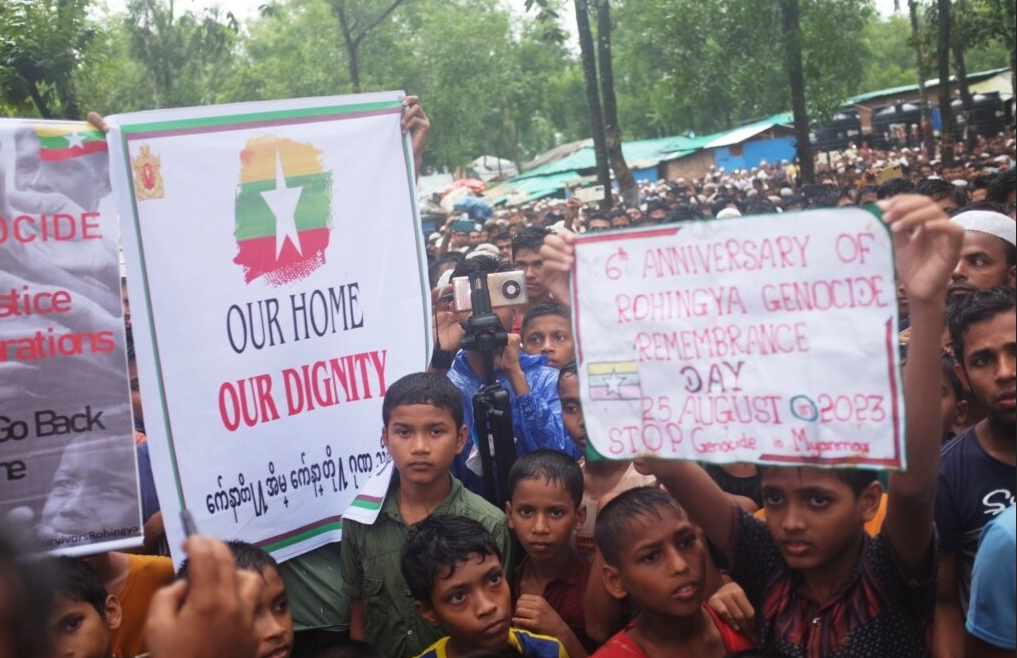

Photos: Wikimedia Commons
Tuesday is Rohingya Genocide Remembrance Day, which marks the start of Myanmar’s brutal “clearance operations” in 2017 that forced 1.2 million Muslim Rohingya into Bangladesh and killed 30,000.

As part of this remembrance, Western countries have taken concrete action to condemn and bring to an end Myanmar’s atrocities. On March 21, 2022, the United States formally determined that the attacks constituted genocide. The U.S. State Department conducted hundreds of interviews of Rohingya refugees and analyzed whistleblower reports by soldiers in order to ascertain whether Myanmar displayed the “intent to destroy” required by the Genocide Convention of 1948.
The result of U.S. inquiries concluded that soldiers had received orders to “shoot at every sight of a person,” burn villages, and rape women. They also showed that soldiers repeatedly engaged in “racial slurs” against the Rohingya they attacked, particularly in mosques, and that they “bragged about their plans on social media.” The U.S. investigation also took issue with Myanmar targeting “women, children, and the elderly” and with the rhetoric by Myanmar authorities, which treated the Rohingya as an “unfinished job” that the government had to “solve.”
The extent of these atrocities led The Gambia to institute proceedings against Myanmar at the International Court of Justice (ICJ) under the Genocide Convention, much like South Africa would later do with Israel. On Jan. 23, 2020, the ICJ issued an order for provisional measures, unanimously requiring Myanmar to take all measures to prevent genocidal acts against the Rohingya.
On Nov. 15, 2023, Canada, Denmark, France, Germany, the Netherlands and the UK filed a Declaration of Intervention with the Court, setting out their understanding of how the Genocide Convention applied to these “clearance operations.” These six Western allies noted that the International Criminal Tribunal for Rwanda held that “contrary to popular belief, the crime of genocide does not imply the actual extermination of a group in its entirety.” In fact, these states said, “properly constructed,” genocide may be committed “by means other than killings.” Thus, genocide could occur when subjecting a population to “subsistence diet, systematic expulsion from homes and the induction of essential medical services below minimum requirement.” They also clarified that while forced displacement did not of itself constitute genocide, it could lead to genocide if it inflicts sufficiently serious mental harm on the displaced people or if their expulsion then subjects them to conditions that lead to their physical destruction. Lastly, these states argued that widespread attacks against children may demonstrate genocidal intent and “preclude a defense that members of a protected group were targeted solely for certain other reasons.” In short, the six Western allies requested the Court to be reasonable and “adopt a balanced approach that recognizes the special gravity of the crime of genocide, without rendering the threshold for inferring genocidal intent so difficult to meet so as to make findings of genocide near-impossible.”
As a result of these atrocities, the U.S. and its allies sanctioned 27 entities and 70 individuals connected to the Myanmar government and provided $1 million in funding to the UN Independent Investigative Mechanism for Myanmar to collect, preserve, and analyze evidence of the genocide.
Myanmar has, predictably, rejected these accusations. According to the U.S., it “portrayed the Rohingya as a foreign jihadist enemy group, and those who fled as guilty of belonging to, supporting, or sympathizing with a terror group.” At the ICJ, The Gambia’s lawyers, the American litigator Paul Reichler, and British scholar Philippe Sands, thoroughly rejected that claim. Reichler, for instance, argued that “razing and completely destroying more than 175 Rohingya villages and partially or mostly destroying over 210 cannot be counter-terrorism” and that the army’s so-called “clearance operations” were “so wildly and blatantly disproportionate to the threat that the ARSA [the Rohingya armed group] was said to represent (…) that it cannot be reasonably inferred that Myanmar’s intent in carrying out these operations was simply to defeat a low-level, poorly armed, and ill-equipped group of rebels who controlled absolutely no territory.” Sands, for his part, argued that “a situation of armed conflict does not preclude the crime of genocide” and that “Myanmar’s assertion that (…) it was merely undertaking counter-terrorism operations cannot, therefore, serve – of itself – to rebut the existence of a genocidal intent.”
Concrete action to end genocide and punish those responsible for it is a core value of the post-World War II rules-based order advanced by the West. That the United States, Canada, Denmark, France, Germany, the Netherlands, and the UK have taken concrete steps to achieve precisely this would normally be commendable. But, on this occasion, these steps are taken under the dark shadow of Israel’s genocide of the Palestinian people – this time carried out with the full support and complicity of these same states. Thus, the U.S. is sanctioning Myanmar genocidaires at the same time as it is sanctioning rapporteurs, judges, and prosecutors investigating Israeli genocidaires.
Never Again Means Never Again for Everyone

The contradiction could not be more glaring. On Jan. 3, 2024, the U.S. stated it had not seen “any acts that constitute genocide” and a few months later, approved billions of dollars in military aid for Israel. In the UK, over 1,000 people have been arrested on terrorism charges for their alleged support of Palestine Action. Germany is now facing its own ICJ case, after Nicaragua accused it of violating its duty to prevent genocide in Gaza. This despite the fact that Israel’s attacks against Palestinians largely mirror those of Myanmar against the Rohingya – which the U.S. and its allies labeled as genocide.
Like in Myanmar, Israeli soldiers have reported receiving orders to shoot Palestinians on sight as well as operating in an environment where “[i]f you want to shoot without restraint, you can.” As one Israeli soldier put it: “[i]f they’re walking too fast, they’re suspicious. If they’re walking too slow, they’re suspicious.”
Like in Myanmar, the Israeli military has destroyed thousands of buildings in Gaza, where 83% of all buildings have been damaged – a scale similar to a Category 5 hurricane.
Like in Myanmar, Israeli forces have overwhelmingly harmed children. According to UNICEF, more than 64,000 children have been killed or injured in Gaza since October 2023, with Gaza becoming the largest population of child amputees in the world – many of them carried out without anesthesia.
Like in Myanmar, Israeli leaders, military officers and soldiers have made genocidal statements about Palestinians and have argued Israel must “finish the job.”
Like in Myanmar, Israel has starved the population of Gaza, limiting their calorie intake to “67% of what the human body needs to survive.”
Like in Myanmar, Israel ordered the “evacuation” of millions of Palestinians, without any plans to address their needs, leaving them stranded and forcing them to undergo what Palestinians have described as “death marches.”
Lastly, like in Myanmar, the Israeli military has used disproportionate force in Gaza, including after a so-called “ceasefire” and against healthcare providers. In fact, Israel completely destroyed Gaza’s healthcare system by attacking nearly every single hospital in the Strip.
And yet, despite the similarities, only one of these genocides has been treated as such by the West. Instead of a rules-based order, the disparity in treatment between Myanmar and Gaza suggests the late Lindsey Graham was right when he told then-ICC Prosecutor Karim Khan that international accountability is only for Africa and Vladimir Putin… and ostensibly Myanmar. Not for Israel, the U.S., or the West.
So, as we mark one more year remembering the genocide of the Rohingya, we should not let the hypocrisy of the West go unmarked either. Never Again means Never Again for Everyone.
Alonso Gurmendi is an academic researching issues of international law and international relations from a postcolonial perspective. He works as a Fellow in Human Rights at the London School of Economics and Political Science (LSE).