Ambassador Juju launches her docu-film at Mestil
By four o’clock on Saturday afternoon, Mestil Hotel had stopped looking like a hotel and started looking like a statement. The guests arriving for the national premiere of Back to the Source: Documentary were dressed by African designers and unapologetically bold. Ambassadors greeted one another near the door. A DJ kept the energy somewhere between […] The post Ambassador Juju launches her docu-film at Mestil appeared first on The Observer.
 Black News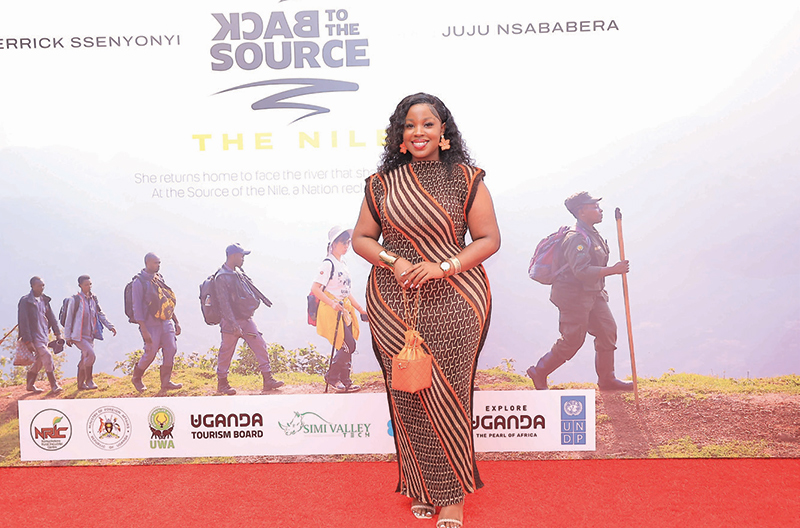

By four o’clock on Saturday afternoon, Mestil Hotel had stopped looking like a hotel and started looking like a statement.
The guests arriving for the national premiere of Back to the Source: Documentary were dressed by African designers and unapologetically bold. Ambassadors greeted one another near the door.
A DJ kept the energy somewhere between a cultural ceremony and a celebration. The film they had come to see, a cinematic documentary following Uganda’s Consul General to China, Ambassador Judyth Nsababera, known to almost everyone in that room simply as Juju, on a deeply personal journey along the River Nile.
Premiered in Guangzhou, China in December 2025, Back to the Source: Documentary reached over 73 million viewers across Chinese digital platforms.
“Tonight we celebrate Uganda,” said singer Esther Nabasa, who opened the evening with a performance of songs built on the visions and philosophy of General Salim Saleh, whose Operation Wealth Creation underpins much of the film’s narrative.
Directed by award-winning photographer Derrick Ssenyonyi, Back to the Source: Documentary follows Ambassador Juju as she confronts a lifelong fear of water and rafts the Nile for the first time.
It is not a brochure but as the UNDP Resident Representative described it in her remarks, “an emotional entry point into Uganda’s soul.”
The film moves through gorilla trekking in Bwindi Impenetrable national park, coffee farming in Kisoro, the Ankole cattle heritage of Mbarara, and the wildlife of Lake Mburo, presenting Uganda not as a destination to be ticked off, but as a deeply human proudly African, profoundly memorable experience.
The whole time I watched proudly like, “This is us!” The cinematography was handled largely by Gilbert Aleku, who arrived at the Nile not expecting to get on a raft at all.
“I thought we would be following from the sidelines,” he said.
“When they said we were also going rafting, I wanted to call it quits. But then I thought, you’ve made it this far. It’s a bigger picture.”
Through every rapid, every moment when the raft lurched and the world went sideways, the Nalubale rafting crew kept the equipment dry. Gilbert still is not entirely sure how.

It is a collaboration that threads through the entire project: Ugandan vision, Ugandan hands, a Chinese production team that handled additional shooting in Guangzhou, and a story bold enough to travel in both directions.
Much of the evening revolved around Ambassador Juju, as the force of will behind its existence.
Derrick Ssenyonyi, when asked how the collaboration began, said: “I called her. She said yes on that very call. In a few minutes we got up, started writing, started planning and everything was ready to go.”
Henry Okello Oryem, minister of State for Foreign Affairs, went further. Born in Jinja, schooled at Victoria Nile School “right next to the source of the Nile”, he had stood at that river dozens of times as a boy, never imagining that one day it would be the subject of a film that crossed continents.
He described meeting Juju for the first time on the streets of Manhattan, outside Uganda House in New York, a young woman he had never met, who flung her arms around him like a long-lost uncle and introduced herself.
“In the midst of Foreign Affairs, no other ambassador has done such a thing,” he said.
He then announced, with the comedic timing of a man who had the whole room, that he would personally be lobbying against her promotion.
“The problem with doing good things is you get promoted,” he said. “I would rather she stayed there.”
The Minister offered a simpler calculation: if just 500 of those 73 million Chinese viewers watched the film, and 300 of them chose to come to Uganda, and each of them spent $3,000 to $4,000, the numbers begin to speak for themselves.
He illustrated the point with a story about a Chinese businesswoman who had come to his, interested in Ugandan coffee. One conversation, and within a year she had an office near Speke Motors and was shipping coffee to China in the hundreds of thousands of dollars.
“That,” he said, “is the impact of a story.” Ssenyonyi used his address to say something that landed with the weight of a long-held frustration. Getting a Ugandan film into a Ugandan cinema, he explained, should be straightforward.
It is not. Local cinemas charge Ugandan filmmakers fees so steep that many local stories never make it to a cinema screen at all. Ssenyonyi decided, instead, to build a different door entirely.
That door is a digital platform, accessible via QR code, designed to host Back to the Source: Documentary as its maiden film and eventually an entire ecosystem of Ugandan film content, at the price of two dollars.
No cinema fees. No middlemen. No story hidden behind a cost that prices out the very people it belongs to. Two dollars, because the whole point, he said, was for a Ugandan in Nakasero or Kamwokya to be able to watch it, not just those seated in a hotel ballroom in African designer wear.
“The call when we were making this film,” he said, “was for people to watch it. Not to hide it. Not to make it hard to watch. It belongs to everyone.”
He then called on the government of Uganda to come through with support to treat Ugandan storytelling the way countries like Egypt treat theirs, with real investment, not just applause.
Egypt’s tourism film budget, he noted, makes Uganda’s look like a rounding error. The films are getting made regardless. The question is how much further they could travel with the wind behind them instead of a wall in front.
After the speeches and screening of the film a raffle draw saw three winners: Antiq Safari Lodge at Murchison Falls, Kaynela Farms in Kayunga, and white water rafting on the Nile.
There was also a surprise performance by Ugandan musician Marco, which brought to the evening the warm, dancing barefoot-onthe-carpet vibes. Ambassador Juju, in her closing remarks, said: “What happens next is not on the screen. It is in how we choose to tell it forward.”
The River Nile has been flowing for thousands of years. On Saturday evening in a hotel in Kampala, it became the subject of something new: a Ugandan story, seen by seventy-three million people in China, finally coming home and asking to be taken seriously.
ashleymwesigye@gmail.com
The post Ambassador Juju launches her docu-film at Mestil appeared first on The Observer.