
Ghana deepens Spain partnership to scale tomato production and cut import reliance
Ghana has signed a new investment push with Spain aimed at expanding agro-industrial capacity, with a particular focus on tomato production and processing, as the West African country seeks to reduce reliance on imports and strengthen exports.
 Black News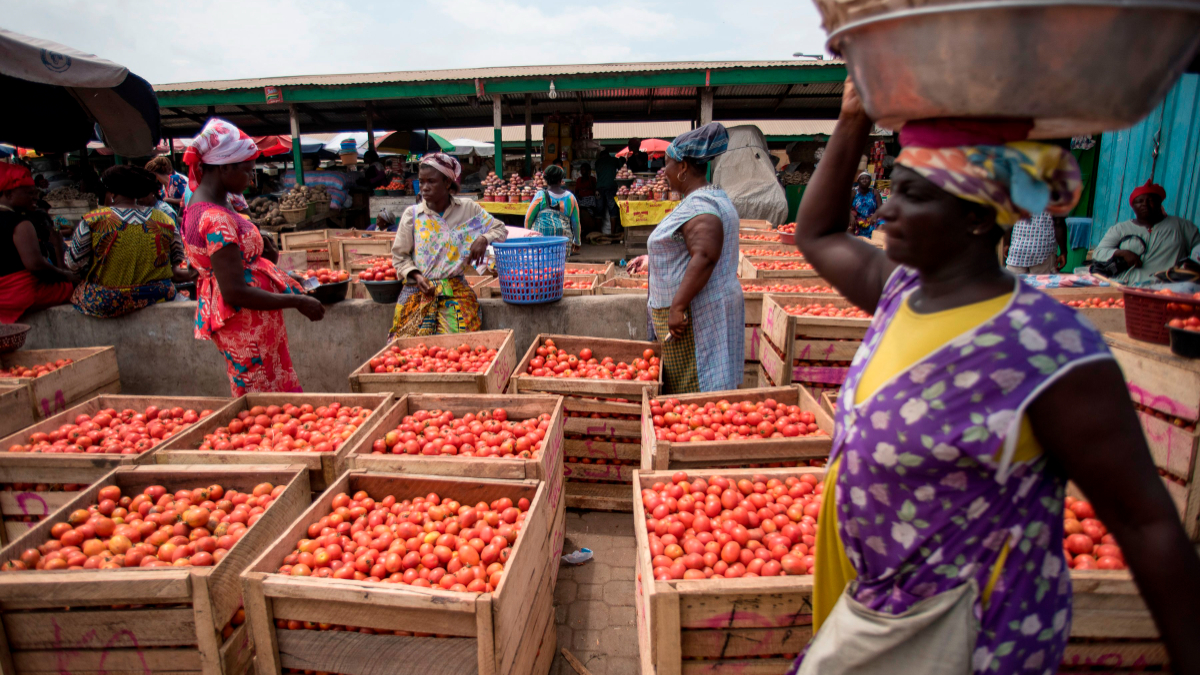


![A woman sells tomatoes to a costumer at her stand at the Agbogbloshie market, Accra. [Photo by CRISTINA ALDEHUELA/AFP via Getty Images]](https://ocdn.eu/pulscms/MDA_/aa0404bd4112834bc5143db78eec5ff0.jpg)
Ghana has signed a new investment push with Spain aimed at expanding agro-industrial capacity, with a particular focus on tomato production and processing, as the West African country seeks to reduce reliance on imports and strengthen exports.
- Ghana has entered into a new agribusiness partnership with Spain to strengthen domestic tomato production and reduce reliance on imports.
- The agreement, discussed in Barcelona, focuses on expanding value addition and supporting smallholder farmers.
- GB Foods has secured 6,000 hectares in Ghana’s Afram Plains for large-scale cultivation.
- The initiative aims to boost yields through technology, improve food security, and create rural jobs.
The initiative was highlighted in Barcelona during talks between Ghana’s Vice President, Naana Jane Opoku-Agyemang, and GB Foods executives, as part of a broader strategy to deepen agricultural value chains and boost local production.
She said government support across the agricultural value chain would strengthen production and agro-processing.
“We look forward to mutually beneficial relationships as we expand and encourage local farmers,” she said, adding that inclusion of smallholders remains a priority.
She added that partnerships would help stabilise supply, create jobs, and improve rural livelihoods while supporting economic growth.
Teddy Ngu, director of corporate affairs for Africa at GB Foods, revealed the company has secured about 6,000 hectares in the Afram Plains.
He said this follows supply challenges, including export restrictions from Burkina Faso.
![Vice President Naana Jane Opoku-Agyemang (middle) held talks with GB Foods – Spain as part of her engagements in Barcelona. [X, formerly Twitter/@tv3_ghana]](https://ocdn.eu/pulscms/MDA_/3580333dac3c8728da6316709b6866b2.jpg)
He emphasised technology-driven farming, noting yield disparities of five,120 and 180 tonnes per hectare in Ghana and Spain, respectively, and in China. He said the company had increased yields in Nigeria from five to 60 tonnes per hectare, expressing confidence that similar gains could be achieved in Ghana.
The partnership is expected to strengthen long-term food security, reduce import dependence, and support agro-industrial development.
The move forms part of Ghana’s broader effort to address persistent shortfalls in domestic tomato supply, which has historically been met through significant imports to meet demand from households and processors.
The Afram Plains project is expected to serve as a major production hub, with the planned use of irrigation and modern cultivation techniques to improve yields and reduce post-harvest losses.
Analysts say the partnership reflects growing interest from European agribusiness firms in West Africa’s agricultural sector, particularly in value addition and supply chain stability, as governments seek to industrialise agriculture and improve food security outcomes.
The agreement is also expected to deepen Ghana–Spain economic cooperation beyond agriculture, supporting knowledge transfer, investment flows, and long-term industrial collaboration across key productive sectors over the coming years.












.png)


