Mogadishu Under Muungaab: 20 Failures, Unanswered Questions and a City Waiting for Change
Facebook

Twitter (X)

Instagram

Somali Magazine - People's Magazine
By Ridwan Yusuf Mohamud Opinion | Somali Magazine Mogadishu is a city that deserves better. It is the capital of Somalia, the centre of its political and economic life, and home to millions of people whose expectations for a better future remain enormous. After decades of […] The post Mogadishu Under Muungaab: 20 Failures, Unanswered Questions and a City Waiting for Change first appeared on Somali Magazine.
 Black News
Facebook Twitter (X) Instagram Somali Magazine - People's Magazine
By Ridwan Yusuf Mohamud Opinion | Somali Magazine
Mogadishu is a city that deserves better. It is the capital of Somalia, the centre of its political and economic life, and home to millions of people whose expectations for a better future remain enormous. After decades of conflict, insecurity and institutional collapse, its residents deserve a government that delivers visible development, modern infrastructure and effective public services.
Yet, despite the city’s growing economic importance and the resilience of its people, Mogadishu continues to struggle with fundamental urban challenges. From poor drainage and waste management to inadequate sewage infrastructure, deteriorating roads and questions surrounding municipal accountability, the capital is still waiting for the transformation its people deserve.
At the centre of this debate is Hassan Mohamed Hussein Muungaab, the Governor of Banadir Region and Mayor of Mogadishu.
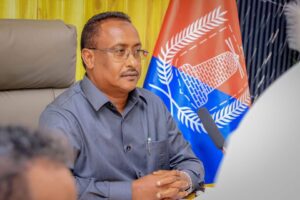
When Muungaab returned to the mayor’s office on 28 May 2025, it was not his first experience governing the capital. He had previously served as mayor between 2014 and 2015. His return therefore created expectations that his experience would translate into a more effective administration, stronger institutions and a clear development agenda.
But more than a year into his second tenure, an important question deserves serious public attention: What has fundamentally changed in the lives of ordinary Mogadishu residents?
Leadership cannot be measured by official ceremonies, press releases, political speeches or photographs of government officials inspecting projects. It must be measured by the quality of public services, the condition of infrastructure, transparency in public expenditure and the everyday experiences of citizens.
The purpose of this article is not to deny the challenges inherited by the current administration. Mogadishu’s problems accumulated over decades and cannot reasonably be attributed to one mayor alone. However, the responsibility for addressing them rests with the administration currently entrusted with governing the city.
Here are 20 major issues that demand answers.
20 Failures, Unanswered Questions and Unfulfilled Expectations
1. The Absence of a Modern Sewage System
How can Mogadishu aspire to become a modern African capital without a comprehensive sewage and wastewater management system?
The city’s sanitation infrastructure remains a major concern. Its growing population requires modern wastewater treatment facilities, proper sewer networks and effective management of sewage disposal.
A modern capital cannot continue relying on inadequate sanitation infrastructure. Where is the comprehensive sewage development programme, and when will residents begin to see meaningful improvements?
2. Persistent Flooding and Inadequate Drainage
Flooding remains one of the most visible problems facing Mogadishu.
On 23 June 2026, Goobjoog English reported that major roads, residential neighbourhoods and business premises remained flooded nearly 40 hours after heavy rainfall. The flooding disrupted transportation, commercial activity, education and access to emergency services.
The report raised serious questions about the city’s drainage infrastructure and preparedness for predictable seasonal rainfall.
A drainage system should not be treated as an emergency project every time it rains. It should be a permanent component of urban infrastructure.
3. Ineffective Garbage Collection
Waste management remains a major challenge across the capital.
A 2026 research study involving 273 respondents found that 49.1% rated solid waste management services as poor, while 46.2% reported roadside dumping as a method of household waste disposal.
These findings raise important questions about service coverage, waste collection contracts, disposal facilities and the value residents receive for the fees they pay.
The city needs a reliable and accountable waste management system, not occasional cleaning campaigns.
4. Uneven Road Development
Road construction is an important part of urban development, and the administration has announced and undertaken several road rehabilitation initiatives.
However, Mogadishu’s development should not be measured exclusively by a few prominent roads.
What about the secondary roads, residential streets and neighbourhood connections that ordinary residents use every day?
A comprehensive road rehabilitation programme should cover all districts according to transparent priorities and measurable targets.
5. The Absence of a Clearly Communicated Urban Master Plan
Mogadishu is expanding rapidly, but expansion without proper planning creates long-term problems.
The city needs a comprehensive master plan covering residential development, commercial zones, public transport, road networks, drainage, green spaces and environmental protection.
Where is the publicly accessible long-term development blueprint that explains what Mogadishu should look like in the next five or ten years?
6. Traffic Congestion and Poor Transport Organisation
Traffic congestion affects workers, students, businesses and transport operators.
The administration needs a coordinated transport policy that includes traffic signals, road regulations, parking management, pedestrian infrastructure and organised public transport.
Traffic management cannot depend entirely on occasional enforcement exercises. It requires a sustainable institutional system.
7. Inadequate Public Sanitation Facilities
Public sanitation is a basic responsibility of municipal government.
Markets, transport centres, commercial streets and public gathering spaces need accessible and properly maintained public toilets.
Residents and visitors should not have to struggle to find basic sanitation facilities in the capital.
8. Insufficient Waste Disposal Infrastructure
Garbage collection alone cannot solve the city’s waste problem.
Mogadishu needs properly managed disposal facilities, recycling programmes, regulated landfill operations and stronger environmental standards.
Without these facilities, collected waste can simply become another environmental problem.
9. Neglect of Mogadishu’s Coastline
Mogadishu has a coastline that could become one of its greatest economic and tourism assets.
Its beaches and marine environment require protection against plastic pollution, sewage discharge and uncontrolled waste disposal.
The city needs a serious coastal management strategy that protects the environment while creating opportunities for tourism, investment and recreation.
10. Inadequate Street Lighting
Public lighting is essential for a functioning city.
Many neighbourhoods need better street lighting to support evening mobility, commercial activity and public safety.
The administration should publish a street-lighting programme identifying the areas covered, the infrastructure installed and the maintenance arrangements.
11. Limited Public Parks and Recreational Spaces
A capital city should provide its residents with more than commercial buildings, restaurants and hotels.
Public parks, gardens, recreational centres and family-friendly spaces are important components of urban development.
Mogadishu needs a deliberate investment programme to create accessible recreational spaces for children, young people and families.
12. Inadequate Pedestrian Infrastructure
Pedestrians remain an important part of the city’s transport system, yet safe walkways and pedestrian crossings deserve greater attention.
Proper sidewalks, accessible crossings and designated pedestrian areas should be incorporated into every major road development project.
A modern city must be designed for people, not only vehicles.
13. The Absence of a Comprehensive Public Transport Strategy
Mogadishu needs a more organised public transport system.
Residents require affordable, reliable and safer transport connecting residential neighbourhoods with markets, business centres, universities and government institutions.
The administration should develop a long-term urban mobility strategy rather than relying on an increasingly congested road network.
14. Weak Urban Water Management
Water management, drainage and sanitation are interconnected.
The city needs better infrastructure for managing stormwater, wastewater and urban water resources.
A comprehensive water management strategy would reduce environmental pollution, improve public health and help protect roads and residential areas.
15. Land Disputes and Questions of Property Protection
Land administration remains one of the most sensitive governance issues in Mogadishu.
Citizens need transparent land registration, reliable documentation, accessible dispute resolution and protection against unlawful occupation of property.
The administration should strengthen land governance institutions and ensure that municipal decisions are transparent, consistent and subject to the rule of law.
16. Unequal Development Across Districts
Development should not be concentrated in a limited number of prominent locations.
Residents across Mogadishu’s districts deserve equitable access to roads, sanitation, drainage, public lighting and other municipal services.
A district’s political visibility should never determine whether its residents receive basic public services.
The administration should publish district-by-district development expenditure and project completion reports.
17. The Living Conditions of Internally Displaced Communities
Mogadishu continues to host vulnerable internally displaced communities.
These communities require access to clean water, sanitation, waste collection, drainage and basic public infrastructure.
Municipal development should include displaced populations rather than treating them as separate from the city’s broader development agenda.
18. Environmental Degradation
Environmental protection should be a central part of Mogadishu’s urban development strategy.
Plastic pollution, uncontrolled dumping, coastal degradation and inadequate waste disposal threaten the city’s long-term sustainability.
The administration needs a comprehensive environmental programme supported by enforcement, public education and investment in appropriate infrastructure.
19. Transparency in Municipal Revenue and Expenditure
One of the most important responsibilities of the Banadir Regional Administration is to demonstrate how public revenue is collected and utilised.
Residents and businesses contribute to municipal revenue and have a legitimate interest in understanding how that money is spent.
The administration should regularly publish financial reports, procurement information, development budgets and project implementation updates.
Public accountability should not be optional.
Citizens should be able to identify how their contributions translate into better roads, cleaner neighbourhoods and improved public services.
20. The Future of Local Democracy and Elected District Councils
The credibility of local democracy depends on respecting the authority of elected representatives.
Mogadishu held local council elections on 25 December 2025, electing 390 representatives across 16 districts.
However, the administration’s subsequent district leadership appointments have generated controversy.
On 3 November 2026, Goobjoog English reported criticism surrounding Muungaab’s decision to replace the Bondheere district governor. The report raised questions about the authority of elected local councils and the significance of the electoral process.
If citizens participate in elections to choose their representatives, those elections must have meaningful consequences.
The administration must clarify the respective powers of the mayor, district governors and elected councils while respecting the applicable electoral and legal framework.
Democracy should not end after citizens cast their votes.
A Sanitation Law Is Not Enough Without Implementation
To be fair, Muungaab’s administration has undertaken and announced certain initiatives.
On 17 June 2026, the Banadir Regional Administration approved Mogadishu’s first dedicated sanitation law, addressing waste management and environmental protection. The legislation introduced measures against illegal dumping and established rules for private waste collection companies.
In February 2026, the administration also announced a road reconstruction programme integrating drainage infrastructure to address chronic flooding.
These are important initiatives and deserve recognition.
However, the existence of a law does not automatically produce a cleaner city. Announcing a drainage programme does not mean that every flood-prone neighbourhood has been protected.
The real test is implementation.
How many neighbourhoods have benefited? How many kilometres of drainage infrastructure have been completed? How much waste is collected every day? How many roads have been rehabilitated? What is the total municipal expenditure, and where can the public access the results?
These are the questions that should define the public discussion.
Mogadishu Cannot Be Governed Through Public Relations
One of the biggest challenges facing public administration is the growing confusion between communicating government activities and actually delivering public services.
A mayor’s responsibility is not simply to announce development projects. It is to ensure that those projects are completed, maintained and beneficial to the people.
Mogadishu needs stronger municipal institutions, professional urban planners, competent technical departments and transparent procurement systems.
The administration should also establish a publicly accessible performance dashboard showing its achievements, expenditure, ongoing projects and outstanding commitments.
Residents should not have to depend on social media debates to understand what their government is doing.
Public communication should explain results, not replace them.
What Should Muungaab Do Differently?
The remaining period of the administration should be an opportunity to demonstrate a measurable change in direction.
Rather than focusing exclusively on individual projects and public appearances, the mayor should introduce a comprehensive urban transformation programme built around five priorities:
First: Infrastructure. Prioritise sewage, drainage, roads, water management and public sanitation.
Second: Environmental protection. Establish effective waste collection, proper disposal facilities, coastal protection and green public spaces.
Third: Institutional accountability. Publish municipal revenue, expenditure, procurement information and independent project assessments.
Fourth: Equal district development. Ensure that every district receives investment based on its infrastructure needs and population.
Fifth: Democratic governance. Respect elected local councils, strengthen district administrations and create meaningful opportunities for residents to participate in municipal decisions.
These priorities should be accompanied by clear deadlines, budgets and measurable performance indicators.
Mogadishu Deserves More Than Political Promises
Muungaab returned to the mayor’s office with the advantage of previous experience. That experience should have provided a foundation for a more ambitious and effective administration.
But experience alone is not enough.
The capital needs leadership capable of turning its enormous potential into visible improvements. It needs a mayor who understands that urban transformation requires planning, technical expertise, financial transparency and institutional accountability.
The challenges facing Mogadishu cannot all be solved within one year, or even one political term. Nevertheless, residents have every right to expect a clear direction, measurable progress and honest communication about what has and has not been achieved.
Criticism should not be interpreted as hostility towards the administration. It is part of the public’s responsibility to demand accountability from those entrusted with public office.
The people of Mogadishu have endured decades of hardship. They have contributed to rebuilding businesses, neighbourhoods and institutions. They have invested in the city’s recovery, often in circumstances where public institutions were unable to provide adequate support.
They deserve a government that matches their determination.
The Final Question: What Will Muungaab Leave Behind?
Ultimately, the measure of Muungaab’s leadership will not be the number of meetings he attends, speeches he delivers or officials he appoints.
It will be the condition of Mogadishu when he leaves office.
Will the city have a modern drainage system? Will its neighbourhoods be cleaner? Will its roads be accessible? Will municipal finances be more transparent? Will elected district councils have meaningful authority? Will residents experience better public services?
These are the questions that matter.
Mogadishu is not the private property of its governor or mayor. It belongs to its people. Its future must be shaped by their needs, aspirations and legitimate expectations.
A capital city cannot continue asking its people for patience while failing to demonstrate measurable progress.
Muungaab has an opportunity to leave behind a meaningful legacy. But that legacy will be determined by what he delivers, not what he promises.
Mogadishu has waited long enough. Its people deserve a city that works.
Mogadishu deserves better.
Ridwan Yusuf Mohamud is the Founder and Editor-in-Chief of Somali Magazine. The views expressed in this article are those of the author.
The post Mogadishu Under Muungaab: 20 Failures, Unanswered Questions and a City Waiting for Change first appeared on Somali Magazine.