Our Right to Thrive: Judging Beyond Form, Listening to Truth
Digital Artwork by Ivan Riches
 Black News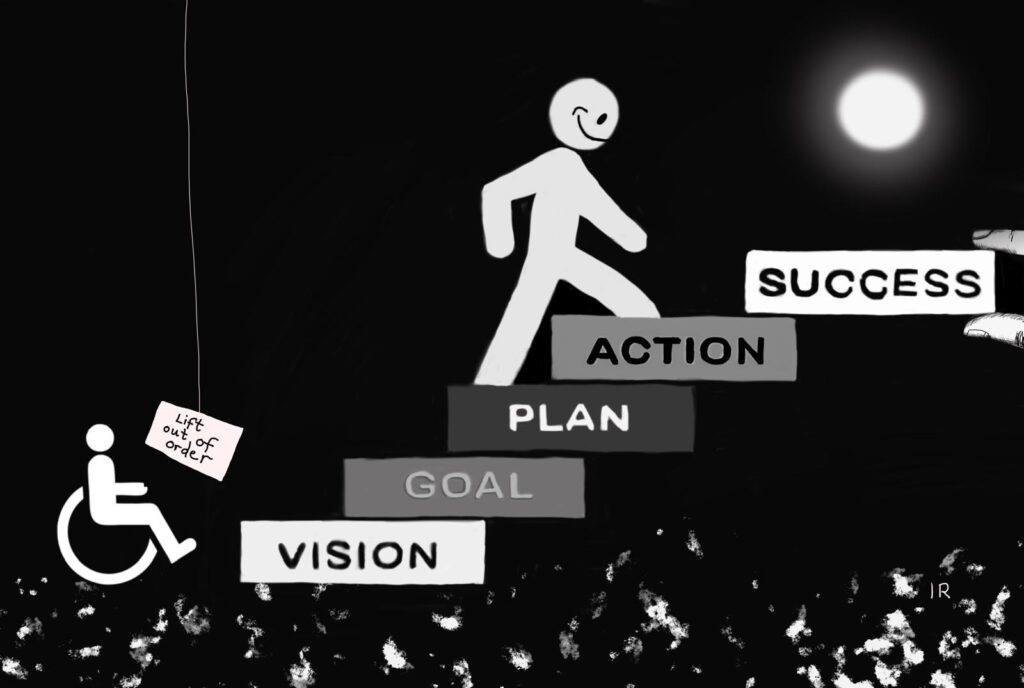

As Poet Laureate of Wolverhampton, I have had the privilege of judging many poetry competitions over the years. Each one brings its own voice, its own energy, its own set of expectations. But nothing quite prepared me for the experience of judging Our Right to Thrive.
This project was something else entirely – a different beast.
We received 98 poems from 65 poets, all living with a wide range of disabilities. From the outset, it became clear that this was not going to be a conventional judging process. Many of the submissions did not follow the structures or conventions typically associated with literary poetry. Grammar was often inconsistent, punctuation irregular or absent altogether. As someone who has, in the past, marked poems down for such things, I had to pause and confront my own assumptions about what makes a poem “good.”
Because here’s what became undeniable: these poems were not lacking. They were overflowing.
What they carried was truth.
Many of the poets were dyslexic, and their relationship with written language was different from the norm. But rather than diminishing their work, this gave rise to voices that were raw, urgent, and unfiltered. The words did not always sit neatly on the page – but they hit hard. They told stories of neglect, of systemic failure, of lives lived in constant negotiation with a society that too often overlooks or undervalues them.
There was anger – real, justified anger. There was confusion, frustration, and a deep sense of being pushed to the margins. These poems spoke of dignity being stripped away, of financial hardship, of battling not only personal challenges but also institutional indifference. They challenged the ignorance of political systems and the complacency of society at large.
And yet, within all of this, there was also resilience.
These were not just poems of suffering – they were poems of resistance. Of people insisting, in their own voices and on their own terms, that they have a right to thrive. Not just survive, not just get by – but to fully participate in life, creatively, socially, and economically.
Judging this competition alongside Ivan Riches was both an honour and a challenge. We approached the work with care, aware of the responsibility we carried. Selecting the winners was no easy task. The quality, honesty and emotional weight of the submissions made every decision a difficult one.
I read the poems over the course of five or six days. By the end of it, my head was spinning, not from confusion, but from the sheer volume of voices, each one demanding to be heard, each one leaving its mark.
This experience has shifted something in me. It has reminded me that poetry is not confined to rules or traditions. It lives in expression, in truth, in the courage to speak – even when the words don’t follow expected patterns.
To everyone who submitted a poem: thank you. Your words mattered. They were heard.
And to Ivan, it was a genuine pleasure to share this journey with you.
Our Right to Thrive is more than a project. It is a statement, a demand, and a reminder that every voice counts, and every person deserves the space and dignity to be heard.