Uganda: Can Military Brutality Suppress Will Of The People?
By Tom Oniro Elenyu Photos: Wikimedia Commons Kampala, UGANDA–This quote is attributed to the late US President John F. Kennedy: “Those who make peaceful revolution impossible will make violent revolution inevitable.” A mix of pessimism and uncertainty hang over Uganda’s post-January 15 general elections as the security apparatus stand accused of being largely partisan and violent. The country’s military headed by incumbent Gen. Yoweri Museveni’s son, Gen. Muhoozi Kainerugaba, (shown above) is viewed as heavily politicized and now overshadowing the electoral body, the Electoral Commission (EC) in managing the electoral process with the assistance of the police—which is also considered militarized and partisan. Several senior military officers have been seconded into the police force and civil service where they serve in various capacities. “I think the EC is grappling with what all State institutions are grappling with in the country: Captivity of State institutions. The framers of the law intended to involve the voters in the entire electoral process,” the main opposition National Unity Platform (NUP) treasurer, Benjamin Katana, said recently. Article 29(1) of the 1995 Constitution permits citizens to express their grievances through peaceful demonstrations to express discontent, but the security forces have strongly stone-walled this constitutional right. So far, the bone of contention is the voters’ right to stay at least 20 meters away from the polling stations after voting and await the tallying, counting and announcement of their voting results. But to citizens’ utter consternation, a trio–Museveni’s son, Gen. Muhoozi, who also doubles as the Senior Presidential Advisor on Special Operations, the EC head Appellate Court Justice Simon Byabakama and Retired Lt-Gen Proscovia Nalweyso the Senior Presidential Advisor on Défense and Security–have decreed that voters must go home immediately after casting their votes. Section 31 of the Presidential Elections Act, Article 7(4) states that voters shall stand or sit at least 20 meters away from the polling stations after voting. The EC is now said to be preoccupied with chasing people from polling stations than addressing fears of irregularities and violent brutality in the electoral process. Theopposition claims EC is currently part of the conspiracy to rig the elections. As the military steps up its brutality on unarmed citizens, its Commander-In-Chief, Gen. Museveni, seems to have forgotten ever saying thus, on February 6, 2023, while marking Tarehe Sita: “People were desperately fed up with the brutality and non-accountability of the old armies—the colonial army, UA [post-independence Uganda Army], and the other one—UNLA [post-Gen Idi Amin April 11, 1979 ouster Uganda National Liberation Army]. So, the UPDF [Museveni’s Uganda People’s Defense Forces] must be very careful; you must never adopt the habits of these old armies: Brutality, corruption…If you do that, the people will hate you, and that’s what happened. The people hated those armies.” Tarehe Sita is Kiswahili for February 6, 1981 when Museveni launched the bush war claiming the December 10, 1980 general elections in which he was a presidential candidate, were rigged in favor of Dr. Apollo Milton Obote. Museveni himself did not win a Parliamentary seat he contested for in the 1980 vote. The civil war, however, rewarded him with the presidency on January 26, 1986 up to now. The Opposition has, in turn, accused Museveni of vote-rigging in every election cycle as he himself accused Obote. His army is blamed for all the brutalities, especially during elections which they tend to “hijack”. And Museveni’s bush war comrade-In-Arms, Retired Maj-Gen Kahinda Otafiire, the current Internal Affairs minister, came out during the Christmas Holidays to distance himself from the national army, Uganda People’s Defense Force (UPDF). “I am not part of the UPDF. I am FRONASA [the bush war Front for National Salvation which preceded the National Resistance Army; UPDF precursor].The reason we took up arms against Amin was because of extra-judicial killings, curtailing freedom of speech and beating up of civilians. Now, you, UPDF, this behavior you have taken up of beating people needs to stop. That’s not part of us [bush warriors]. Leave people alone. If they find you quarreling with a mad man, they cannot tell who is sane, and who is not.” The military and police brutality on civilians, according to political theorist, Yusuf Serunkuma, is because “the [ruling] NRM is scared of the crowds around Bobi Wine [the NUP Presidential candidate real-named Robert Kyagulanyi]. So, the whole system is so scared. That’s why you see there’s safeguarding of this predetermined thing,” he said recently on Capital Gang radio talk show in Kampala. Analyst view is that NRM manufactures crises every election cycle as a justification against its fiercest opponents which so has been NUP
 Black News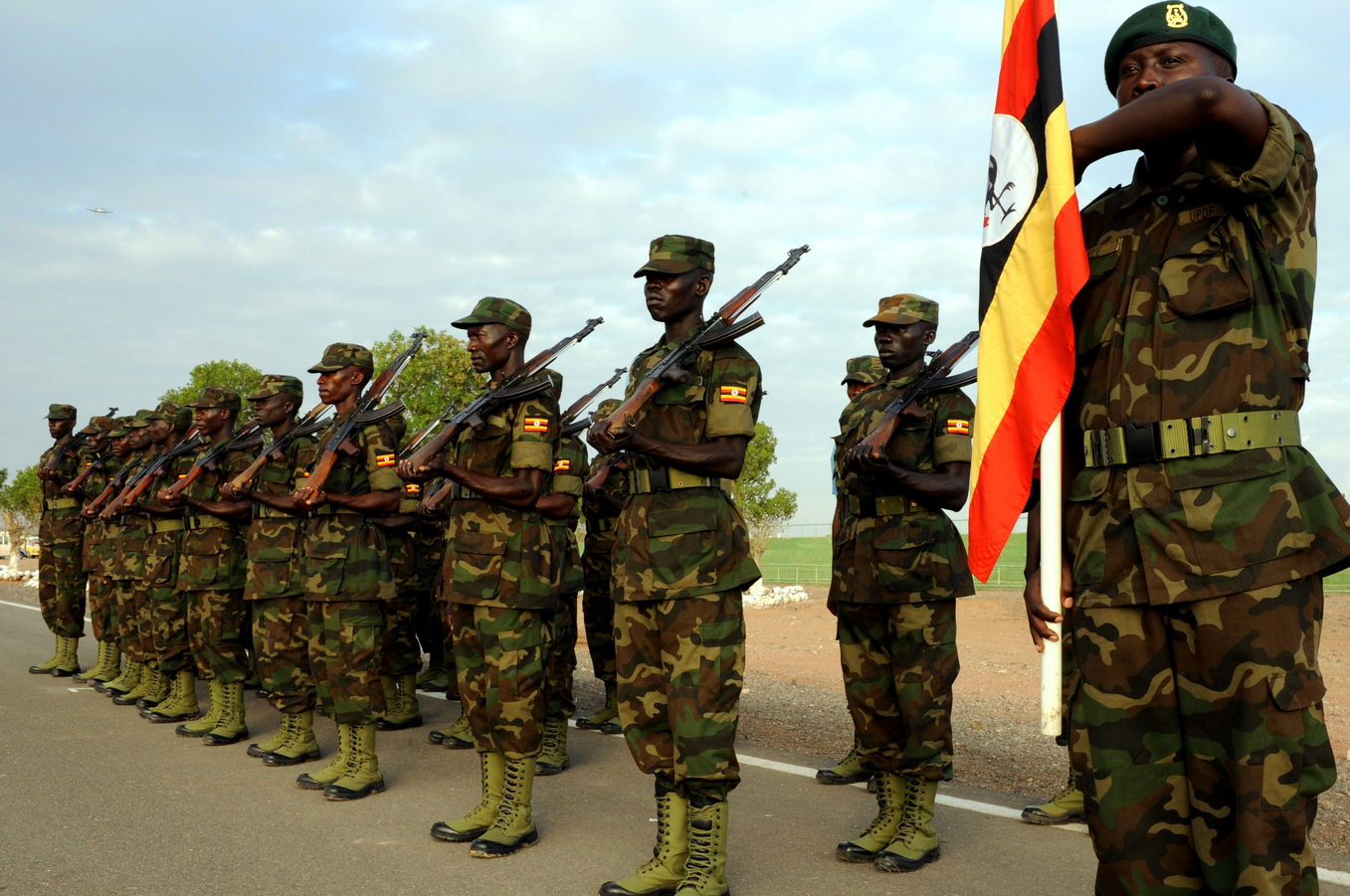
By Tom Oniro Elenyu
Photos: Wikimedia Commons
Kampala, UGANDA–This quote is attributed to the late US President John F. Kennedy: “Those who make peaceful revolution impossible will make violent revolution inevitable.”

A mix of pessimism and uncertainty hang over Uganda’s post-January 15 general elections as the security apparatus stand accused of being largely partisan and violent.
The country’s military headed by incumbent Gen. Yoweri Museveni’s son, Gen. Muhoozi Kainerugaba, (shown above) is viewed as heavily politicized and now overshadowing the electoral body, the Electoral Commission (EC) in managing the electoral process with the assistance of the police—which is also considered militarized and partisan.
Several senior military officers have been seconded into the police force and civil service where they serve in various capacities.
“I think the EC is grappling with what all State institutions are grappling with in the country: Captivity of State institutions. The framers of the law intended to involve the voters in the entire electoral process,” the main opposition National Unity Platform (NUP) treasurer, Benjamin Katana, said recently. Article 29(1) of the 1995 Constitution permits citizens to express their grievances through peaceful demonstrations to express discontent, but the security forces have strongly stone-walled this constitutional right.
So far, the bone of contention is the voters’ right to stay at least 20 meters away from the polling stations after voting and await the tallying, counting and announcement of their voting results.
But to citizens’ utter consternation, a trio–Museveni’s son, Gen. Muhoozi, who also doubles as the Senior Presidential Advisor on Special Operations, the EC head Appellate Court Justice Simon Byabakama and Retired Lt-Gen Proscovia Nalweyso the Senior Presidential Advisor on Défense and Security–have decreed that voters must go home immediately after casting their votes. Section 31 of the Presidential Elections Act, Article 7(4) states that voters shall stand or sit at least 20 meters away from the polling stations after voting.
The EC is now said to be preoccupied with chasing people from polling stations than addressing fears of irregularities and violent brutality in the electoral process. Theopposition claims EC is currently part of the conspiracy to rig the elections.
As the military steps up its brutality on unarmed citizens, its Commander-In-Chief, Gen. Museveni, seems to have forgotten ever saying thus, on February 6, 2023, while marking Tarehe Sita: “People were desperately fed up with the brutality and non-accountability of the old armies—the colonial army, UA [post-independence Uganda Army], and the other one—UNLA [post-Gen Idi Amin April 11, 1979 ouster Uganda National Liberation Army]. So, the UPDF [Museveni’s Uganda People’s Defense Forces] must be very careful; you must never adopt the habits of these old armies: Brutality, corruption…If you do that, the people will hate you, and that’s what happened. The people hated those armies.”
Tarehe Sita is Kiswahili for February 6, 1981 when Museveni launched the bush war claiming the December 10, 1980 general elections in which he was a presidential candidate, were rigged in favor of Dr. Apollo Milton Obote.

Museveni himself did not win a Parliamentary seat he contested for in the 1980 vote. The civil war, however, rewarded him with the presidency on January 26, 1986 up to now. The Opposition has, in turn, accused Museveni of vote-rigging in every election cycle as he himself accused Obote. His army is blamed for all the brutalities, especially during elections which they tend to “hijack”.
And Museveni’s bush war comrade-In-Arms, Retired Maj-Gen Kahinda Otafiire, the current Internal Affairs minister, came out during the Christmas Holidays to distance himself from the national army, Uganda People’s Defense Force (UPDF). “I am not part of the UPDF. I am FRONASA [the bush war Front for National Salvation which preceded the National Resistance Army; UPDF precursor].The reason we took up arms against Amin was because of extra-judicial killings, curtailing freedom of speech and beating up of civilians. Now, you, UPDF, this behavior you have taken up of beating people needs to stop. That’s not part of us [bush warriors]. Leave people alone. If they find you quarreling with a mad man, they cannot tell who is sane, and who is not.”
The military and police brutality on civilians, according to political theorist, Yusuf Serunkuma, is because “the [ruling] NRM is scared of the crowds around Bobi Wine [the NUP Presidential candidate real-named Robert Kyagulanyi]. So, the whole system is so scared. That’s why you see there’s safeguarding of this predetermined thing,” he said recently on Capital Gang radio talk show in Kampala.
Analyst view is that NRM manufactures crises every election cycle as a justification against its fiercest opponents which so has been NUP since 2020 when it registered as a political party to contest in the January 2021 general polls. In his end of the year televised address, Museveni accused the opposition of orchestrating disorder and being backed by foreign interests. “On law and order,” Museveni said, “you have been seeing the indiscipline and archaic conduct of some of the opposition, guided by the wrong politics in their heads and the parasitic foreigners that back them.”
“The criminal opposition must also stop intimidating Ugandans. You have no right to intimidate a Ugandan…I have, however, heard that the mobile audiences of Mr Kyagulanyi have been looting people in some cases,” Museveni claimed on December 31.
Unsurprisingly as usual, Museveni did not blame his soldiers even for once in his address. “Regarding the police methods,” he went on, “some police forces around the world do it using batons. I, however, reject it. It must stop…Police should be more methodical; if they’re to use teargas or water canons or other non-lethal techniques by for instance using loudspeakers to warn people and give them time to pull away…I reject the practice of caning lawbreakers.”
Well, as Uganda’s opposition hopes for peaceful transition of power via democratic elections, it is not yet clear whether the military’s acclaimed brutality will allow this even if NUP wins.