Virginia’s Redistricting Vote Was About Representation, Power, and History
ARLINGTON, Virginia — After weeks of wall-to-wall campaigning, Virginians made their voices heard, approving a new U.S. House map that could help Democrats to pick up four additional seats and bolster Black political power in Congress. “Black voters showed up. Hispanic communities showed up. Communities that Republicans tried to mislead — that they targeted and suppressed […] The post Virginia’s Redistricting Vote Was About Representation, Power, and History appeared first on Capital B News.
 Black News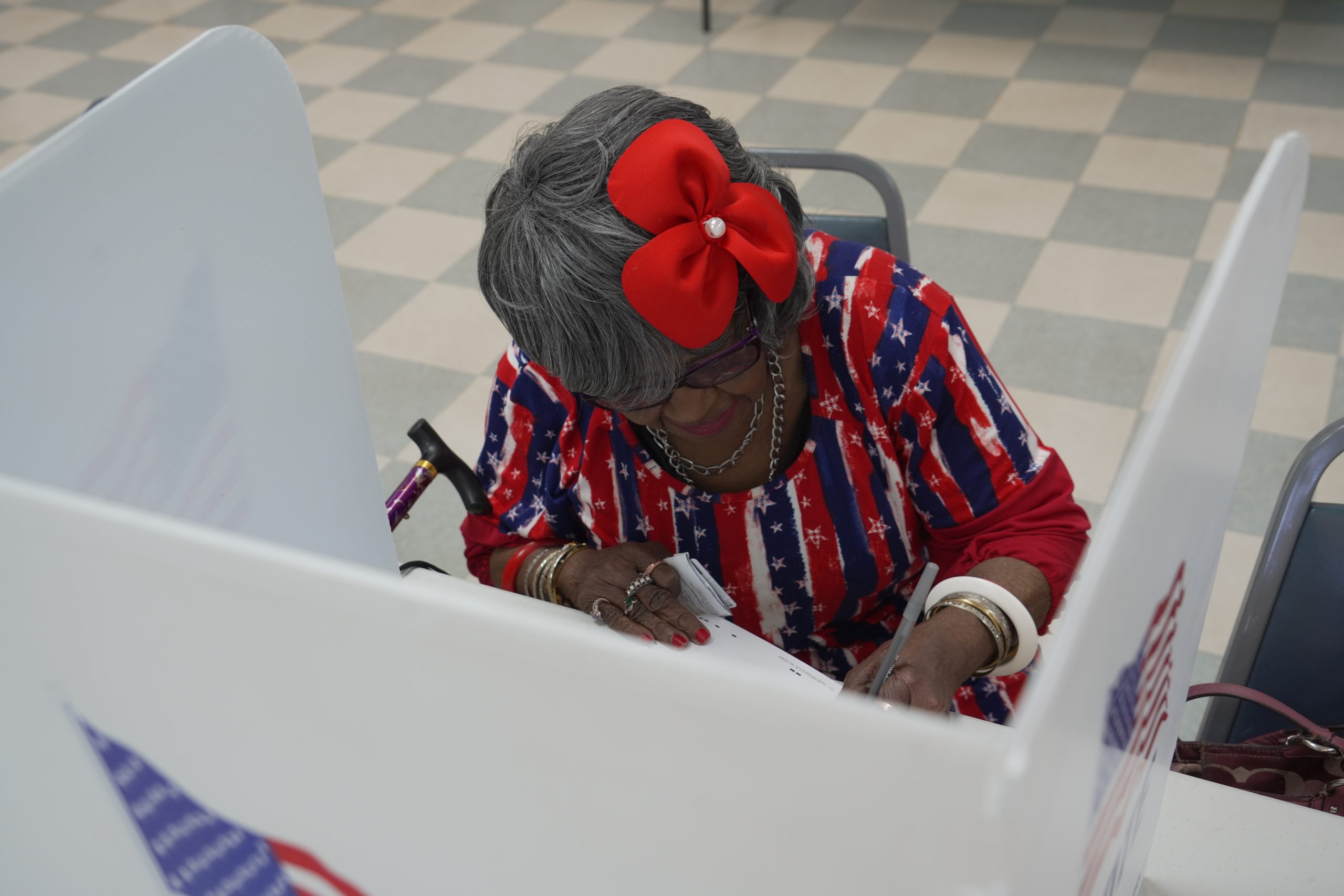

ARLINGTON, Virginia — After weeks of wall-to-wall campaigning, Virginians made their voices heard, approving a new U.S. House map that could help Democrats to pick up four additional seats and bolster Black political power in Congress.
“Black voters showed up. Hispanic communities showed up. Communities that Republicans tried to mislead — that they targeted and suppressed — showed up and made their voices heard,” House of Delegates Speaker Don Scott, a Democrat, said at a Wednesday press conference following Tuesday’s vote.
Counties with a Black population of at least 25% backed the measure by a 14-point margin, according to a Washington Post analysis.
Virginia’s mid-decade redistricting came in response to calls from President Donald Trump last year for Republicans in states including Texas, North Carolina, and Missouri to draw new maps that could pad their thin majority in the House.
Trump’s demands set off an escalating back-and-forth over redistricting, with Democrats and Republicans seeking to redraw maps in ways that could net them an electoral advantage. The stakes are sky high, especially for Black voters: District lines determine whether different communities have a meaningful chance to pick candidates who reflect local priorities.
Because Black voters overwhelmingly back Democratic candidates — more than 80%, according to the Pew Research Center — redrawing district boundaries can have a major impact on their ability to influence elections. This means that redistricting isn’t just a partisan fight; it’s also a battle over representation and power.
“We don’t want voices silenced in other places,” Marsha Mitchell, the senior director of Community Coalition, a racial solidarity group, told Capital B last year, after Californians approved a measure to allow the state to redraw its House map. “It’s about balance, and it’s about defending democracy. Black folks are the ones who have made the promise of democracy real for America.”

The “Jim Crow” messaging that didn’t work.
“Fight Back, Vote YES.” “Vote NO, Don’t Divide Arlington.”
The run-up to the vote in Virginia was dominated by intense campaigning, with signs lining streets and ads flooding airwaves. Some of this campaigning targeted Black voters. One mailer, in particular, attracted much attention. It was paid for by a political action committee chaired by former state Del. A.C. Cordoza, a Black Republican from Hampton.
The mailer leaned heavily on imagery from the Civil Rights Movement, with a black-and-white photograph of marchers filling the page. “Our ancestors fought to represent us,” the headline read, warning that politicians were attempting to “take our districts away.” The message encouraged voters to reject the state’s redistricting measure.
In Virginia, invoking the Civil Rights Movement carries particular historical weight. It’s the state that birthed Massive Resistance, the campaign by white leaders to block school integration after 1954’s landmark Brown v. Board of Education U.S. Supreme Court decision. Observing this history being repurposed angered many Black Virginians.
“These mailers have caused quite an uproar in the African American community in the Commonwealth of Virginia,” the Rev. Cozy Bailey, the president of the NAACP Virginia State Conference, told NBC4 Washington in March. “They’ve used this hyperbolic messaging, and it has actually backfired on them because now people are becoming even more aware of what this issue is about and making intelligent decisions.”
To many of Virginia’s Black political leaders, the mailer underscored concerns about how historical narratives are used in present-day political messaging. Jay Jones, the state’s first Black attorney general, condemned the mailer and its use of history.
“I take very seriously the history that is being invoked in these mailers,” Jones, a Democrat, said, adding that they “misuse imagery from the Civil Rights Movement and even invoke Jim Crow while falsely suggesting the measure threatens Black representation.”
He also rooted his criticism in family memory: “My parents and grandparents lived through the reality of Jim Crow in Virginia,” Jones said. “They experienced firsthand what it meant when the law and the political system were used to silence Black voices. That history is not a political prop, and it should never be exploited in a misleading attempt to confuse voters.”
Cordoza defended the mailer. At a recent press conference, he pushed back against accusations that it was misleading or racially inflammatory.
“I know there’s some controversy behind [the mailer],” he said. “The people who have controversy with this mailer are the same people talking about fairness while constructing a map that disenfranchises Black voters in favor of Northern Virginia legislators. It’s a shameful act.”
What the vote means for Black political representation.
The win in Virginia is a crucial one for Democrats after they lost redistricting battles in other parts of the country.
Redistricting efforts have forced U.S. Rep. Al Green of Texas out of his former district and have made a North Carolina district that has for decades enjoyed Black Democratic representation friendlier to Republicans.
Missouri Republicans also have targeted Democratic U.S. Rep. Emanuel Cleaver, shaving off portions of his Kansas City district and stretching it into Republican-heavy rural areas.
Though most Virginians supported the redistricting measure, the outcome might not be final. The state Supreme Court is weighing a legal challenge that could render it meaningless.
Still, civil rights activists this week have painted the public vote as a triumph over a divisive campaign.
“[Politicians] targeted Black voters with manipulative mailers and weaponized fear in an attempt to tilt the outcome. It failed,” Nadine Smith, the president and CEO of the nonprofit advocacy organization Color of Change, said. “Voters saw through it, stood together, and sent a clear message: If you try to rig our democracy, we will organize, we will vote, and we will win.”
The post Virginia’s Redistricting Vote Was About Representation, Power, and History appeared first on Capital B News.