A historic UN resolution, but the question of reparations remains
In a historic vote on March 25th – the International Day of Remembrance of the Victims of Slavery and the Transatlantic Slave Trade – the United Nations General Assembly adopted a resolution declaring the transatlantic slave trade the “gravest crime against humanity”. Ghana’s President John Mahama spearheaded the landmark resolution, supported by the African Union […] The post A historic UN resolution, but the question of reparations remains appeared first on New African Magazine.
 Black News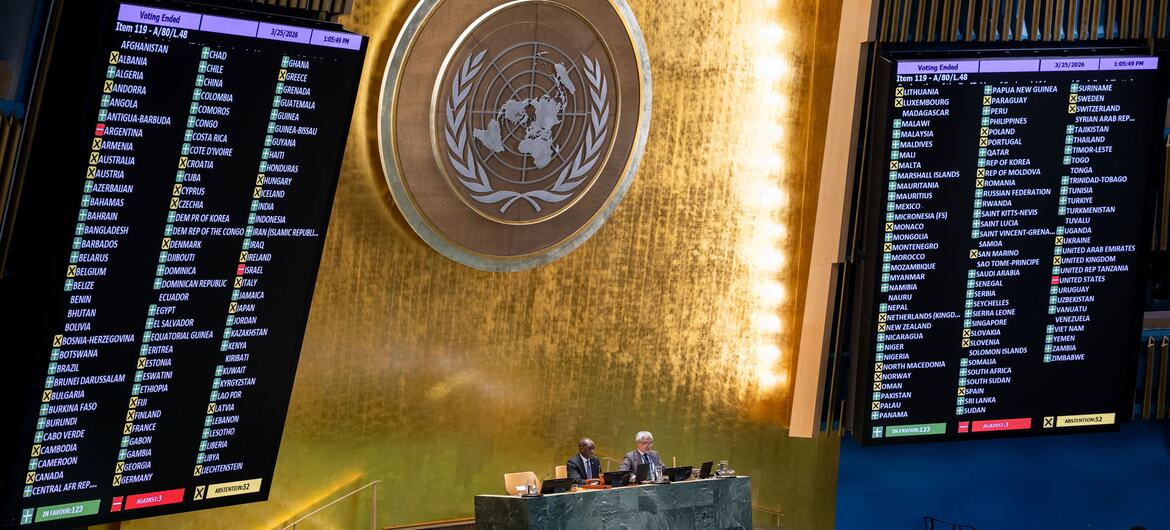
In a historic vote on March 25th – the International Day of Remembrance of the Victims of Slavery and the Transatlantic Slave Trade – the United Nations General Assembly adopted a resolution declaring the transatlantic slave trade the “gravest crime against humanity”. Ghana’s President John Mahama spearheaded the landmark resolution, supported by the African Union and the Caribbean Community.
The resolution was adopted with 123 votes in favour – representing almost 75% of the world population. Among the five permanent members of the UN Security Council, China and Russia voted in favour; the UK and France were among the 52 countries to abstain; and the United States was one of the three countries that voted against it, with Argentina and Israel the other two.
The UN’s classification of the transatlantic slave trade – which started after eight centuries of the Arab slave trade (or Trans-Saharan slave trade) – as the gravest crime against humanity, even in a non-binding resolution, is extremely significant. UN resolutions shape global norms and moral standards, and influence treaties and court decisions. Recognition is often the first step toward truth, justice, and reconciliation. By linking past injustices to current conditions, the resolution could influence how future atrocities are judged and prevented. “Let it be recorded that when history beckoned, we did what was right for the millions who suffered the indignity of the slave trade and those who continue to suffer racial discrimination,” President Mahama told the assembly ahead of the vote.
The historical injustice, beginning in the 15th century, especially after the edicts of Pope Nicholas V in 1452 and 1455 – and lasting for more than 400 years, affected all people of African descent worldwide. It involved the large-scale, systematic dehumanisation and commodification of African bodies, a cultural holocaust, loss of identity, and a legacy of discrimination and unequal access to opportunities that still encumbers Africans and the diaspora to this day, making slavery not just a historical crime but an ongoing source of injustice. The extent of chattel slavery was so severe that abolitionists in the 18th and 19th centuries coined the term “crime against humanity” to describe it.
Millions of young Africans forcibly transported across the Atlantic Ocean died during the infamous Middle Passage. Those who survived the journey were subjected to atrocious, dehumanising treatment and exploited. In his 1805 illustrated publication Injured Humanity, Samuel Wood provided a vivid representation of what the children of Africa endured as slaves in America – how enslaved people were flogged and branded with a “red hot iron”, subjected to brutal conditions that denied their humanity, how families were “violently separated; probably never to see each other more.” Enslaved Africans and their descendants were also renamed and denied any legal recognition as human beings.
Through the legal structures, economic systems, cultural suppression, and violence that buttressed the transatlantic slave trade, Europe’s imperial powers built models that not only exploited African labour and resources but also denied Africans their humanity. The system created and maintained a worldview in which African lives were seen as inherently inferior and disposable, going beyond most other forms of oppression.
Across Africa, the continent’s flourishing civilisations were systematically destroyed by slavery and the colonial regime, and ordered systems of governance were brought down. Precious artefacts and symbols of cultural meaning were either looted or destroyed, engendering a sense of cultural discontinuity that has fueled alienation and a loss of identity. African languages are at risk of extinction, reflecting the long-term effects of the colonial education system, and more broadly, what scholars describe as psychological colonisation, which suppressed indigenous languages, religions, and cultural practices.
The slave trade, which for centuries primarily targeted Africa’s young and most able workforce, fundamentally altered Africa’s economic trajectory, stunted economic growth and long-term development, setting the region down a lasting path of external dependency, which has become the root cause of intergenerational poverty and systemic inequality. Economists have shown that regions heavily affected by slavery are significantly poorer today. The slave trade and colonialism, which followed, rank among the most consequential forces in shaping the modern global economy. They created enduring structures of wealth accumulation, inequality, and dependency that continue to define relationships between nations.
Several factors have shaped the legacy of the transatlantic slave trade. First, when imperial powers finally abolished slavery, they did not engage in a period of atonement or attempt to undo the racial hierarchies that had fundamentally transformed the world. Second, those countries that benefited from slavery were more focused on maintaining wealth and global economic dominance than on creating equal-opportunity societies after abolition. Historians have connected wealth generated from slavery to the rise of mass industrialisation in the West.
Slavery was so profitable for Europe’s imperial powers that they felt the need to compensate slaveholders after its abolition. For example, the Slavery Abolition Act of 1833, which ended slavery in most British colonies, included a compensation package for enslavers worth £20 million (more than £2 billion today), accounting for around 40% of the government’s total annual spending at the time.
France likewise granted reparations to enslavers to compensate for their lost revenues after abolition. The most emblematic case is Haiti, where France imposed a huge independence debt of 150 million francs (representing 10 years of the Haitian government’s entire revenue) on former slaves. The payment ran for 122 years, between 1825-1947, and the money went to more than 7,900 former slave owners and their descendants in France. French economist Thomas Piketty estimates that France should repay at least US$28 billion to Haiti in restitution.
Moreover, Napoleon reinstated slavery in 1802 – making France the only country in the world that had to abolish slavery twice.
And because the abolition of slavery had no cost to France, it was reinstated and later abolished again, still at no cost to the state; since it had no cost to all European imperial powers, colonialism quickly followed, reshaping African societies and dismantling indigenous governance to sustain systems of exploitation and dominance that created societies where race and class intersect. Some Western policymakers seem to regret the end of the colonial period – speaking at the Munich Security Conference in February, US Secretary of State Marco Rubio expressed nostalgia for that era, describing post-WWII decolonisation as a contraction of Western power.
The UN first recognised that slavery was a crime during a 2001 conference on racism, xenophobia, and related intolerance in Durban, South Africa. That same year, France became the first country to declare the transatlantic slave trade a crime against humanity, although President Emmanuel Macron ruled out reparations in 2017, instead calling for reconciliation. In a more positive development, in December 2022 the Netherlands apologised for its role in slavery and established a €200 million fund (around US$208 million) to raise awareness of the Netherlands’ history as a colonial power, as well as “fostering engagement” and “addressing the present-day effects of slavery”.
International law recognises that those who commit crimes against humanity must make reparations. Several countries have received compensation under this law, including the Republic of Korea, which suffered under the Japanese invasion, and Israel, which received compensation from (West) Germany under the Luxembourg Agreement of 1952. Several communities have also received reparations for state crimes committed within national borders, including Japanese Americans after their internment and ill-treatment at the hands of US authorities and the Māori of New Zealand, who received compensation for the seizure of their land by British colonisers in 1863.
In a departure from international norms, African slaves and states did not receive compensation. Instead, the abolition of slavery was associated with costs to slaves in a power-imbalanced world where imperial nations had the memory of abolitionists and not of slaves.
The UN resolution affirmed the importance of addressing historical wrongs affecting Africans and structural inequalities rooted in slavery in a manner that promotes justice, human rights, dignity, and healing, while emphasising that claims for reparations represent a concrete step toward remediation. In addition to acting as insurance against the repetition of past (and ongoing) harms, restorative justice could bring together the descendants of enslaved people and slaveowners for a genuine dialogue to co-create a better world for all, going beyond monetary compensation to create a more humanist and globally-inclusive post-slavery world of equal opportunities and profound respect for human dignity.
Restorative justice today should prioritise the renewal of productive capacities across Africa and among the African diaspora to address entrenched income inequality and the persistent output gap rooted in history. This will drive entrepreneurship, expand employment opportunities, and sustain per capita income growth, breaking the vicious cycle of racial inequality and intergenerational poverty that has dominated the post-abolition era. This requires significant investment in physical and human capital to bolster technological endowment and competitiveness, driving productivity growth and structural transformation.
As emphasised by the UN resolution, restorative justice should also include the return of looted artefacts, which embody African history, culture, and spiritual significance, to end the damaging legacy of African heritage being held hostage by European museums. Simultaneously, African leaders should reform their institutions to memorialise and reappropriate their history and cultural heritage. African leaders must urgently invest in preserving and restoring their cultures and revitalising their languages. Language is identity; it is also a powerful vector of projection into the future, and Africa, the cradle of civilization, cannot afford to miss out on the ongoing digital and AI revolution. That revolution is also taking a linguistic shape and is increasingly expressed through voice.
Finally, achieving a genuine post-slavery society characterised by equal opportunity and human dignity requires a collective effort grounded in a global commitment to reform education systems and address the realities and repercussions of slavery. This approach should foster awareness and discourage denial and minimisation. By removing ambiguity regarding the gravity of slavery and its persistent harm across successive generations, recognition—which is anticipated to impact the manner in which history is taught and remembered—should serve as a crucial step in shaping collective memory.
Recognising slavery’s enduring impact as the greatest crime against humanity is a crucial milestone in ongoing efforts to create a more just and equitable global order. While the UN resolution does not impose legal obligations, its power lies in shaping how the world perceives and addresses one of its darkest eras. It affirms historical truth, reinforces international moral standards, and lays a foundation for continued discussions about justice and reparations. Its impact will depend on the commitment of all actors on both sides of the restorative justice equation. To quote UN Secretary-General António Guterres, “We must commit – fully and without hesitation – to human rights, equality and the inherent worth of every person.”
The post A historic UN resolution, but the question of reparations remains appeared first on New African Magazine.