Africa’s third-richest man Abdulsamad Rabiu is taking on Nigeria’s food giants with BUA Foods’ biggest expansion ever
After reporting a record N518.4 billion ($373 million) profit in 2025, BUA Foods is launching the largest expansion programme since it was founded, betting that bigger factories, broader product lines and greater scale will help it overtake long-established rivals and become Nigeria’s biggest food manufacturer by next year.
 Black News
![Abdulsamad Rabiu says BUA Foods’ biggest-ever investment programme will make it Nigeria’s largest food manufacturer.[Twitter:@NTANewsNow]](https://ocdn.eu/pulscms/MDA_/8906743d1ea05723a5b45b4a2f181d29.jpeg)
After reporting a record N518.4 billion ($373 million) profit in 2025, BUA Foods is launching the largest expansion programme since it was founded, betting that bigger factories, broader product lines and greater scale will help it overtake long-established rivals and become Nigeria’s biggest food manufacturer by next year.
- BUA Foods is embarking on the biggest investment programme in its history after almost doubling annual profit in 2025.
- The company is entering Nigeria’s instant noodles market while expanding wheat milling and edible oils production.
- Chairman Abdulsamad Rabiu says the projects will make BUA Foods Nigeria’s largest food manufacturer by next year.
- The move could reshape competition in one of Africa’s biggest consumer markets as demand for affordable staple foods continues to rise.
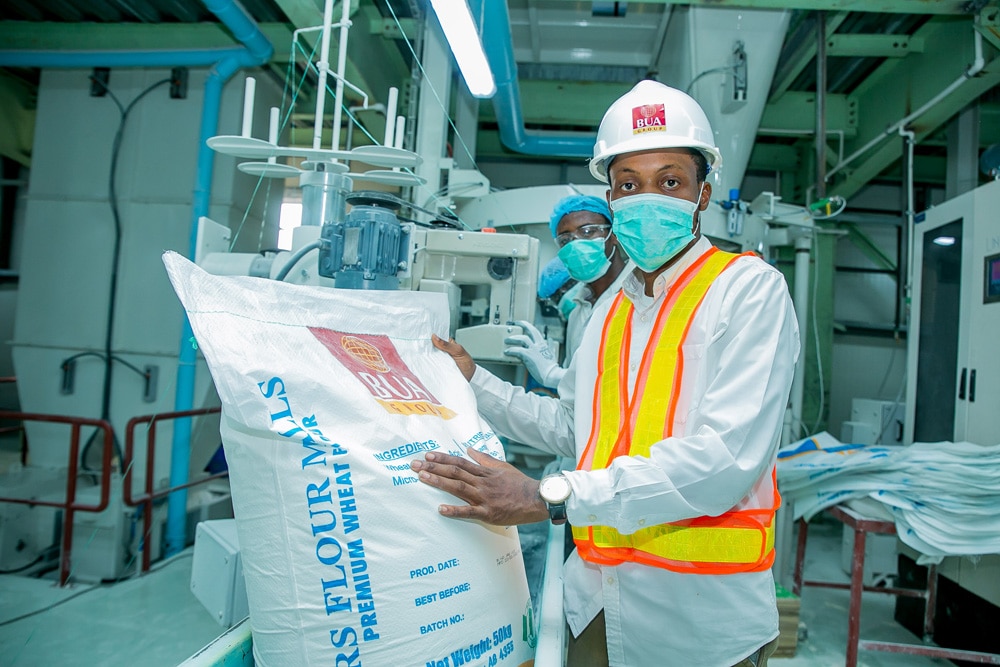
The investment spans several of the country’s most important food categories. BUA Foods is expanding wheat milling capacity, completing its edible oils business, investing further in its integrated manufacturing operations and entering the instant noodles market for the first time.
The move places the company in direct competition with established players across multiple product segments at once, marking one of the biggest strategic shifts in Nigeria’s consumer goods industry in recent years.
DON'T MISS THIS: Africa’s third-richest billionaire loses over $1 billion as Nigerian stocks suffer biggest rout of 2026
Speaking at the company’s annual general meeting in Abuja, Chairman Abdulsamad Rabiu said the expansion is driven by long-term competitiveness rather than size alone.
“By next year, when our current projects are completed, BUA will become the largest player in our sector in Nigeria. We are not pursuing growth simply for the sake of becoming bigger. We are pursuing growth because scale matters in an industry like ours,” he said.
Why this matters
The expansion comes at a time when Nigeria’s food industry is under intense pressure.
Food manufacturers have had to navigate high inflation, a weaker naira, high borrowing costs and volatile foreign exchange markets, all while consumers grapple with a prolonged cost-of-living crisis.
Despite these challenges, demand for staple foods has remained resilient because products such as flour, pasta, sugar, edible oils and instant noodles remain household essentials for millions of Nigerians.
For BUA Foods, the strategy is straightforward- produce more locally, expand into high-demand categories and build enough scale to improve efficiency while competing more aggressively on price.
The investment also aligns with Nigeria’s broader push to strengthen domestic manufacturing and reduce dependence on imports, particularly in food processing.
Entering one of Nigeria’s biggest food battles
Perhaps the most significant part of the expansion is BUA Foods’ entry into the instant noodles market.
Instant noodles have become one of Nigeria’s most consumed packaged foods, supported by rapid urbanisation, population growth and increasing demand for affordable convenience meals.
The sector has long been dominated by established manufacturers, making BUA Foods’ entry one of the biggest competitive developments in the industry in years.
The company is also increasing wheat milling capacity, deepening competition in another strategically important business.
Nigeria remains one of Africa’s largest wheat importers because domestic production falls well short of demand. Expanding local milling capacity therefore strengthens food processing while supporting the government’s drive to increase domestic value addition.
DON'T MISS THIS:Africa’s 3rd richest billionaire’s BUA foods approves record $363-million dividend payout
Completing its edible oils business further broadens BUA Foods’ presence across products used daily by households and food manufacturers alike.
Record profits provide the firepower
The ambitious expansion is being funded from BUA Foods’ strongest financial performance since listing on the Nigerian Exchange.
Revenue rose 16% to N1.77 trillion ($1.27 billion) in 2025. Profit after tax surged 95% to N518.4 billion ($373 million).
Gross profit climbed to N737.3 billion, earnings per share increased to N28.80, while total assets expanded 27% to N1.39 trillion.
The company said the performance reflected sustained demand across its core businesses, stronger operational efficiency, improved cost management and tighter supply chain execution despite Nigeria’s difficult operating environment.
Sugar, bakery flour and pasta remained its biggest revenue drivers.
One of the Nigerian Exchange’s biggest payouts
The strong earnings also translated into one of the largest shareholder rewards on the Nigerian Exchange.
Investors approved a final dividend of N28 per share, bringing the total distribution to approximately N504 billion ($363 million).

The payout is more than double the N13 per share declared for 2024 and continues a sharp upward trend from N5.50 paid for 2023.
As BUA Group owns roughly 90% of BUA Foods, Rabiu will receive the overwhelming share of the dividend.
The bigger picture
Rabiu has spent more than three decades building BUA Group into one of Nigeria’s largest industrial conglomerates, with interests spanning cement, sugar refining, food manufacturing, real estate and other sectors.
DON'T MISS THIS: Africa’s 3rd richest Man, Abdulsamad Rabiu’s latest acquisition is Africa’s first Bombardier Global 8000 jet
Today, BUA Foods is one of the group’s most valuable businesses and one of the largest consumer goods companies listed on the Nigerian Exchange.
Its latest investment reflects a broader trend among Nigeria’s biggest industrial groups, which continue investing billions of naira despite macroeconomic uncertainty, convinced that Africa’s largest consumer market will continue to support long-term growth in food demand.
Whether BUA Foods reaches Rabiu’s target now depends on execution.
Delivering multiple large-scale projects simultaneously will require careful management of construction timelines, foreign exchange risks, input costs and consumer demand.
If completed on schedule, the expansion will do more than increase BUA Foods’ production capacity.
It could reshape competition across Nigeria’s food industry, intensify pressure on established rivals and strengthen one of Africa’s largest indigenous consumer goods companies at a time when food security and local manufacturing have become central to Nigeria’s economic agenda.