Attorney General now proposes sweeping changes to Sovereignty Bill
The Attorney General, Kiryowa Kiwanuka, has proposed sweeping amendments to the controversial Protection of Sovereignty Bill, 2026, signalling a government retreat from some of its most contentious provisions. The original Bill, tabled before parliament, has faced widespread opposition from the banking sector, legal fraternity, religious leaders, and civil society organisations, among others. Critics raised concerns […] The post Attorney General now proposes sweeping changes to Sovereignty Bill appeared first on The Observer.
 Black News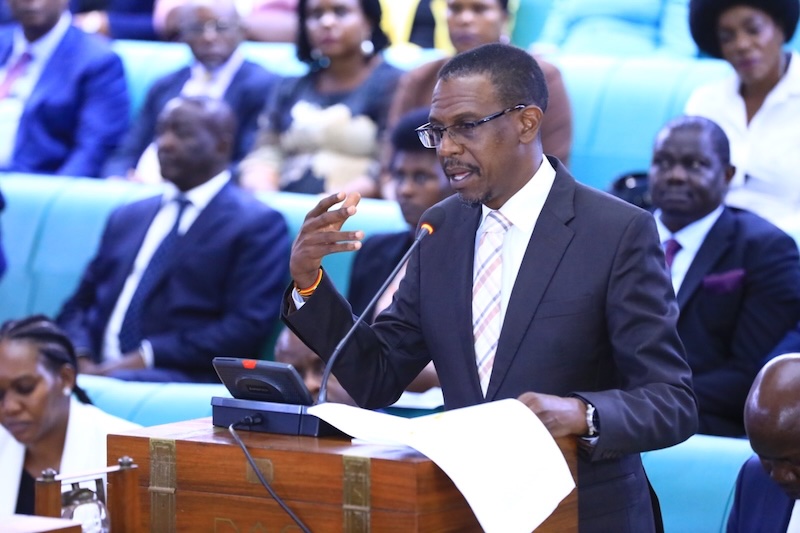

The Attorney General, Kiryowa Kiwanuka, has proposed sweeping amendments to the controversial Protection of Sovereignty Bill, 2026, signalling a government retreat from some of its most contentious provisions.
The original Bill, tabled before parliament, has faced widespread opposition from the banking sector, legal fraternity, religious leaders, and civil society organisations, among others.
Critics raised concerns over vague definitions and sweeping powers granted to the minister of Internal Affairs, warning that the proposed law could stifle civil society, restrict freedom of expression, and undermine foreign investment and remittance flows.
President Yoweri Museveni, in a three-page letter this week, said the Bill under consideration by the joint committees on defence and internal affairs, and legal and parliamentary affairs, differed significantly from what he had approved in cabinet.
“Which Sovereignty Bill is the rwaari about? The one I initiated in the cabinet or another …. That is not the Bill I initiated,” Museveni said.
The President said he had engaged Government Chief Whip Hamson Obua and committee chairpersons, urging that the Bill be refocused on sovereignty in policy-making and avoid “meander[ing] in the areas of free private enterprise transfers or church donations.”
The Inter-Religious Council of Uganda (IRCU) is among groups that called for the withdrawal of the Bill in its entirety. Kiwanuka, alongside state minister for Defence David Muhoozi, reappeared before MPs, acknowledging concerns raised in memoranda submitted over the past two weeks.
“We have tried to list out as much as possible…because we have heard what the concerns are,” he said.
He said the revisions aim to “remove doubt” and clarify that the law targets only individuals acting on behalf of foreign interests in political activities. A key amendment shifts the scope from “any person” to specifically an “agent of a foreigner.”
“For avoidance of doubt, this Act applies to an agent of a foreigner,” Kiwanuka said.
Government has also proposed changes to Clause 2, widely criticised as vague and overly broad.
“We are saying for avoidance of doubt, this act applies to an agent of a foreigner who engages in any of the following activities through any means, including the use of digital platforms. For example, engages in political activities in Uganda to further the interest of a foreigner,” he explained.
Under the revised proposals, the Bill will apply only to individuals who, on behalf of foreign actors, seek to influence legislation, government policy, or electoral outcomes.
“For example, if I’m the Attorney General and I receive from a foreigner a motion of any nature, that’s a prohibited activity.”
Kiwanuka outlined prohibited activities to include receiving foreign funding to influence political decisions, lobbying government officials on behalf of foreign interests, or sponsoring individuals and organisations to advance foreign agendas.
“A Ugandan is at liberty to challenge and question any policy,” he said.
“But when that person is sponsored by a foreigner to promote that agenda, that is where the problem starts.”
Responding to concerns about disruption of legitimate financial flows, the Attorney General proposed explicit exemptions for foreign funding to banks, health facilities, academic institutions, and faith-based organisations, provided such funds are used lawfully.
The Bill will also exclude legitimate inflows such as foreign direct investment, diaspora remittances, trade finance, humanitarian aid, and development assistance.
“Nothing in this Act shall be construed as prohibiting… lawful foreign exchange inflows,” Kiwanuka said.
“So we are saying that notwithstanding nothing in this act shall be construed as prohibiting or requiring compliance with it with this act for lawful foreign direct investment, portfolio investment, diaspora remittances, export proceeds, trade finance, commercial loans, humanitarian assistance, technical assistance, grants, concession of financing, development assistance, or any other lawful foreign exchange inflow and such related activities.”
He said the clarifications were introduced after stakeholders warned that the initial draft could harm Uganda’s investment climate and essential services. The amendments also refine key definitions.
A “foreigner” will now be defined based on involvement in prohibited activities rather than nationality alone, and Ugandans in the diaspora will not be classified as foreigners under the law.
Similarly, the definition of an “agent of a foreigner” will be tied directly to engagement in specified political activities, preventing arbitrary designation. Kiwanuka also proposed removing provisions that granted the minister discretionary powers to designate individuals as foreigners—a clause widely criticised as overly broad.
The amendments replace prior requirements for ministerial approval of foreign funding with a declaration system. Under the new framework, agents of foreign entities will be required to declare funds exceeding a specified threshold, but will not need prior approval to receive them.
“The person can receive the money… but must declare it,” he said, adding that the change is intended to reduce excessive discretion and bureaucracy.
The Bill also introduces stricter thresholds for criminal liability, requiring proof of intent in offences such as economic sabotage.
“We are introducing intention…so that the person does this purposefully,” Kiwanuka said.
Other provisions seek to restrict foreign agents from implementing government functions without approval, while allowing legitimate collaboration under regulated frameworks. Several of the proposed changes appear to address concerns raised by Michael Atingi-Ego and the Financial Intelligence Authority during committee proceedings.
Observers have also argued that many of the issues targeted by the Bill are already covered under existing laws, including the Public Finance Management Act and the Anti-Money Laundering Act. The amendments are expected to be incorporated into the joint committee report to parliament next week.
The post Attorney General now proposes sweeping changes to Sovereignty Bill appeared first on The Observer.