CXC reports successful rollout of first fully electronic/hybrid exams
The Caribbean Examinations Council (CXC) has reported a successful outcome for the January 2026 Caribbean Secondary Education Certificate (CSEC) examinations, which were administered for the first time using a fully electronic and hybrid delivery model. Speaking during a regional media briefing, Registrar and Chief Executive Officer Dr Wayne Wesley described the examination session as a […] The article CXC reports successful rollout of first fully electronic/hybrid exams is from St. Lucia Times.
 Black News
The Caribbean Examinations Council (CXC) has reported a successful outcome for the January 2026 Caribbean Secondary Education Certificate (CSEC) examinations, which were administered for the first time using a fully electronic and hybrid delivery model.
Speaking during a regional media briefing, Registrar and Chief Executive Officer Dr Wayne Wesley described the examination session as a landmark moment in the organisation’s digital transformation journey.
According to CXC, 10,481 candidates from 17 territories participated in the examinations, accounting for 17,695 subject entries. About 96 per cent of entries were administered electronically, marking a significant shift in how examinations are delivered across the region.
Wesley noted that the examinations were conducted between January 5 and January 29, 2026, with the schedule extended by four days compared with the 2025 sitting in order to accommodate the new digital format for high-volume subjects such as Mathematics and English.
He reminded media stakeholders that the Council had also been managing the impact of Hurricane Melissa in Jamaica during the examination period. The organisation activated its disaster response protocols to support affected candidates.
“Our efforts were largely successful,” Dr Wesley said, thanking Jamaica’s Ministry of Education, along with school leaders, teachers, parents and students who assisted in ensuring the examinations proceeded smoothly.
CXC also provided special humanitarian consideration for schools affected by the hurricane. As part of these arrangements, 708 subject entries across 29 centres, representing roughly four per cent of total entries, were allowed to sit their examinations using the traditional paper-based format. These accommodations covered 12 CSEC subjects.
Despite the unprecedented nature of the digital transition, Wesley reported that feedback from candidates and participating countries has been largely positive.
“Students across the Caribbean are ready for e-examinations and CXC is ready to meet the moment,” he stated.
He explained that the Council’s experience during the January session confirmed that many Caribbean students are comfortable working in digital environments. The shift to electronic examinations, he said, reflects the need for assessment systems that align with how modern students learn and process information.
“Living and operating in the digital domain comes naturally for our students,” Wesley noted.
While acknowledging operational challenges during the rollout, he assured stakeholders that none of the issues compromised the integrity of the examinations. Technical problems that arose were quickly addressed at examination centres with assistance from education ministries, IT personnel and CXC officials.
“In all cases where examination delays occurred, candidates were awarded the full amount of lost time,” he said.
Wesley further emphasised that candidates would not be disadvantaged by any irregularities beyond their control, noting that all cases submitted for compassionate consideration will be reviewed in accordance with established procedures.
“I can therefore confidently report to all of our stakeholders that despite the scale and novelty of this undertaking, the January 2026 examinations were carried out successfully,” he said.
The Council believes the successful session provides strong momentum ahead of the traditional May-June examinations.
“This success demonstrates that digital examination delivery is not only viable, it is the future for our Caribbean,” Dr Wesley added.
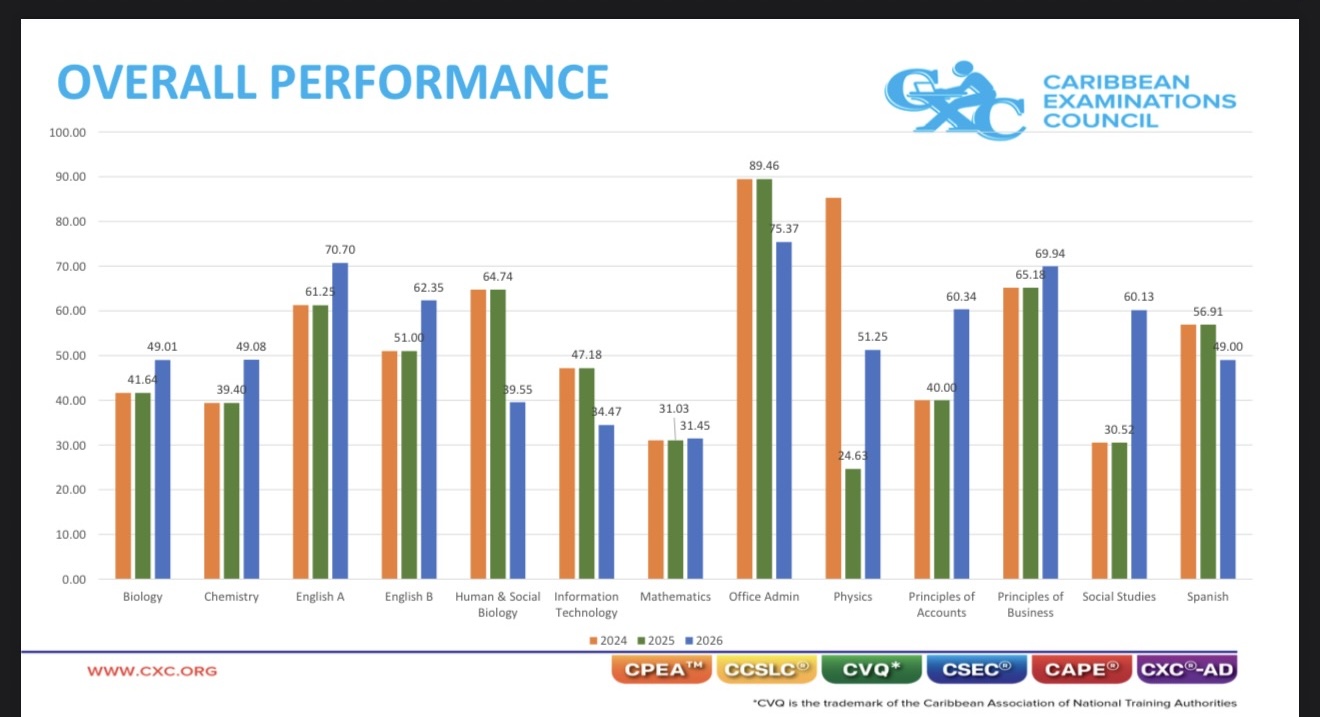
Performance data released by CXC showed varied results across subjects. Among the stronger performing areas were English A, Principles of Business, Principles of Accounts, and Office Administration, while Mathematics and Physics continued to present challenges for candidates. The data also highlighted the percentage of candidates attaining Grades I to III across several subjects, reflecting overall achievement trends across the region.
Beyond examination results, CXC also announced preparations for its inaugural Regional Education Conference and Ministerial Forum, scheduled to take place in Kingston, Jamaica, from March 16 to 19.
Wesley said the gathering aims to encourage collaboration and innovation in education, particularly as digital technologies and artificial intelligence increasingly influence teaching and learning.
The article CXC reports successful rollout of first fully electronic/hybrid exams is from St. Lucia Times.