Ghana records over $3 billion in exports as cocoa processing drives industrial shift
Ghana’s drive to expand industrial capacity and move up the value chain delivered a record performance in 2025, as non-traditional exports surged, driven by strong growth in cocoa processing and other value-added commodities.
 Black News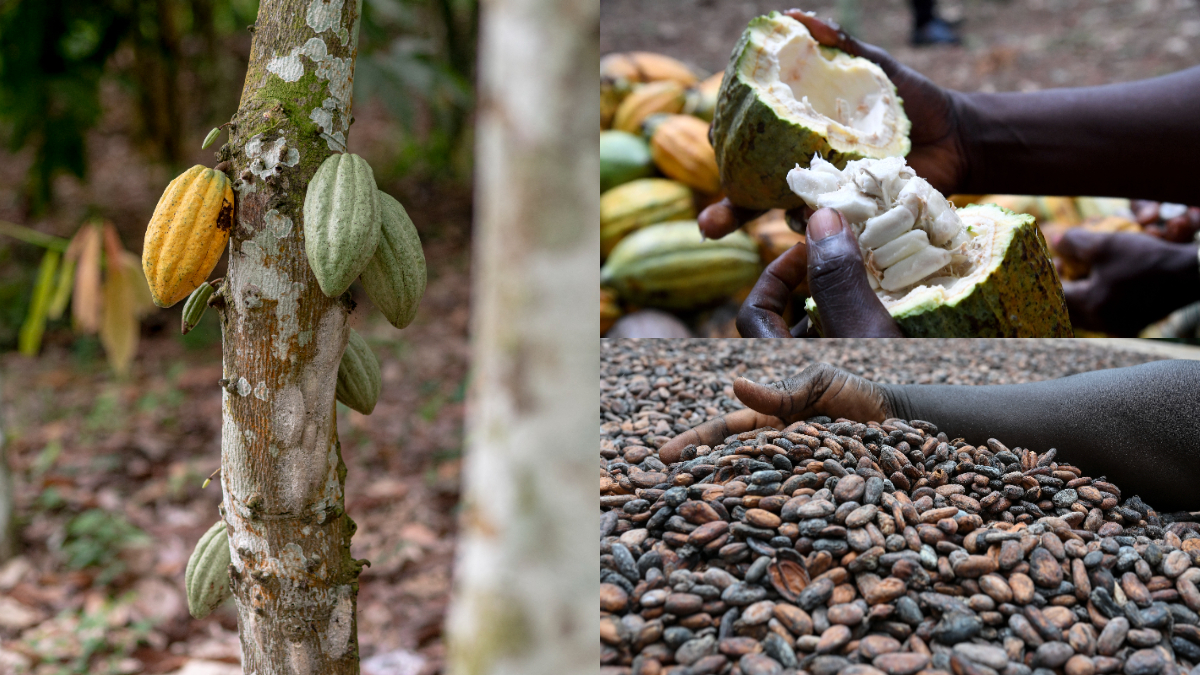
![Cocoa processing facility in Ghana, highlighting the country’s shift from raw exports to high-value manufacturing, as non-traditional exports hit record levels in 2025. [Getty Images]](https://ocdn.eu/pulscms/MDA_/e899f66a4cfe44732f29cf3b814f2a08.jpg)
Ghana’s drive to expand industrial capacity and move up the value chain delivered a record performance in 2025, as non-traditional exports surged, driven by strong growth in cocoa processing and other value-added commodities.
- Ghana’s non-traditional exports surged to about $2.42 billion in 2025, driven by rapid growth in cocoa processing and value-added goods.
- Cocoa paste remained the leading export earner, while cocoa butter and powder recorded triple-digit growth amid rising global demand.
- Manufactured goods and agricultural diversification strengthened the export base, with over 83% of earnings coming from processed products.
- Despite a slight decline in iron and steel exports, Ghana’s industrialisation drive continues to reshape its trade structure and regional competitiveness.
The shift away from raw material dependence is increasingly reshaping the country’s trade structure and strengthening its position in regional and global markets.
According to data from the Ghana Export Promotion Authority (GEPA), the top ten non-traditional export products generated $3.28 billion in 2025, equivalent to about $2.42 billion. This marks a 53% increase from roughly $1.59 billion in 2024. These leading products accounted for 65.48% of total non-traditional export earnings, with the average value per product in the top tier reaching about $242 million.
GEPA described the performance as evidence of “a broader structural shift in Ghana’s export strategy, from raw commodity dependence to processed and semi-processed goods.”
At the centre of this transformation is cocoa processing, which continues to anchor Ghana’s export earnings while evolving into a more diversified industrial base.
Cocoa paste remained the single largest export earner, generating $789.3 million in 2025. This reflects a 70.97% year-on-year increase and underscores Ghana’s deepening investment in domestic processing capacity rather than in raw cocoa exports.
Secondary cocoa products recorded even faster expansion, driven by demand from Europe and other industrial markets. Cocoa butter exports rose to about $469 million following a 120.18% increase, while cocoa powder climbed to approximately $173 million after a 112.97% rise. GEPA noted that the cocoa sector as a whole achieved earnings of about $3.69 billion, describing it as a “historic milestone” for the country’s value-added export agenda.
Beyond cocoa, agricultural diversification continued to strengthen Ghana’s export base. Cashew nuts generated roughly $219 million, reflecting steady expansion in the sector. The shea industry also recorded strong momentum, with shea nuts rising to about $131 million and shea oil reaching approximately $129 million, supported by growing demand from the cosmetics and pharmaceutical industries.
Industrial and fisheries exports also contributed to the overall performance. Articles of plastics rose to about $203 million, aluminium products reached approximately $121 million, and canned tuna exports climbed to around $157 million. Collectively, manufactured and semi-processed goods accounted for more than 83% of total export earnings, signalling a clear shift towards industrial output.
However, not all sectors performed strongly. Iron and steel exports declined slightly to about $233 million amid pressure from volatile global prices and intensifying international competition.
GEPA attributed this divergence to external market conditions, even as broader export performance remained robust.
Ghana's international cash cows
In terms of trade destinations, Europe retained its dominance, with the Netherlands, the United Kingdom, and France emerging as key markets.
At the same time, intra-African trade continued to expand, supported by demand within the Economic Community of West African States. Regional trade now accounts for 30.36% of Ghana’s non-traditional export earnings.
GEPA chief executive Francis Kojo Kwarteng Arthur said the figures reflect “Ghana’s growing competitiveness in regional markets,” highlighting the importance of ongoing initiatives such as the Accelerated Export Development Programme to improve production standards and capacity.
The results were unveiled during the launch of the 2025 Non-Traditional Export Statistics Report on 17 April 2026, which underscored Ghana’s accelerating integration into the African Continental Free Trade Area framework.
Overall, the 2025 performance points to an economy increasingly anchored in industrialisation and value addition, as Ghana positions itself as a rising manufacturing and processing hub in West Africa.