How Black leaders are pushing back after Supreme Court Voting Rights Act decision
As critics reacting to the Supreme Court ruling in the Louisiana redistricting case, saying it “guts” Voting Rights Act of 1965 protections, Black congressional and legal leaders have already convened to mount a defense The post How Black leaders are pushing back after Supreme Court Voting Rights Act decision appeared first on New York Amsterdam News.
 Black News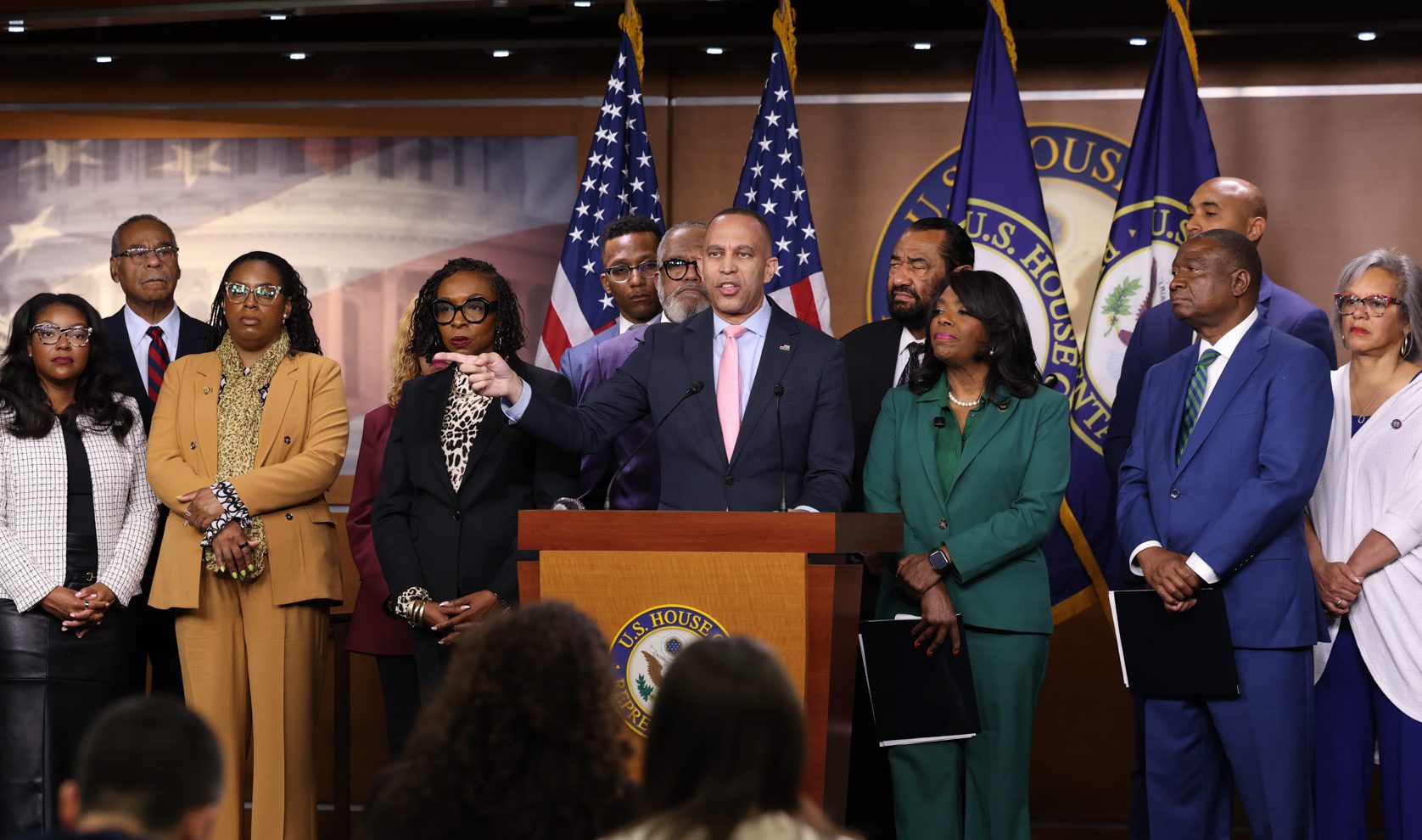


As critics reacting to the Supreme Court ruling in the Louisiana redistricting case, saying it “guts” Voting Rights Act of 1965 protections, Black congressional and legal leaders have already convened to mount a defense and rally behind the passage of the John R. Lewis Voting Rights Advancement Act of 2025 (H.R.14.)
“We did not become a truly multi-racial democracy until the Voting Rights Act of 1965 enforced the 15th Amendment because Black Americans demanded the right to be seen, heard, and counted. That progress was paid for in blood, in sacrifice, and in unbreakable resolve,” said Congressional Black Caucus CBC Chair Yvette Clarke at a press conference on April 29.
The Louisiana v. Callais case centered on the constitutionality of Louisiana’s congressional map, which provided two majority-Black districts situated in New Orleans and Baton Rouge in 2024. This map came out of years of litigation under Section 2 of the Voting Rights Act in Robinson v. Landry. The argued over section of the VRA of 1965 prohibits voting practices or procedures that discriminate on the basis of race, color, or minority group; which of course is rooted in the 14th and 15th Amendments.
The U.S. Supreme Court ruling on April 29 states that the Louisiana map is an “unconstitutional racial gerrymander” because the VRA did not require the state to create an additional majority-minority district and that there was “no compelling justification” for the use of race in its creation. Those completely opposed said that this decision is “a devastating blow” to critical civil rights protections by permitting states to use “partisan gerrymandering,” which affects a community’s ability to select their preferred leaders.
“With its decision in Louisiana v. Callais, the Supreme Court has opened the door to a coordinated attack on Black voters across this country. This is an outright power grab. It’s about silencing Black voices, dismantling majority Black districts, and rigging the map so that politicians can choose their voters instead of the other way around,” she continued.
Marc H. Morial, president and CEO of the National Urban League, called the Supreme court ruling “an affront and assault” on American democracy. Morial said he’d rather not telegraph their response except to encourage voters to come out during the primaries this year.
Morial quickly convened an emergency meeting on April 30 with other civil rights and legal minds to discuss outrage and strategy.
“The reason race is an issue is because they made it an issue. We were banned from certain things because of race. We were denied the right to vote, and then voter protection because of race. So to blame those of us that inherited a racist history, or a racial setup that you need to correct, is an insult to the intelligence of the American people,” said National Action Network president Rev. Al Sharpton. “So we are ready to mobilize. We are not going to take this sitting down.”
Sharpton spoke about NAN’s upcoming listening tour, which will visit more than 23 cities in an effort to encourage voter engagement.
Leadership Conference on Civil and Human Rights President and CEO Maya Wiley said, “ever since a Black man won a presidential election with a diverse coalition named Barack Obama, we saw a rush of states to take voting power away from people of color. We heard politicians who were largely Republican, say out loud, and be reported on from Florida to Pennsylvania. We can deliver an election if we make it harder for Black people to vote. And what the Supreme Court has essentially done is said, Yes, you can. As long as you hide behind partisanship, you can ignore the fact that this is a long history of taking power from people whose decisions you may not like.”
Some congressional members discussed updates to the John Lewis Act to include modern day language that counteracts the Supreme Court’s ruling and other protections not in the 1960s legislation, like preclearance, bail reform, and even possibly covering passport fees among low-income citizens that can’t afford a renewal or the REAL ID.
They also pointed out that it’s a fallacy that Black leaders can’t be elected in districts that aren’t majority-Black.
“Because these extremists have failed America in every possible way. They failed on the economy, they failed on healthcare, they’re failing as it relates to this reckless and costly war of choice. The extremists have completely and totally failed America. So they’ve concluded, aided and abetted by the Trump Court, that they have to cheat to win,” said House Democratic Leader and Congressmember Hakeem Jeffries.
Jeffries resolved to summon courage and get this situation turned around going into the 2026 midterm election. “We will not let their scheme to rig the midterm election and beyond be successful,” he said. “And when we take back the majority in the aftermath of the November 2026 elections, one of our first acts is going to be to make sure we pass the John Robert Lewis Voting Rights Amendment Act so we can end the era of voter suppression in America once and for all.”
On April 30,Louisiana suspended primaries for the state’s six U.S. House seats as a result of the Supreme Court ruling, which would have begun May 2. Early voting for the U.S. Senate May 16 election primaries will begin that day and continue as planned.
The post How Black leaders are pushing back after Supreme Court Voting Rights Act decision appeared first on New York Amsterdam News.