How the Home Counties took over UK rap
The Huck Long Read — An unprecedented number of the UK’s most exciting young rappers are emerging from unglamorous commuter towns and suburbs in the counties around London. Fred Garratt-Stanley investigates this development and the factors underpinning it.
 Black News
The Huck Long Read — An unprecedented number of the UK’s most exciting young rappers are emerging from unglamorous commuter towns and suburbs in the counties around London. Fred Garratt-Stanley investigates this development and the factors underpinning it.
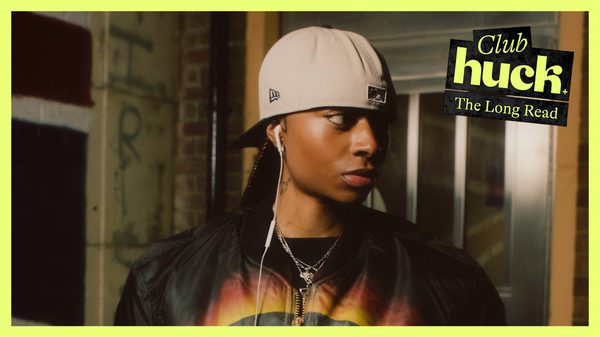
It’s a grey, wintry afternoon, and BXKS is delivering a freestyle for UK rap platform Victory Lap’s new film ‘Training Mode: Vol.1’, a Russian fur hat wrapped over her head to keep out the cold. “I’m from Luton, so I bring the hell to you,” she spits: a casual bar, but one that reflects a wider mission to shout out her hometown.
“I’m definitely honing in on my Luton heritage,” BXKS tells Huck over the phone. “I’ve even started calling myself 01582hottie on TikTok, which is the landline for Luton. I’m tryna make Luton sound a bit more pleasing to the ears!”
Rappers repping their area is no new thing. But there’s been a notable shift in the places the UK’s most exciting young rappers are turning people's attention to. More than ever before, a sizeable cohort of these artists are emerging not from London and other major cities, but from unglamorous commuter towns and suburbs in the counties surrounding London, aka the Home Counties.
This term has built-in associations with a provincial middle-class lifestyle, far removed from the stresses of the city. But while it’s true that the mainstream explosion of UK rap has changed the class makeup of fans and artists alike, the modern counties of Surrey, Kent, Essex, Hertfordshire, Buckinghamshire, Bedfordshire, and Berkshire are diverse places, containing a wide range of communities and voices.
Leading lights include hip-hop storyteller Joe James, whose debut album The Ends, Never Ends reflects powerfully on his upbringing in the poor, disjointed suburbs and towns of Essex, and Canterbury rapper Kwes E, who played a key role in connecting BXKS with other London creatives. There are artists like Buckinghamshire rapper and producer Killowen, and Berkshire’s Songer, who broke into the mainstream in 2024 with his viral ‘Toxic Freestyle’ (now on 44m Spotify streams). There’s BXKS and her fellow Bedfordshire native Niko B, a rapper from Milton Keynes who's grown a huge platform via freestyles on platforms like Victory Lap and parody vlogs under the handle @lunchtimemobile.
Then, of course, there’s Fakemink, a pioneer of the twisted, distorted ascendant genre UK Ug, who has been critiqued for labelling himself “London’s Saviour” despite hailing from Basildon, Essex. In many cases, the UK rap scene is now being pushed forward by artists from unglamorous suburban communities in the outer crumbs of Greater London.
Read next: Joe James: “I will never be absent in my children’s lives because I know it doesn’t feel nice”
“Shout to Fakemink, man. Globally he’s done so well, he’s taken over, and being from the same place as him feeds into the idea that anyone can do it,” says Tkandz, a young rapper who’s also from Basildon, and whose single ‘Now or Never’ blew up earlier this year, clocking over 8m YouTube views to date. For him, representation is massive, and it’ll only boost the number of young artists emerging from towns like Basildon. “It’s really motivating to think that we’re from the same place, we’re both charting, getting millions of streams, global recognition… it’s big.”
There are a number of factors that have fuelled this shift, but the impact of social media is impossible to deny. “When I first came up, the way I was able to be known in London was from Instagram,” says BXKS. “Social media helps a lot of people transition from coming from a small town to having an audience. It helped me find my way; I just used to go to parties on my own, go to shows, and use social media to put myself out there. People that come from bigger cities don’t realise how much everything is just in front of them.”
According to Tkandz, “most artists now have to make content themselves, or go and do certain things to push the music without saying directly that they’re pushing the music.” Inevitably, that leaves social media-savvy musicians like him (an ex-gaming streamer) better placed to blow up. And when you’re operating outside the London bubble, where opportunities for networking and meeting like-minded creatives aren’t as readily available, using that advantage only becomes more crucial. “In Basildon, people are ambitious, but there are less people going out and trying to do creative things,” he says. “Whereas in London, it’s so oversaturated. Everyone’s tryna become something.”
We should view the rise in home counties rappers as directly connected to shifts in how music is consumed via social media. “Five, six years ago, if I released a song, it was a case of ‘how much money can I save up to make a music video?’ Now, it’s ‘let us release 12 little clips to promote it’ – it’s completely changed, it’s upside down,” says Songer, who hails from Wokingham, just outside Reading. “I personally preferred the older version, but I’m well aware that it’s ‘adapt or drown’, so there’s a middle ground I’m trying to find. And there’s an accessibility side to it: anyone from anywhere can write, release, produce music, so what’s possible is changing. It’s becoming way less important to be from London.”
At the same time, there are obvious benefits that come with being in the capital, from the endless opportunities to watch live music, to the plethora of high-quality recording studios and the proximity to a wide range of other artists and creatives. How accessible do these benefits feel to rappers coming through from outside the city?
“It’s obviously more difficult because you are travelling into London,” says Songer. “But my social life and my friends and family and my peace are literally the most important things for me. And it’s never really bothered me having to trek to London for shoots and bits and bobs; I’m in west London all the time, and that’s 45 minutes away, it’s the same as getting from east to west London.”

“Being a bigger fish in a smaller pond gives you more freedom. There’s less comparison, and it allows you to maintain that level of authenticity and originality that you don’t always have if you’re caught up in a rat race.”
This is a pivotal point: for rappers from the home counties, London is still within touching distance. If you’re in Manchester, Birmingham, or Liverpool, you’re far more likely to stay local, growing your own scene, as the likes of Jaykae, SafOne and Mist did so effectively in Brum back in the day. When you’re an affordable 40-minute train ride from the capital, however, accessing its opportunities becomes far easier.
“Most of the recording studios I go to are in London,” says Tkandz, who grew up in Ilford, east London, before moving to Essex for secondary school. “It feels a lot more accessible, because I can drive up there, get the train, and every time I go up there it’s always for something to do with music, so the journey makes sense.”
One thing that appears to connect so many of the rising Home Counties rappers is a terrier-like sense of activity, a willingness to be on the move, travelling to the capital, making things happen. “Coming up from smaller towns, the hunger is a little bit different,” explains BXKS. “You don’t have a choice but to make something of yourself. Growing up, there was a lack of resources, a lack of studios, we didn’t have community centres. You can’t escape being on the block. There’s more eagerness to wanna leave that place.”
At the same time, the vast majority of these artists retain a strong sense of pride in their hometowns. They might not be as stimulating or glamorous as the capital, but there’s a feeling of ownership and familiarity that prompts love and care. And one of the most interesting figures within the contemporary UK rap space – Harrow's finest, Kibo – has spent this year developing a finely tuned creative philosophy centred around paying tribute to these seemingly mundane urban spaces.
“I look out, see clouds and towers, wires, skies and stadiums / It’s where I’ve always stayed though / Only place I can place my hope,” he spits on ‘Red Starz’, the thematic cornerstone of his new album Kwengletaria: Ragamyff. In the outro, he adds: “Surrounded by red stars, scattered around the monolithic preakness that is forced around you / Form yourself a nang constellation / And make your own mythology”. This philosophy about finding beauty and poetry in unexpected places; it’s a message that should hold weight for the landscape of lyricists emanating from the Home Counties.
Read next: Kibo’s compendium of Kwengletarianism
“Making mundane things seem beautiful is what writing is,” says Songer. “That’s what expression is, that's what being creative is. London seems like the hub, it’s where everything's going on, but the majority of the people listening to these songs are in suburban towns, or in the middle of nowhere, or in Wycombe or Milton Keynes or Reading or Bournemouth.”
He continues: “Being a bigger fish in a smaller pond gives you more freedom. There’s less comparison, and it allows you to maintain that level of authenticity and originality that you don’t always have if you’re caught up in a rat race in London or another city where everyone’s trying to do the same thing.”
This is an interesting point. For a London artist surrounded by people adhering to the structures and expectations of a well-established, locally built scene – UK drill or grime, for example – there’s perhaps less incentive to break boundaries and experiment without judgment. For the group of commuter belt UK rappers gaining widespread attention, fitting into a local scene isn’t a concern.
The prominent role of artists outside London in pushing forward the production rule-breaking UK Ug sound (Fakemink, EsDeeKid, Ledbyher) suggests this is the case. By the same token, Joe James’ music is defined by its emphasis on breathing space and pauses for reflection (augmented by clever touches of jazz instrumentation) that seem to mirror his roots in Essex’s less built-up, buzzy spaces.
According to BXKS, the “roughness” of somewhere like Luton drips into the music, too. “Everything is very raw,” she says. “In London, there are parts where you can escape the deprivation and poverty, you can go to Leicester Square and you can go to Primrose Hill… we don’t have stuff like that. So you’re constantly in reality all the time.”
Read next: Wu-Tang Clan forever, and ever

“In London, there are parts where you can escape the deprivation and poverty, you can go to Leicester Square and you can go to Primrose Hill… we don’t have stuff like that. So you’re constantly in reality all the time.”
A mixture of social, cultural and economic realities – from rising rents and house prices, to the greater connectivity provided by high-speed railway routes like the Elizabeth Line and their absorption of suburban areas like Romford and Shenfield – forged the current Home Counties landscape that rappers like BXKS emerged from.
Our perception of Greater London, geographically and culturally, has stretched outward, and will continue to do so. Meanwhile, the ongoing decentralising of the British economy, championed by the new Prime Minister and so-called ‘King of the North’ Andy Burnham, is likely to further reduce the feeling that in order to get on as a creative, you must move to the capital.
At the same time, those Home Counties rappers who have stuck their heads above the parapet have found a perfect balance between accessing London and its benefits, while keeping the relationship at arm's length and maintaining solid local ties.
“Being from outside London enables you to shout about your town, and build a loyal community of people around you,” says Songer. “There will be a million people who like UK music in London who don’t know who I am, and I quite like that. I prefer being the underdog.”
Fred Garratt-Stanley is a freelance music and culture journalist. Follow him on Instagram.