Israel Is a Minefield for New Democratic Leadership
Attacking Israel no longer carried an electoral price, whereas making a point of speaking out in support of the Jewish state, once a sure applause line with Democratic voters, could actually damage one’s campaign. The post Israel Is a Minefield for New Democratic Leadership appeared first on Moment Magazine.
 Black News

Jewish Politics & Power is published every other week. Sign up for our newsletter for updates.
1. Anti-Israel Democratic caucus?
Hakeem Jeffries is about to make history. After winning the Democratic caucus’s trust, Jeffries is poised to take over as the next Speaker of the House and will be the first African American to hold the most powerful position in Congress. But it’s not going to be an easy ride.
Yes, Jeffries will preside over a massive Democratic majority, one that should allow him to advance the mainstream points of his party’s agenda. But he’ll also be presiding over a Democratic majority bent on adopting measures intended on limiting U.S. support for Israel in order to make clear that the days of a blank check are over.
An emboldened progressive group within the House Democratic caucus will try to use the party’s majority to advance legislative initiatives that will block arms shipments to Israel, end funding for U.S. military aid to Israel and impose broad sanctions on settlers and on those enabling settlement expansion in the West Bank.
Jeffries’ set of priorities looks different.
In a wide-ranging interview with The New York Times on Saturday, the soon-to-be speaker repeatedly refused to commit to advancing two key pieces of legislation relating to Israel: One that would block the sale of 2000-lb. bombs, guided bomb kits, tank rounds and 155 mm artillery shells already approved for sale to the IDF, and another imposing sanctions on Israeli individuals and companies that support settlement expansion. “I haven’t articulated a position one way or the other,” Jeffries said. When pressed on the issue, he would only indicate that he intends to hold discussions with members of the caucus before deciding.
Blocking significant arms shipments to Israel is viewed as a major intervention in U.S.-Israel military relationship and a move that Congress has been reluctant to take in past years. Sanctioning Israeli companies for supporting building in West Bank settlements is also seen as a step into uncharted territory that could easily bring about debilitating banking sanctions on large Israeli firms, hampering the country’s economic stability.
Jeffries doesn’t seem inclined to go down that path. Instead, he is prioritizing legislation that would target individual Jewish settlers involved in acts of violence and terrorism against Palestinians in the West Bank. This is a much easier step to take. Settler violence has been on the radar of the entire international community, and the proposed legislation would basically codify into law measures that were already taken in the past by the Biden administration (and then revoked by Trump).
On issues relating to Israel, Jeffries is a Biden Democrat. He supports an approach of tough love—one that acknowledges the need to make Israel understand it has crossed the line but in the context of U.S. support and friendship.
Can he pull it off?
With all the talk of progressive wins in the midterms, the huge blue wave delivered victories to more mainstream Dems who are likely to fall in line with the next speaker’s approach.
Instead of focusing on Israel, Jeffries has set his goals on action items aimed at ending the war with Iran, an issue all Dems can unite behind. “Here’s what I think we should do very early on in the first week or so of the new Congress: We should aggressively move to end the reckless and costly war of choice in Iran,” Jeffries said.
This on its own could be the most impactful legislative move relating to America’s relations with Israel. The current government in Israel has made continuing the Iran war and reigniting military activities its top national security priority. Netanyahu has spent hours trying to convince Trump that there’s an imminent need to resume attacks and has sent emissaries to Washington to present intelligence information supporting his claim that Iran’s ability to threaten Israel and the United States has grown, not diminished.
A House led by a speaker with Jeffries’ commitment to ending the war could go a long way in denying Bibi’s wish.
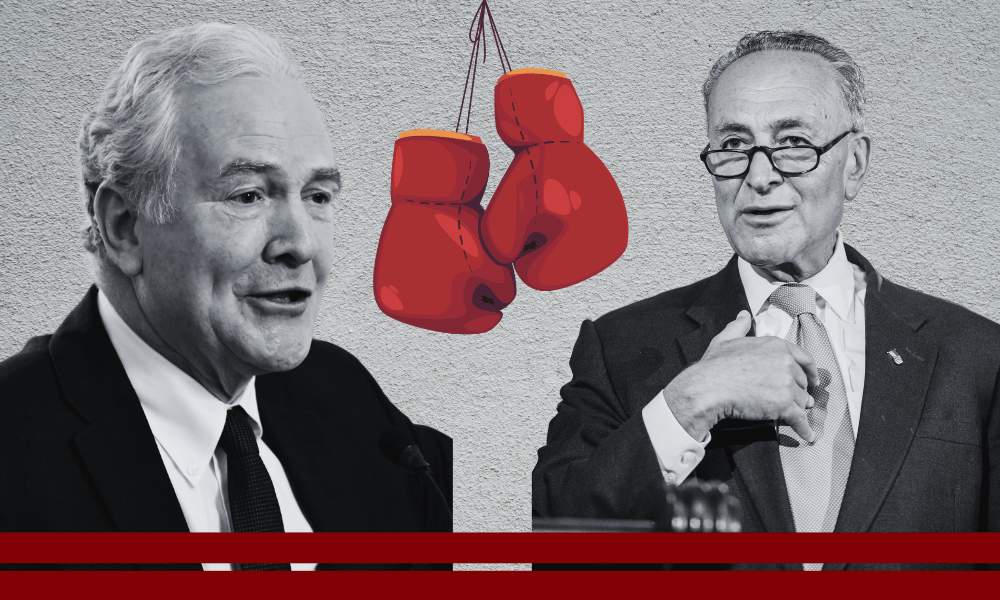
2. Schumer’s battle
Now to the Senate, where a surprisingly tight leadership battle could also shape how Congress impacts relations with Israel.
After his party claimed an unprecedented midterm victory that landed Democrats with a 56-44 majority, Senator Chuck Schumer is vying to reclaim his position as majority leader (which would make him once again the highest-ranking Jewish American in U.S. political history).
It should have been a no-brainer, given Schumer’s experience and the role he played in helping Dems achieve their historic Senate midterm victory, until Maryland Senator Chris Van Hollen threw his hat in the ring, challenging Schumer from the left.
Democrats will elect their new Senate leader on December 1, and until then all bets are off. Political websites are keeping a daily whip count of the race, and while Schumer currently has more senators pledging to support him, the majority of Democrats have yet to commit.
One major difference between the two rivals has to do with Israel. Van Hollen has emerged as one of the top critics of Israel in the Senate, one who has led calls for accountability and for limiting military aid early on in the Gaza war.


Schumer, on the other hand, is anything but an Israel critic. For years, the New York senator had used his favorite shtick when speaking to Jewish and pro-Israel crowds. “Schumer,” he’d say, comes from the Hebrew word “shomer” or guardian. “For as long as I live, for as long as I have the privilege of serving in the Senate from New York, I will unflinchingly be Shomer Yisrael,” he said at a 2017 AIPAC conference.
Since then, Schumer too has changed. In 2024 he publicly accused Netanyahu of being an obstacle for peace and of prolonging the Gaza war for political gains. But just as is the case with Jeffries in the House, Schumer doesn’t believe in cutting ties with Israel. He believes that a post-Netanyahu Israel would resolve most ongoing issues between the two countries and meanwhile is interested in focusing on specific cases of settler violence, rather than on Israeli policy.
3. Trump’s silence as Bibi struggles
It’s been four weeks since Israelis cast their ballots, and a new government is still not in sight. This is quite normal, given the complexity of the Israeli multi-party coalition system. What’s unusual is the deafening silence from Netanyahu’s top backer—Donald Trump.
Before the elections, Trump issued a ringing endorsement of Netanyahu, urging Israelis to vote for the current prime minister and promising that together with Bibi, he’ll finish the job in Iran.
But once election results came in, showing a majority for the anti-Bibi bloc, Trump went silent. The president initially said the outcome was looking good for Netanyahu; then, days later, when asked about Gadi Eisenkot getting the first chance to form a coalition, he seemed open to the idea, stating that Eisenkot and Netanyahu “are very similar” in terms of their policies.
Netanyahu, waiting on the sidelines to see if Eisenkot succeeds in forming a coalition before the deadline, is desperate for help, and Trump could be the one throwing him a line. A statement of support from the U.S. president, a call for an Israeli national unity government, or any gesture of embrace toward Netanyahu, would have the potential of changing the political dynamic in Israel.
So why the silence?
Some believe that Trump, who prides himself of being averse to losers, is sensing that Bibi is going down and does not want to be associated with another failure of a world leader he had warmly endorsed.
Another explanation: Trump and top Republicans truly believe that the Iran war and their close ties with Israel led to the party’s midterm failures. And if that’s the case, why go out of one’s way to help the leader who got you in all this trouble?
4. Huckabee doesn’t think it was Israel’s fault
Was Israel the cause for the Democratic tsunami?
U.S. ambassador to Israel Mike Huckabee recently chose to weigh in. “Israel was not the reason the midterm elections yielded disappointing results for the Republicans,” Huckabee said in an interview with the press service of Israel.
According to Huckabee, a former governor and evangelical preacher, there’s no need to look for reasons across the ocean—the collapse happened from within. “The real reason was that the Republicans failed to provide even their own supporters with a compelling reason to go out and vote for them,” he said, pointing to the fact that only 17 percent of Christian evangelicals turned out to vote.
5. Bernie Sanders reflects on his Jewish roots
It’s rare to hear Independent Senator Sanders discuss his family’s Jewish history. The 85-year-old democratic socialist has never shied away from his Jewish identity, but in a recent podcast interview he provided a window into how family history shaped his life.
“If you ask me where my political views came from—one, I’m Jewish,” Sanders said in a lengthy interview with the Diary of a CEO podcast. He described learning about his parents’ family members lost in the Holocaust and his visit to Poland to see his grandparents’ village. “There was a mound, and they killed hundreds of people and dumped them into a mound.”
And it all ties into his political beliefs, including his views on Israel. “As somebody who is Jewish, to see what Israel has done in Gaza to the Palestinian people is horrible.” And yes, Sanders has endorsed Van Hollen for majority leader.
(Top image credit: United States Senate, CC BY 2.0; Maryland GovPics, CC BY 4.0, via Wikimedia Commons)
The post Israel Is a Minefield for New Democratic Leadership appeared first on Moment Magazine.