Museveni unveils Shs 466bn steel ambition
When President Yoweri Museveni commissioned the Shs 466 billion Danieli Cold Rolling Mill Complex last week, the event was framed as a step toward a larger ambition, of producing more steel in Uganda, reducing reliance on imported finished products, and building an industry capable of serving regional markets. The new facility, operated by Roofings Group, […] The post Museveni unveils Shs 466bn steel ambition appeared first on The Observer Media Ltd.
 Black News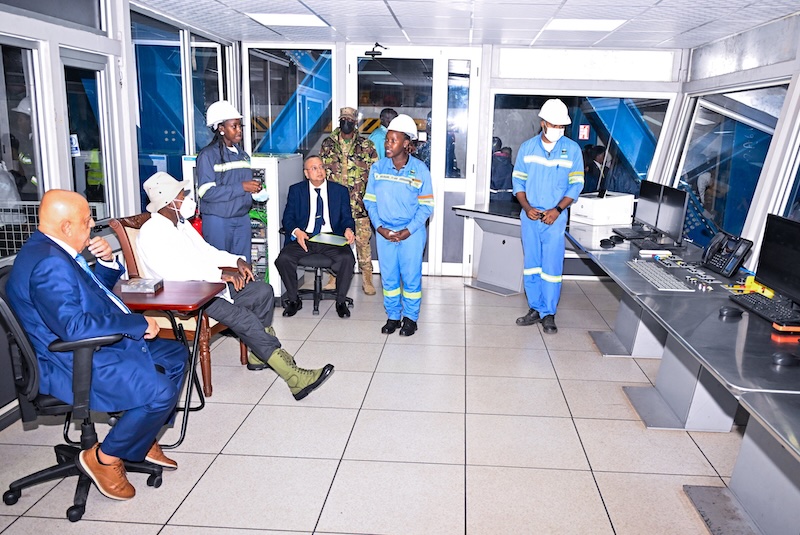


When President Yoweri Museveni commissioned the Shs 466 billion Danieli Cold Rolling Mill Complex last week, the event was framed as a step toward a larger ambition, of producing more steel in Uganda, reducing reliance on imported finished products, and building an industry capable of serving regional markets.
The new facility, operated by Roofings Group, has an annual production capacity of 150,000 metric tonnes. That doubles the company’s cold-rolled steel capacity to 300,000 tonnes. Cold-rolled steel is used in products where strength, smoothness and precise dimensions matter.
The new plant takes steel through several stages that shape, trim, coat and finish it before it reaches the market. At the heart of the complex is the 4-Hi Cold Rolling Mill. Roofings Group chief executive Sheikh Arif said the machine reduces steel to the required thickness while improving its flatness and surface finish.
The strip passes repeatedly through the same mill stand, becoming thinner and longer with each pass. The facility also includes an Edge Trimming Line, which cuts the steel strip to an exact width, and a Hot-Dip Galvanizing Line that coats it with aluminium and zinc to protect it from corrosion and extend its working life.
A fourth line applies colour coatings to produce pre-painted steel. According to the company, the line can switch colours quickly and includes equipment designed to treat exhaust gases before release.
All that engineering matters only if it translates into more locally processed steel, lower production costs, jobs and stronger industrial supply chains for ordinary consumers. That was the point Museveni emphasized at the launch.
“I want to congratulate Lalani for his contribution to this effort. He has been importing steel raw materials, dubbed intermediate products, and adding value here. Which has, of course, saved money. Because of the fabrication he is doing here and the value addition- the coating, the galvanizing, the work- if they were done abroad, the products would be more expensive. And then all these jobs would not be there,” Museveni said.
The President said Roofings had grown from a small operation into a business with turnover of $1.2 billion, including $70 million from exports. Dr Sikander Lalani, chairman and managing director of Roofings Group, said the company began 30 years ago as a modest sheet-forming operation in Lubowa.
Today, he said, it produces 360,000 tonnes of steel products annually and supplies markets across East and Central Africa.
“This growth was not accidental. It was built on a consistent set of values: diligence, integrity and a conviction that sound business practice, paired with fair treatment of people, compounds into lasting success,” Lalani said.
But the bigger issue is what comes next. Uganda still imports intermediate steel products that are then processed locally. Both the government and Roofings now speak of “vertical integration,” in simple terms, creating a steel industry that controls more stages of production, from extracting iron ore to producing finished steel.
Uganda has more than 500 million tonnes of confirmed iron ore reserves, including high-grade hematite in the southwest and magnetite. Museveni argued that those reserves could support domestic steel production for generations.
“There are enough raw materials. The raw materials we have for steel are about 500 million tonnes. If you are using two million tonnes per year, it will take us 250 years to finish it,” he said.
Lalani said Roofings had already established a separate entity to begin exploration work in Uganda and accelerate plans for integrated iron and steel production.
“We have already established a dedicated entity to begin exploration work here in Uganda, to fast-track this vertical integration journey to bring quality iron and steel making to Uganda, at significant scale,” he said.
The potential market is also large. Uganda’s steel consumption currently stands at about 20 kilograms per person, compared with a global average of 200 kilograms. Museveni linked the gap to the country’s level of construction, arguing that demand will rise as more people move from grass-thatched homes into permanent buildings.
The post Museveni unveils Shs 466bn steel ambition appeared first on The Observer Media Ltd.