OpEd: Registered to Vote? Good. Go round up five
Don't just register to vote; help five friends or family members get ready to vote.
 Black News

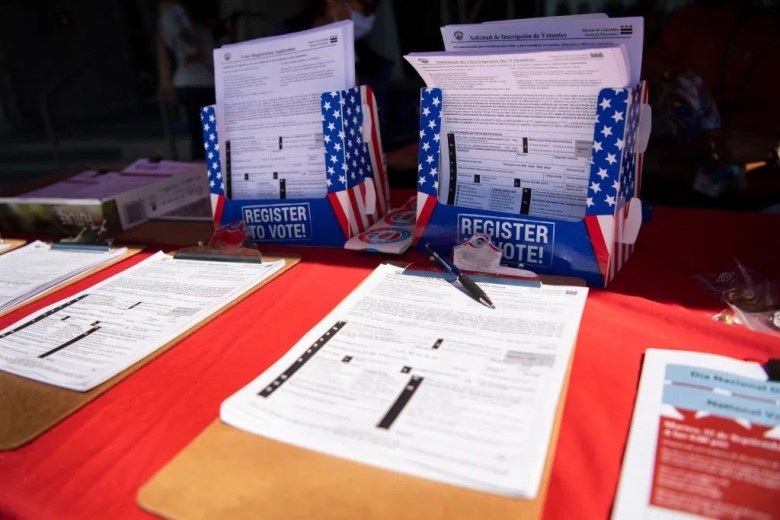
Every election season, we hear the same message: Register to vote.
And yes, you absolutely should. But this National Voter Registration Day, Sept. 15, and National Black Voter Day on Sept. 18, I want us to think bigger. I’m asking you to Round Up Five.
Not five strangers. Not five names on a mailing list. Five people you already know. Your friends. Your family. Your fellow church members. Your co-workers. Your cousins. That young person in your family who recently turned 18.
Ask them one question: Are you registered to vote? And don’t accept, “I think so.” Check.
Because registering to vote is not busywork. It is the first practical step toward participating in the decisions that shape our schools, neighborhoods, taxes, criminal justice system, health care, roads, and representation.
And the numbers show why those personal conversations matter.
Young voters made remarkable gains in the 2020 presidential election, but they still participated at substantially lower rates than older Americans. CIRCLE estimates that about 50% of eligible voters ages 18 to 29 cast ballots in 2020. Census data show turnout among Americans 65 and older was about 74%.
Race matters, too. Census data from 2020 show turnout among non-Hispanic White voters was 71%, compared with 63% among non-Hispanic Black voters and 54% among Hispanic voters.
Those aren’t just percentages. Those are voices that make it into the political process and voices that don’t. And participation becomes even more important when the rules governing elections are changing.
According to the Brennan Center for Justice, between January 2021 and September 2024, at least 30 states enacted 78 laws that the organization classified as restrictive, including changes involving mail voting, voter identification, and registration.
Identification can create another hurdle. A 2024 national survey, cited by the Brennan Center, found that 21.3 million voting-age Americans lacked ready access to documents proving citizenship, such as a birth certificate, passport, or naturalization certificate.
That is why “Are you registered?” shouldn’t be the end of the conversation.
Ask: Is your registration current? Do you know where you vote? Do you know what identification you need? Do you know when early voting begins?
There is another problem we don’t discuss nearly enough: Civic knowledge.
We cannot effectively participate in a government we don’t understand. The good news is that recent data show improvement. The Annenberg Public Policy Center’s 2025 civics survey found that 70% of American adults could name all three branches of government, up from 65% the previous year. But fewer than half could identify most of the freedoms guaranteed by the First Amendment.
Then there is distrust.
In 2024, Pew Research Center found that only 22% of Americans said they trusted the federal government to do what is right “just about always” or “most of the time.”
I understand the frustration behind that number. People look at Washington, D.C., their statehouse or even city hall, and wonder whether anybody is listening. And Lord knows it’s easy to just turn everything off whenever the President takes the stage. But disengagement doesn’t make government disappear.
Decisions still get made. Budgets still get approved. School boards still set policy. Judges are still elected. Laws still get passed. Somebody still decides.
The question is whether we participate in choosing who those decision-makers will be.
For Black Americans, that question carries particular historical weight. Generations before us fought through poll taxes, literacy tests, intimidation, and violence for access to a ballot that many of us can now treat as optional.
We honor that history not simply by talking about voting rights, but by exercising them and helping other eligible voters understand how to exercise theirs.
So this National Voter Registration Day, I’m issuing a simple challenge. Round Up Five.
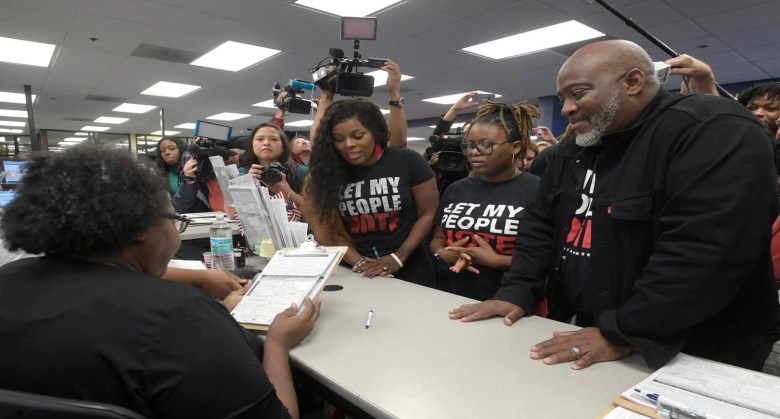
Five people do not sound like a movement. But if each of those five reaches five more, suddenly it is.
That’s how civic participation grows. Not just through campaigns and organizations, but through relationships. One friend or family member. One conversation at a time.
So this National Voter Registration Day, don’t stop at being registered. Round Up Five. Make sure they’re ready. Then send them out to find five of their own.
Because civic participation doesn’t have to begin with a massive organization, a viral campaign, or a celebrity spokesperson. Sometimes it begins with one person asking another: “Are you registered?”
And caring enough to wait for the answer.