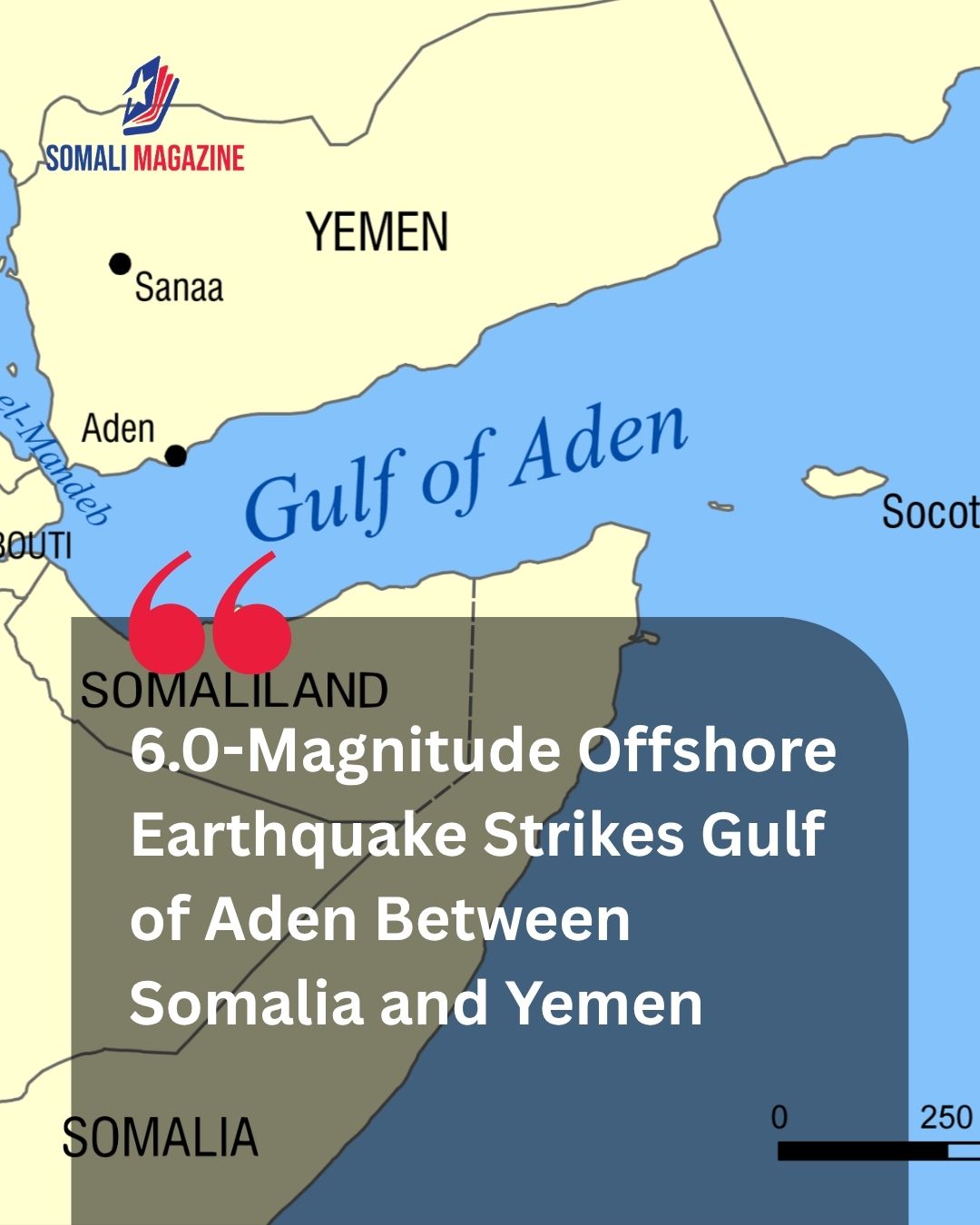
Seismic monitoring stations across the Horn of Africa registered significant offshore activity early Friday after a powerful 6.0-magnitude earthquake strikes Gulf of Aden between Somalia and Yemen, shaking the sea floor along an active divergent plate boundary. Reports released by the U.S. Geological Survey confirm that the shallow tremor hit at 12:07 a.m. local time at a focal depth of ten kilometers, with its epicenter located roughly 145 kilometers off the northern coastline of Somalia. Independent European seismological institutions, including the GFZ German Research Centre for Geosciences, verified the seismic event, noting that shaking was concentrated in maritime waters separating the African continent from the Arabian Peninsula.
The epicenter was recorded approximately 146 kilometers north of Caluula, a prominent coastal town situated in the Bari region of Puntland State. According to USGS intensity modeling, the earthquake generated light to moderate ground shaking rated at level IV on the Modified Mercalli scale across adjacent land areas. Residents in nearby northern settlements reported noticeable tremors that rattled doors, windows, and household items, though local emergency responders confirmed there were no immediate reports of structural damage, casualties, or maritime disruption to local shipping routes.
Geological experts emphasize that events exceeding a magnitude of 6.0 are relatively uncommon along this specific oceanic transform zone, making Friday’s quake an extraordinary event for the region. The Gulf of Aden forms part of the dynamic Afar-Red Sea-Gulf of Aden rift system, where the Arabian and Somali tectonic plates pull apart continuously at a rate of several millimeters per year. While seafloor spreading frequently produces minor to moderate tremors, deep ocean quakes of this magnitude occasionally trigger heightened concern among local coastal populations dependent on maritime transit and fishing activities.
Emergency management systems maintained an alert status following the tremor, but international warning centers confirmed that no tsunami advisories were issued for either Somalia or Yemen due to the strike-slip nature of the fault movement. Regional authorities in Puntland are currently conducting standard assessments along northern coastal corridors to verify infrastructure integrity in surrounding towns. As scientific monitoring continues after the 6.0-magnitude earthquake strikes Gulf of Aden between Somalia and Yemen, disaster response agencies stress the importance of enhancing regional seismic tracking and maintaining community preparedness across Horn of Africa maritime zones.

 Black News