Social critic Ishmael Reed strikes again with new play, Amanuensis
Ishmael Reed’s new play, “Amanuensis,” takes on the theft of Black storytelling behind “Uncle Remus’ Stories” and Disney’s “Song of the South.” In this Q&A, Reed also speaks bluntly about the Black Repertory Theater, independent Black press and the forces he says are trying to marginalize both. The post Social critic Ishmael Reed strikes again with new play, Amanuensis appeared first on San Francisco Bay View.
 Black News

by JR Valrey
The legendary playwright, author, professor, musician and modern-day Renaissance man known for placing political and social criticism in his work is at it again with his new play, “Amanuensis,” which debuts Oct. 9 at the Black Repertory Theater in Berkeley and will run for two consecutive weekends.
The Bay Area-based social critic Ishmael Reed sat down for this Q&A and discussed “Amanuensis” and its relationship to “Uncle Remus’ Stories” and Disney’s stolen, billion-dollar adaptation, “Song of the South.” We also went into the importance of the SF Bay View newspaper and the Black Repertory Theater. Check out “Uncle Ish” in his own words.
JR Valrey: Your new play is titled “The Amanuensis.” What does that word mean? Why did you use this word to title your most recent play?
Ishmael Reed: An amanuensis is someone who takes dictation. Though white supremacists give Joel Chandler Harris credit for “The Uncle Remus Stories,” he merely wrote down stories that were told to him by three of the enslaved on the Turner Plantation. He never claimed the stories originated with him.
JR Valrey: Interestingly, your new play deals with a part of history that includes Walt Disney and his company’s adaptation of “The Uncle Remus’ Stories.” Why did you feel that these occurrences deserved to be the subject of your play, “The Amanuensis”?
Ishmael Reed: Through research, I found the names of the plays’ originators: Old Harbart, Aunt Crissy and George Teller. Disney made millions from “Song of the South,” and he paid Chandler, a pro-slavery writer who mocked Black Reconstruction legislators and benefited handsomely from property that didn’t belong to him.
This kind of rip-off is a constant feature in Black history, like the multibillion-dollar industry based on Rock and Roll, which profited Elvis Presley and others. Writer Zora Neale Hurston mentioned Rock and Roll in the 1940s.
JR Valrey: What part does theater play in the tradition of Black resistance?
Ishmael Reed: Black theater from early times was a theater of resistance.
JR Valrey: Why did you choose to open “Amanuensis” on Oct. 8 at the Black Repertory Theater in Berkeley? What do you think about that space?
Ishmael Reed: I began as a playwright at the Black Repertory Theater when the late Nora Vaughn commissioned me to write about the crack epidemic. The play was called “Hubba City.”
Though local reviewers slammed it, the premier New York critic at the time, Clive Barnes, raved about the play when it reached New York. “Gethsemane Park” was a Gospera with a book by me and music composed by Carman Moore, who was elected to the exclusive American Academy a few years ago. It traveled to San Francisco and New York. Another play, “Mother Hubbard,” began at the Black Repertory Theater and traveled to Hunan, China.
JR Valrey: Why do you support newspapers like the SF Bay View newspaper, which is celebrating its 50th anniversary this year?
Ishmael Reed: You have a pro-Confederate administration that’s trying to stamp out Black culture and opinion. There has been a purge of Blacks, Latinos and Asian Americans from the mainstream media, so the independent Black press is all that we have. Award-winning journalist Ron Scott of The New York Amsterdam News visited the Black Repertory Theater last week and was very impressed. The New York Amsterdam News, the SF Bay View and other Black newspapers are the last outposts of Black opinion.
Scott was here to receive an American Book Award for his outstanding jazz and theater criticism. He was very impressed with the work performed by the Black Repertory Theater, even though they get nothing but criticism from the local media except for the SF Bay View and the Oakland Post. He also visited the African American Museum and said it was more beautiful than the Schomburg.
Who else is impressed with the Black Repertory Theater? The Mellon Foundation and the MacArthur Foundation, which is sponsoring an event there on Nov. 14 featuring the great novelist Charles Johnson, whose novel “The Middle Passage” became a major Hollywood movie.
You know who is not impressed with the Black Repertory Theater? Their enemies in the Berkeley City Council who prostrate themselves before the Berkeley Repertory Theater, “the white Rep,” and every mediocre white theater in town, awarding them millions of dollars while subjecting the Black Repertory Theater to decades of harassment. I wrote an article about the harassment for Alta magazine, https://www.altaonline.com/culture/a38403159/black-repertory-ishmael-reed/, including the unlawful entry into the theater by an aide to a councilman who used a crowbar to break in.
We need somebody to investigate the source of hostility toward the Black Repertory Theater coming from elements in the Berkeley City Council, while they’ve built three theaters for the Berkeley Repertory Theater! “The white Rep” and other white theaters receive hundreds of thousands of dollars from them. While the city won’t pay the Black Repertory Theater a piddling $25,000 per year or make repairs, they’re building “the white Rep” a hotel for out-of-town actors so they can save on rentals, while they harass the Black Rep with surprise inspections and sneaking around for “gotcha” moments.
Every play I’ve seen at the Berkeley Repertory Theater that includes Black characters stereotypes them. They turned Zora Neale Hurston’s play, “Spunk,” into a minstrel show. Both poet Judy Juanita and I were racially profiled at the “white Rep.” Some Black child was instructed to stalk me and be very rude to me when I went to see “The Delany Sisters’ First 100 Years.” I was only there because of the great actress and diva, the late Vinnie Burrows, who was starring in the play and invited me. Vinnie played the lead role in the New York run of “Hubba City.”

The way racists operate in Berkeley is to hire Black children and other Blacks to do their dirty work, spy on Blacks in retail stores and elsewhere. These people are pathetic. I was racially profiled at the U.C. campus bookstore by a Black man.
The Black Rep has a summer program that keeps Black youth off the streets. They rehearse a play during that period. Their production of “The Wiz” was better than the movie version. Their enemies at the council even tried to undermine that program. Incidentally, the councilman’s assistant who unlawfully entered the theater using a crowbar was involved in a scandal that made the news. He’s still on the councilman’s payroll.
JR Valrey: What is the importance of Black people supporting our own community institutions?
Ishmael Reed: The Black Repertory Theater doesn’t get the support it deserves. In fact, there are powerful Blacks who have traditionally opposed the Black Repertory Theater, but like its enemies on the city council, you never see them at Black Repertory plays. But the Black Rep has a loyal following that supports them. When one of the mayors tried to secretly choose someone to replace the current producers, the Black Rep fans rallied. The people showed up at city council meetings to support the Black Rep.
JR Valrey: You have been a playwright, author, professor and more in a career that spans more than 60 years. How do you feel when you put out new work?
Ishmael Reed: My point of view is not welcomed by the corporate media. Twice within the last year, my views have been distorted by The New York Times, where Lin-Manuel Miranda’s biographer Daniel Pollack Pelzner dismissed me as a “left-wing provocateur” as a result of my play, “The Haunting of Lin-Manuel Miranda,” which challenges the billion-dollar fraud, “Hamilton’s” portrayal of Alexander Hamilton as an “ardent abolitionist.” He was involved in the slave trade for all of his life. His in-laws were traffickers, and so was his wife. Then The New York Times ran a piece by art critic Deborah Solomon accusing me of “pigeonholing” Black painters. They didn’t print my letter challenging Miranda’s biographer, and they didn’t print my reply pointing out that Solomon hadn’t read the essay in which I was supposed to have pigeonholed Black painters. She sent me a private note telling me how much she admired my work.
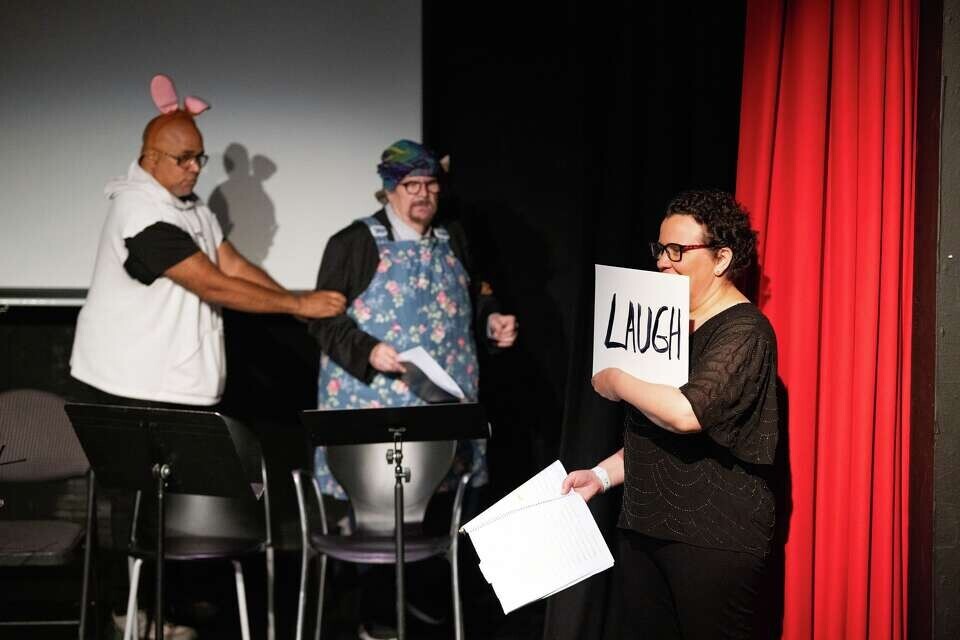
So stage, poetry, songwriting and fiction are how I get my views known. I’m also a musician with three CDs out. The latest is “Everytime I Feel The Spirit,” in which I play over 20 of my piano compositions.
Like Sean Vaughn Scott has to use his salary, his grandfather and Mona Vaughn Scott had to use their Social Security checks to keep the Black Rep going; I have to use my own funds to provide actors with roles that are different from the slop that Hollywood and corporate TV offers them, like the recycled minstrel shows “The Wire” or “The Deuce,” both by David Simon, who plays on stereotypes that were applied to his people in Nazi Germany, where Jewish men pimped Aryan women.
Those were popular images in the Nazi media. Yet thousands of Blacks are crazy about “The Wire” and “Hamilton.” Goes to figure.
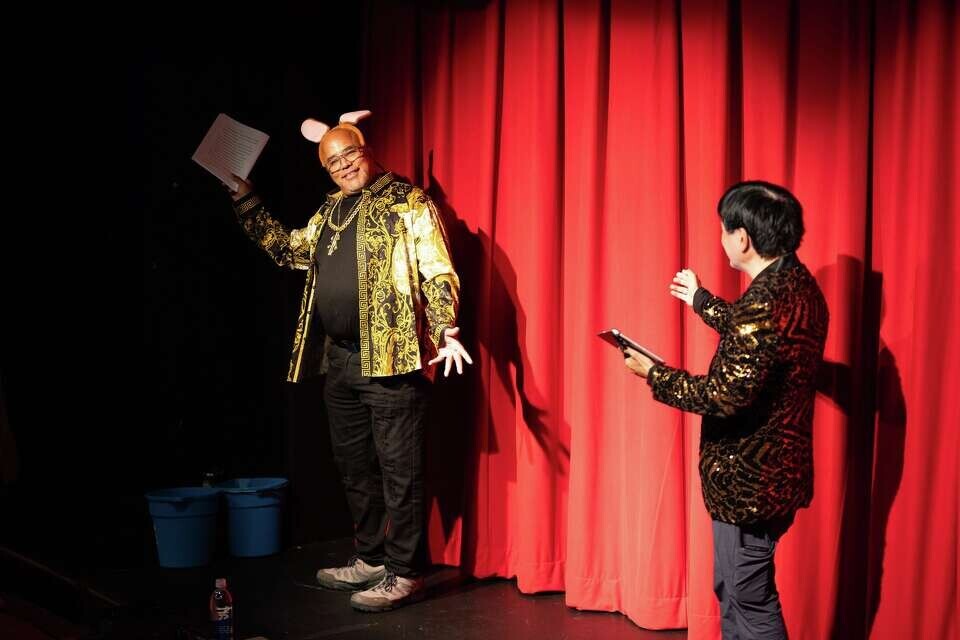
Paul Schrader, who, according to Cecil Brown, ripped off a Black writer’s script for his movie “Blue Collar,” has come up with such a foul movie about Black life that even Black actors turned it down, so it must be terrible. He said he’s going to use Artificial Intelligence to substitute for Black actors.
I have a couple of patrons, but most of the money comes out of my pocket for my new play, “The Revenge of King Ludd,” which tackles the racism and anti-Semitism of two of the most powerful men in the world, Peter Thiel and Elon Musk. We will do four readings at Theater 33 in San Francisco Dec. 4, 5, 11 and 12, and a three-week performance at American Theater of Actors in New York beginning Nov. 30. I have a GoFundMe effort up, but it has stalled. https://www.gofundme.com/f/living-newspaper-king-ludd-amanuensis
Now dig this: Because my plays are performed at the Nuyorican Poets Cafe after being performed at the Black Repertory Theater, and because that theater is funded by The New York State Council of the Arts, my plays have received more support from that organization than from the California Council of the Arts, which turned me down for the second year. I applied for a Master’s Grant and wasn’t even told why they turned me down.
JR Valrey is a veteran journalist and Editor in Chief at the San Francisco Bay View. He can be reached at JR@sfbayview.com
The post Social critic Ishmael Reed strikes again with new play, Amanuensis appeared first on San Francisco Bay View.