The Man Who Refused to Be Silenced
The first time my father was taken to prison, I was a toddler and did not know what prison was. When I asked where he had gone, my mother told me he had to go rest in a resort for a while. I was allowed to visit him on weekends. And he played the part. He would stand among armed guards and smile, relaxed, as if he were indeed on vacation. He pressed a handful of sweets into my hands, bought from the prison shop, as proof that he was in a good place and having a good time. I […] The post The Man Who Refused to Be Silenced appeared first on African Arguments.
 Black News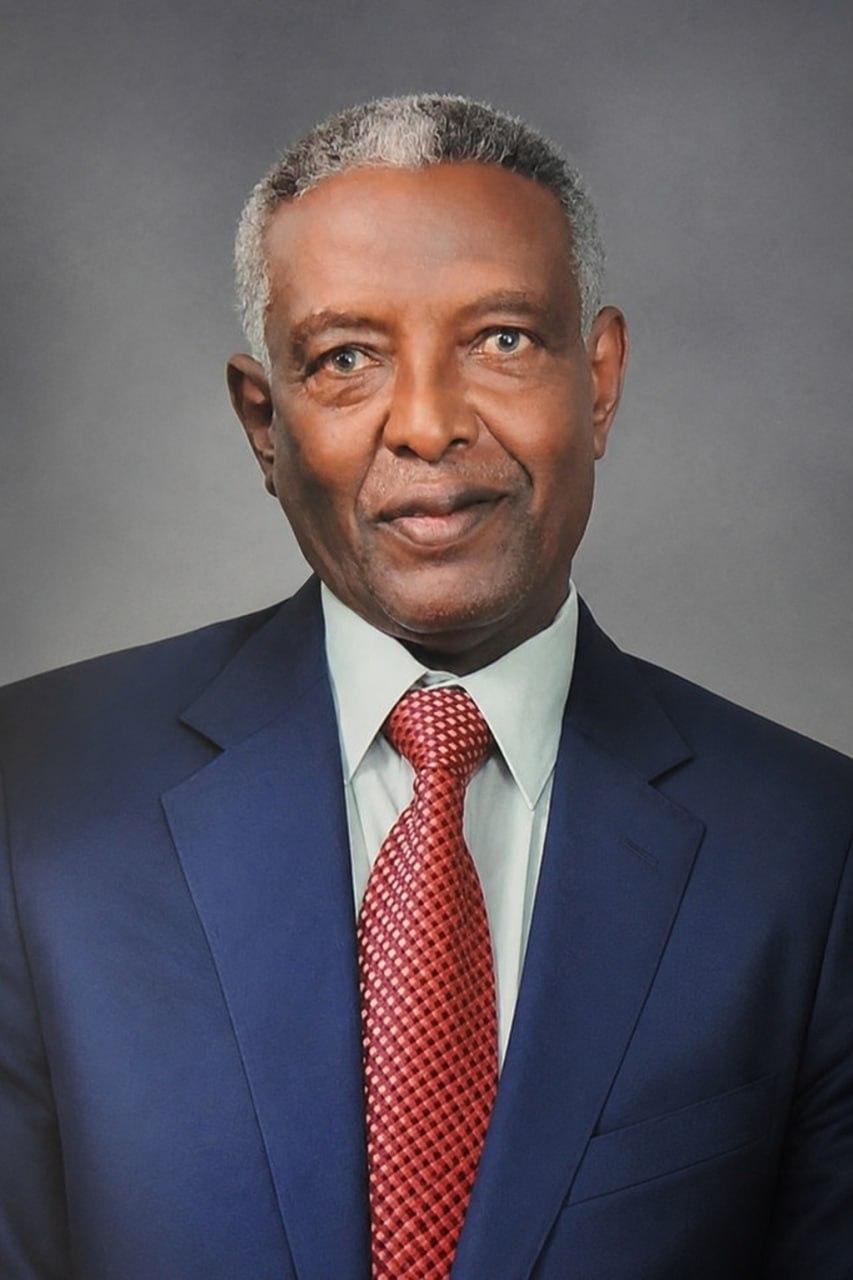

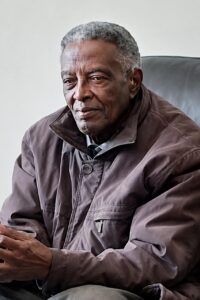
Goshu Moges
The first time my father was taken to prison, I was a toddler and did not know what prison was. When I asked where he had gone, my mother told me he had to go rest in a resort for a while. I was allowed to visit him on weekends.
And he played the part. He would stand among armed guards and smile, relaxed, as if he were indeed on vacation. He pressed a handful of sweets into my hands, bought from the prison shop, as proof that he was in a good place and having a good time. I believed him; I was three years old.
I grew up. I learned the bitter truth of imprisonment of conscience, of torture and oppression, and of what my father had endured throughout my entire childhood while pressing sweets into my hands and calling the prisons Kerchele, Maekelawi and Kaliti resorts.
Goshu Moges, founder and editor of Tobia, Ethiopia’s pioneering independent magazine; journalist, teacher, prisoner of conscience, and father; died on 4 June 2026 at his home in the Hayahulet neighbourhood of Addis Ababa, surrounded by family and neighbours. He was 89 years old. He died in his own home, in his own city, among his own people. For a man who had spent so much of his life inside prison walls, he experienced something that had not always been guaranteed to him: to remain where he belonged, among the people he loved.
For years, my father had told me in our conversations that he was ready. He had made amends with the people in his life. He had reconciled with God. After a lifetime of struggle, sacrifice, and searching, he left this world with a sense that his journey was complete. I am his youngest daughter, writing from Berlin. He is survived by my mother, Yitayish Mekonnen Beshir, his wife of 39 years, and their children.
He was born in 1936 in Debre Marqos to his father Moges Belete and his mother Fetenech Mihrete. Even as a schoolboy he stood out: his academic and athletic achievements at King Tekle Haymanot School earned him a gold medal from Emperor Haile Selassie I.
He went on to earn a diploma from Debre Birhan Teachers’ College and a degree from Addis Ababa University, where he served as student body president. For decades he worked as a teacher, then a school principal, then in supervisory roles at the Press Directorate and the Ministry of Domestic Trade. He was patient, methodical, and determined to build a life in public service.
When Ethiopia permitted an independent press in the early 1990s, my father was ready. With a group of colleagues, he co-founded Tobia, the newspaper and magazine that would become a symbol of independent Ethiopian journalism. He wrote under several pen names in addition to serving as its editor. As the government harassed and persecuted Tobia, it was forced to shut down. Later, he established another independent newspaper and magazine, Lisane-Hizb, serving as editor and contributing under the pen name ‘Orion’.
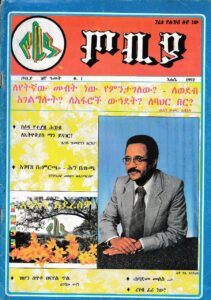
My father believed liberty began in the mind. His most prized possession was his freedom to think. No cell could hold that. No government ever did. And he died never surrendering his. But his conviction had a cost. My father’s commitment to truth did not come without consequences.
His arrests began when I was still a baby and continued throughout my childhood and teenage years. He was detained more than five times. He was arrested for his journalism. He was imprisoned for publishing information authorities did not want published. He was accused of crimes that carried severe consequences.
I remember the last time they came for him. It was the middle of the night. I heard boots land in our compound before I saw anything, men dropping over the walls. Then we were surrounded by armed federal police, rushed out of our beds and gathered in the living room. They searched every inch of the house. There was no warrant. We sat there through the night and into the afternoon as the inspector and his men worked their way through our home. At one point, officers accessed the ceiling with a ladder. Later, the inspector announced that a handgun and a grenade had been discovered there and belonged to my father. The claim struck us as absurd.
My father laughed out loud.
The inspector grew angry and began calling him names. My father was shoved, pulled, and loaded onto a military pickup packed with armed men, followed by a convoy of vehicles. I stood outside our compound with my family and watched him look back at us as they drove away. He was charged with treason and sentenced to ten years in prison.
This is the public record. What is not is the strong woman he depended on and that we depended on as children. Behind him, through all of it, was my mother. She is the other half of this story, and she should not be invisible in it. Every time he was taken, she became both parents at once. She kept food on the table. She managed the money and the household and the grief. She made sure that when he came back from prison, there was a home to come back to, holding the family together by sheer force of will and love. She did this not as someone merely enduring her husband’s choices, but as someone who shared his convictions entirely. The editorial office of the Lisane-Hizb newspaper was in our home, and she was there, present, part of it. She made his life’s work possible.
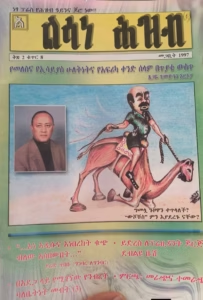
My father was also a man of humor. His sarcasm was sharp, his jokes intelligent, and his command of the Amharic language extraordinary. Even when surrounded by armed men, he found ways to make remarks that they did not understand but we did.
At home, he was a progressive man in a society where many expectations were fixed. He prepared our baby formula bottles, fed and clothed us. He participated fully in raising us in a culture and at a time when many people believed such responsibilities belonged only to women.
He did not demand that we inherit his opinions. Instead, he invited us into conversations. He debated with us. He challenged us. In our home, we discussed everything from existential questions to Ethiopian politics to philosophy and religion.
He had one rule: education. He believed our minds were our greatest assets, and he expected us to use them fully. Everything else; dress, temperament, opinion, identity; was ours. As his youngest daughter, I was never told to behave as a girl, never directed to the kitchen, never handed a feminine script. I dressed as I wanted. I cut my hair short. I played with boys, fought with boys, and came home with scars that proved it.
In a country where political opinions were whispered at home, he would take me on walks; government informants trailing behind us, and state his opinions loudly, on the street, for anyone to hear. He did not only write his convictions; he theatrically performed them, to break the chilling silence the government tried to impose on all of us. As a child I could not fully comprehend the significance of that defiance, or the intrigue of the watching faces across the street. I only knew that my father was not afraid. He protested oppression in every way he could, and he lived as an example for his children.
Ethiopia today is still a place where journalists remain at risk of imprisonment for their opinions. To his last day, my father’s wish was that we would become a land of free thinking and free expression. He hoped Ethiopians would fight for freedom of thought as successfully as we once fought against slavery and colonialism. He understood that independence is not only a physical state but a mental one; that it begins in the individual mind, in the right to think a thought and say it plainly. He died still hoping for a free Ethiopia.
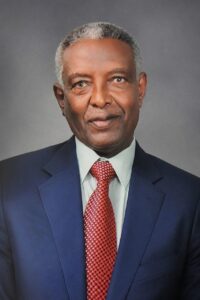
Gosh Moges at retirement
My father was a journalist. He was a prisoner of conscience. He was a defender of free expression. But before all of that, he was a man who lived freedom. And that is the legacy he leaves behind.
The post The Man Who Refused to Be Silenced appeared first on African Arguments.