Two European powers throw their weight behind Morocco as Algeria challenges its claim to the disputed Sahara territory
Both Denmark and Greece have formally thrown their support behind Morocco’s Western Sahara autonomy initiative, marking a major diplomatic win for Rabat as it continues to secure critical backing across Europe.
 Black News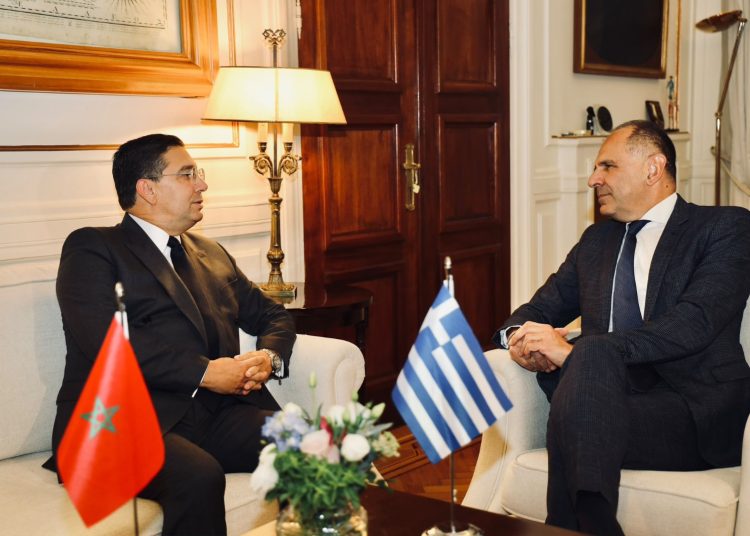

Both Denmark and Greece have formally thrown their support behind Morocco’s Western Sahara autonomy initiative, marking a major diplomatic win for Rabat as it continues to secure critical backing across Europe.
- Denmark and Greece have officially endorsed Morocco's Western Sahara autonomy initiative.
- Denmark praised the autonomy plan as a 'serious and credible framework' and pledged to deepen bilateral cooperation.
- Greece reiterated its support, labeling the Moroccan proposal as the 'most feasible solution.'
- High-level meetings concluded with commitments to expand cooperation between Morocco and both European nations.
This double endorsement from two European nations strengthens the international momentum behind Morocco's sovereignty framework and positions its proposal as a realistic pathway toward a peaceful resolution under the auspices of the United Nations.
Denmark aligns with Morocco on regional autonomy plan
According to Atalayar, Denmark has officially welcomed Morocco’s autonomy proposal, perceiving it as a "serious and credible framework" to resolve the long-standing Western Sahara dispute.
DON'T MISS THIS: Greece Reaffirms Support for Morocco’s Autonomy Plan for Western Sahara
During a high-level meeting between Danish Foreign Minister Lars Løkke Rasmussen and Moroccan Foreign Minister Nasser Bourita, Copenhagen praised the plan as a "serious and fundamental contribution" to the ongoing negotiations.
As an active member of the UN Security Council, Denmark’s endorsement carries substantial weight in guiding the international dialogue toward a consensual agreement between Morocco and the Algeria backed Polisario Front.
The Moroccan plan stipulates that the Sahara would operate as an "autonomous region within the Moroccan state," granting the territory extensive decentralized administrative, political, and economic powers.
Alongside this diplomatic alignment, Denmark and Morocco are moving to expand their bilateral ties.
DON'T MISS THIS: A $1 billion highway, a U.S.-backed green project and Trump's letter: How Western Sahara became a new focus of U.S.-Morocco ties
As reported by Atalayar, the two nations have established a shared agenda to boost commercial exchanges and co-investment in key sectors such as green energy, agriculture, water technology, and migration management.
Greece backs Morocco as Athens hosts high-level diplomatic talks
In a similar diplomatic breakthrough, Morocco World News recently reported that Greece has reaffirmed its backing for the Moroccan autonomy plan, calling it a potential "most feasible solution" to end the regional dispute.
Following a bilateral meeting in Athens, Greek Foreign Minister George Gerapetritis expressed his country's strong alignment with the European Union’s approach to the conflict.
Gerapetritis declared that Greece “fully supports the efforts undertaken by the Personal Envoy of the UN Secretary-General to conduct negotiations, based on the Moroccan autonomy proposal, with a view to reaching a just, lasting and mutually acceptable solution”.
![Moroccan flags are seen at the Jemaa el-Fnaa in Marrakesh, Morocco, on April 25, 2026. [Photo by Jakub Porzycki/NurPhoto via Getty Images]](https://ocdn.eu/pulscms/MDA_/1941ddabbb304fb807e7d1a6bbbb6750.jpg)
Greece, which holds a non-permanent seat on the UN Security Council for the 2025-2026 term, welcomed the adoption of UN Resolution 2797, which promotes peaceful progress in the territory.
DON'T MISS THIS: U.S. finally steps in to ease Morocco-Algeria rift over Western Sahara as Russia’s influence wanes in North Africa
This diplomatic visit by Morocco’s Minister of Foreign Affairs, Nasser Bourita marked the first time in over three decades that a Moroccan foreign minister has traveled to Greece at this level.
The meeting concluded with both countries agreeing to draft a formal roadmap to strengthen and expand their cooperation in trade, maritime transport, green energy, defense, and tourism.
The Western Sahara Sovereignty Dispute and Algeria's Support for the Polisario Front
Western Sahara was a Spanish colony until the mid-1970s, after which Morocco and Mauritania partitioned the region, leading the pro-independence Polisario Front to launch a guerrilla war in 1975.
Morocco annexed the entire territory after Mauritania withdrew in 1979. Today, the sovereignty dispute remains unresolved:
Morocco controls more than three-quarters of the land, while the Sahrawi Arab Democratic Republic (SADR), representing the Indigenous Sahrawi people, also claims sovereignty.
The conflict is the main cause of the regional rivalry between Morocco and Algeria.
According to the Council on Foreign Relations (CFR), Algeria actively supports the Polisario Front : "In 1975, the Polisario Front relocated its headquarters to the town of Tindouf in Algeria, which has since provided the group with military aid and allowed it to operate out of Algerian territory".
This military assistance and political backing deepened regional divide, culminating in Algeria severing diplomatic ties with Morocco in 2021.