12M+ Dot Show = 100 Migrants: Breaking Down the Migration Data Elon Musk Shared
On X, Elon Musk shared a visualization with the caption: “That’s a lot of illegal immigrants. Each. Dot. Represents. 100. Migrants. This is what an invasion looks like: 12M+ from 2008 to 2024. Nearly 14M if not more as at 2026.” The post raises a core question: Is this migration or movement of people from […]
 Black News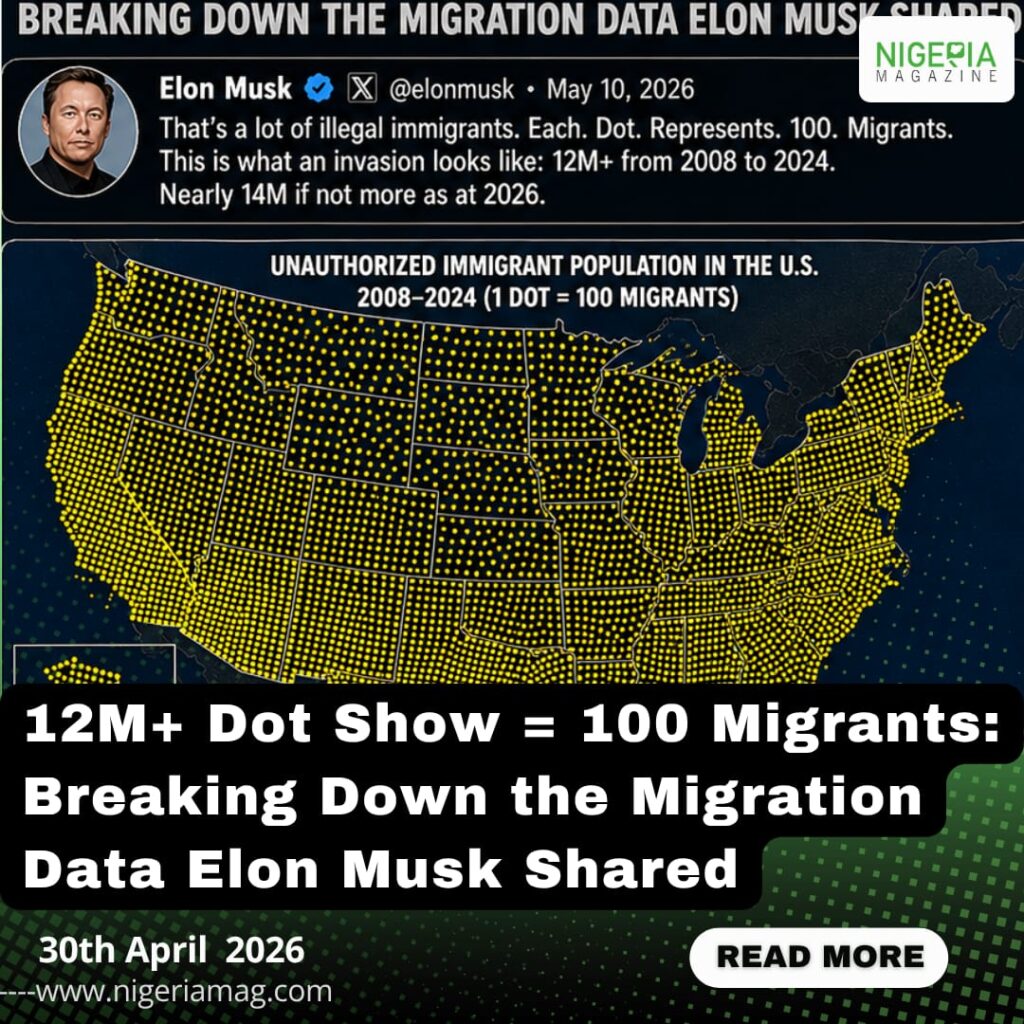
On X, Elon Musk shared a visualization with the caption: “That’s a lot of illegal immigrants. Each. Dot. Represents. 100. Migrants. This is what an invasion looks like: 12M+ from 2008 to 2024. Nearly 14M if not more as at 2026.”
The post raises a core question: Is this migration or movement of people from one region to another in the world?
What the post shows
The map uses dots to represent scale — 1 dot = 100 people — totaling over 12 million individuals between 2008–2024, with a projection to nearly 14 million by 2026. The framing calls it an “invasion,” linking the volume of unauthorized border crossings to national security and policy concerns.
What “migration” means
Migration is the movement of people from one place to another, often to seek work, safety, or family reunification. It includes legal immigration, asylum seekers, refugees, and unauthorized entry. Every country has categories for each. The UN defines “migrant” broadly as any person who changes their country of usual residence.
What “illegal immigration” means in policy terms
In U.S. law, “illegal immigrant” generally refers to foreign nationals who enter without inspection or who overstay a visa. The 12M+ figure aligns with estimates from DHS and Pew Research of the total unauthorized immigrant population living in the U.S., which has fluctuated between 10.5M–12M since 2008. “Gotaways” and recent border encounters 2021–2024 add to annual totals, driving projections toward 14M.
“Invasion” vs “Movement”
The word “invasion” is political language, not a legal term in immigration law. It frames migration as a military or security threat. “Movement” or “migration” are demographic terms describing population flow. The same 12M dots can be described as labor migration, humanitarian movement, or unauthorized entry — the data stays the same, the framing changes the interpretation.
Why scale matters
12M–14M people over 16–18 years equals ∼700K–800K per year on average. For context: The U.S. admits ∼1M legal permanent residents annually. U.S. births are ∼3.6M per year. So unauthorized migration is significant, but it’s one component of overall population change alongside legal immigration, births, and deaths.
The takeaway: Maps and dots show scale. Words like “migration” vs “invasion” show perspective. Understanding both helps separate data from debate. Policy responses depend on which lens lawmakers use — economic, humanitarian, or security.
Source note: The X post is dated 2026. For official figures, refer to DHS Office of Immigration Statistics, CBP Encounters Data, and Pew Research Center unauthorized immigrant estimates.