Africa’s Digital Backbone: $300 Million Investment Accelerates the Continent’s Digital Transformation
Africa’s digital transformation is entering a new phase, and the infrastructure required to power it is attracting increasingly strategic investment. The latest signal is a US$300 million investment in WIOCC.
 Black News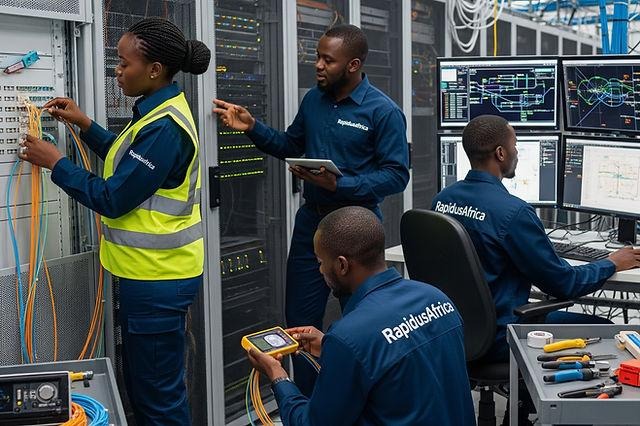
Africa’s digital transformation is entering a new phase, and the infrastructure required to power it is attracting increasingly strategic investment. The latest signal is a US$300 million investment in WIOCC Group by Africa Finance Corporation (AFC) and Vision International Investment Company, announced in September 2026.
The investment will support the expansion of data centres, terrestrial fibre networks and strategically selected subsea infrastructure across Africa. More importantly, it highlights a growing recognition that digital infrastructure is no longer simply a telecommunications issue. It is becoming a foundation for economic competitiveness, artificial intelligence, financial inclusion, public services and regional integration.
READ ALSO: African Green Banks: De-risking Renewable Projects for Private Investment Growth
Building the Infrastructure Behind Africa’s Digital Economy
WIOCC operates across more than 30 African countries and has developed an open-access digital infrastructure platform connecting businesses and digital ecosystems. Its infrastructure portfolio includes terrestrial fibre, subsea connectivity and data-centre capacity. The new capital is expected to accelerate data-centre deployment and consolidation, extend open-access fibre into new markets, and strengthen international connectivity through additional subsea assets.
The timing is significant.
According to the International Telecommunication Union (ITU), only 35.7% of Africa’s population used the internet in 2025, compared with a global average of 73.6%. The gap highlights both the scale of Africa’s digital infrastructure deficit and the opportunity available to investors, governments, and technology companies.
For African economies seeking to move beyond dependence on raw commodities, closing that gap is increasingly strategic.
From Connectivity to Economic Transformation
Reliable digital infrastructure determines whether businesses can access cloud computing, whether financial institutions can deliver digital services efficiently, whether governments can build effective digital public infrastructure and whether African companies can participate competitively in the global digital economy.
Artificial intelligence makes this even more urgent.
AI applications require significant computing power, data storage, reliable networks and secure data infrastructure. Without these foundations, African countries risk becoming consumers of technologies developed elsewhere rather than participants in their creation and ownership.
This is why investments such as the WIOCC transaction carry significance beyond the technology sector. They can support the development of local digital businesses, create demand for skilled professionals and enable African economies to capture more value from data-driven industries.
The next challenge is ensuring that digital infrastructure investment translates into African digital capability.
Governments must create regulatory environments that encourage long-term infrastructure investment while protecting competition, data security and consumer interests. Development financiers should continue backing infrastructure that connects markets rather than isolated national projects.
African businesses, meanwhile, must be positioned to use this infrastructure to build regional platforms, expand across borders and develop home-grown solutions in areas such as fintech, health technology, agriculture, logistics and AI.
The opportunity is therefore not simply to connect Africa to the internet. It is to build an African digital economy capable of generating significant value from that connectivity.
Turning Infrastructure into Opportunity
The US$300 million WIOCC investment demonstrates that global and African investors increasingly recognise digital infrastructure as a strategic asset.
The responsibility now lies with African leaders to ensure that infrastructure expansion is matched by digital skills, affordable access, reliable electricity, supportive regulation and stronger regional markets.
Africa’s digital future will not be determined by connectivity alone. It will be determined by what Africans build on top of that connectivity.
The priority should therefore be clear: invest not only in the networks that connect Africa, but in the people, enterprises and innovations that can turn those networks into engines of African economic transformation.