AI Attack on Black: Tech Lynchings & Cyber Discrimination 101
*Artificial Intelligence is not the devil. Let us begin there. AI is not some evil machine sent to destroy humanity, nor is it a mysterious force beyond our control. It is, however, another industrial revolution—perhaps the most powerful one since the cotton gin, the steam engine, and the internet itself. This is the cyborg chapter […] The post AI Attack on Black: Tech Lynchings & Cyber Discrimination 101 appeared first on EURweb | Black News, Culture, Entertainment & More.
 Black News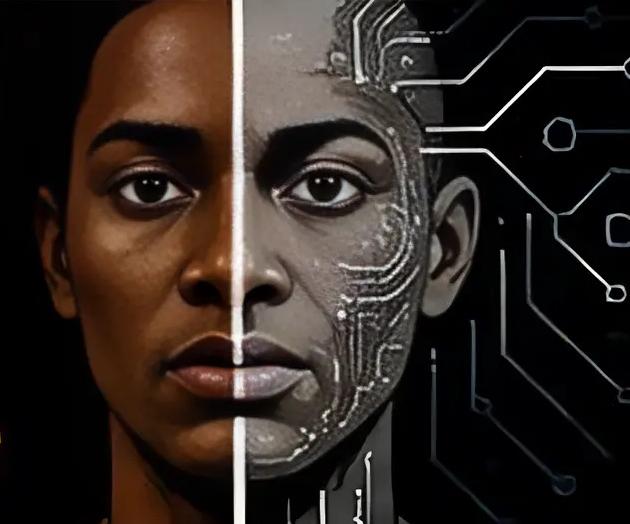
*Artificial Intelligence is not the devil. Let us begin there.
AI is not some evil machine sent to destroy humanity, nor is it a mysterious force beyond our control. It is, however, another industrial revolution—perhaps the most powerful one since the cotton gin, the steam engine, and the internet itself. This is the cyborg chapter of the human revolution. And like every revolution before it, it raises one central question: Who benefits, and who gets left behind?
For Black Americans, that question is not theoretical. It is historical.
Before there was artificial intelligence, there was Black intelligence—exploited, extracted, and often erased. Long before America embraced the term “white,” the colonies depended on African labor as the original engine of forced productivity. In many ways, enslaved Africans were the original “AI before AI”—the hands, minds, and bodies that built wealth for others while being denied humanity themselves.
They were not born slaves. They were made into slaves.
The Africans kidnapped and brought to the Americas were artisans, philosophers, engineers, agriculturalists, doctors, chefs, builders, linguists, and leaders. Many Africans were already present in the Americas before the transatlantic slave trade reached its height. These were not unskilled people waiting to be civilized; they were highly developed human beings whose labor, intellect, and systems of knowledge transformed the Western Hemisphere.
At the same time, we must be honest about another uncomfortable truth: much of Europe did not send its best to the colonies. America inherited many of the most uneducated, unskilled, and unwanted populations of Europe. Georgia itself began as a penal colony—similar in many ways to Australia under the English Crown. Yet somehow history was rewritten to paint Africans as primitive and Europeans as superior.
That lie still lives today—only now it has Wi-Fi.
Artificial Intelligence reflects the values of the people who build it. If racism exists in society, racism will exist in code. If sexism exists in hiring, sexism will exist in algorithms. If healthcare systems undervalue Black lives, AI trained on those systems will do the same.
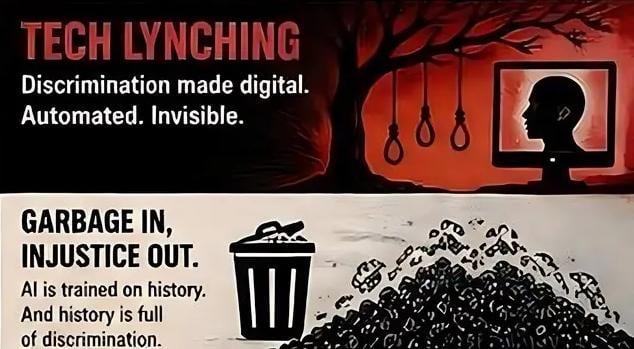
This is what I call tech lynching: discrimination made digital, automated, and often invisible.
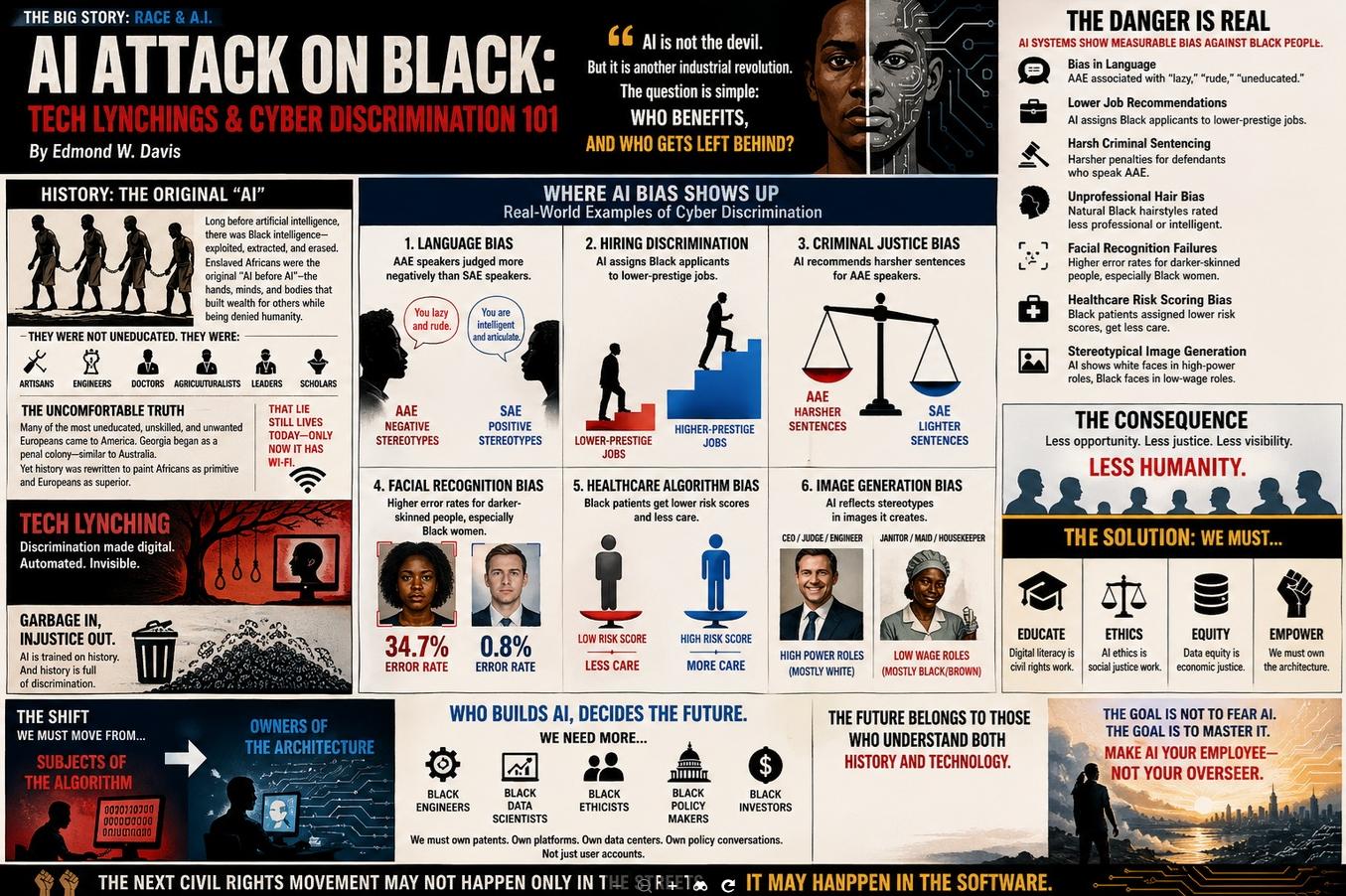
Research continues to prove what many already suspected. Large language models show measurable bias against African American English (AAE), associating Black speech patterns with words like “lazy,” “rude,” or “uneducated,” while Standard American English is associated with intelligence and professionalism. The same content, spoken differently, receives different judgments.
Imagine applying for a job and your résumé is silently downgraded because your language reflects your culture.
That is not innovation. That is cyber discrimination.
Studies have shown AI systems assigning Black applicants to lower-prestige jobs, recommending harsher criminal sentencing for defendants whose speech resembles African American English, and ranking Black women’s natural hairstyles—braids, locs, afros—as less professional or less intelligent than white hairstyles.
Facial recognition systems have repeatedly shown dramatically higher error rates for darker-skinned people, especially Black women. Research by scholars like Joy Buolamwini found that while AI could identify white male faces with near perfection, it failed Black women at alarming rates. That is not just inconvenient—it becomes dangerous when those same systems are used in policing, surveillance, airports, and criminal investigations.
Ask yourself: if the machine cannot see you correctly, how can it judge you fairly?
In healthcare, the consequences are even more deadly. Widely used hospital algorithms have been shown to assign Black patients lower risk scores than equally sick white patients—not because they were healthier, but because the system used healthcare spending as a proxy for need. Since Black communities historically spend less due to unequal access, the algorithm concluded they needed less care.
Less treatment. Less urgency. Less humanity.
That is not a glitch. That is structural racism with software.
Image generators create another quiet violence. Ask AI to show you a CEO, a judge, or an engineer, and you will likely get a white man. Ask for a janitor, maid, or housekeeper, and the faces become darker. Ask for beauty, and darker skin is often lightened. Ask for professionalism, and Black features are often erased.
White supremacy has entered the machine.
And perhaps most dangerous of all is that people trust machines more than people. When AI makes a biased decision, many assume it must be objective because “the computer said so.” But algorithms are not neutral. They are trained on history, and history is full of discrimination.
Garbage in, injustice out.
This should concern everyone, but especially Black communities. We cannot afford to become intellectual sharecroppers in the digital South—where our language, our culture, our creativity, our labor, and even our facial features are harvested for profit while we remain excluded from ownership.
We must move from being subjects of the algorithm to owners of the architecture.
Digital literacy must become civil rights work.
AI ethics must become social justice work.
Data equity must become economic justice work.
We need more Black engineers, Black ethicists, Black data scientists, Black coders, Black policy makers, and Black investors shaping the future of AI. We need classrooms teaching not just how to use ChatGPT, but how to question the systems behind it. We need young people to understand that AI should be their employee—not their overseer.
This is why I continue to say HBCU + AI is not a trend; it is a survival strategy.
Historically Black Colleges and Universities must become the frontlines of technological liberation. If Black students are trained only to consume technology rather than build it, we will repeat history. We must own patents, platforms, data centers, and policy conversations—not just user accounts.
The future belongs to those who understand both history and technology.
If we do not shape AI, AI will shape us.
And if we do not demand justice in the code, injustice will simply become faster, cheaper, and harder to detect.
The goal is not to fear AI.
The goal is to master it.
Make AI your employee—not your overseer.
Because the next civil rights movement may not happen only in the streets.
It may happen in the software.
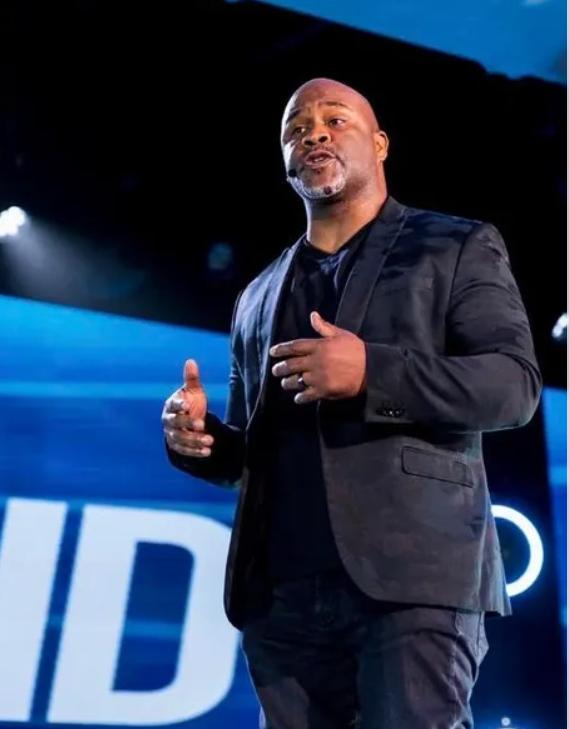
ABOUT THE AUTHOR:
Edmond W. Davis is an American social historian, international speaker, and Amazon #1 bestselling author. He is a global authority on the Tuskegee Airmen and serves as the founder of the National HBCU Black Wall Street Career Fest. A native of Philadelphia, PA, and currently resides in the Little Rock, Arkansas, area. Davis is committed to cultural empowerment and educational equity through storytelling and civic engagement. Davis is a Grand Marshal at the 38th Annual African American History Month Celebration Parade.
(If You Like/Appreciate This EURweb Story, Please SHARE it!)
MORE NEWS ON EURWEB.COM: Black Teens Lead in AI Use for Schoolwork, Pew Survey Shows
We Publish Breaking News 24/7. Don’t Miss Out! Sign up for our Free daily newsletter HERE.
The post AI Attack on Black: Tech Lynchings & Cyber Discrimination 101 appeared first on EURweb | Black News, Culture, Entertainment & More.