Battle of the Polls: Valencia to Face Cepeda in Second Round
A new national survey suggests Colombia’s 2026 presidential race is shaping into a high-stakes runoff between Iván Cepeda and conservative rival Paloma Valencia, with the first round on May 31 favoring the left-wing senator, but the second round – on June 21 – projecting a narrow victory for the Centro Democratico candidate. The latest poll […]
 Black News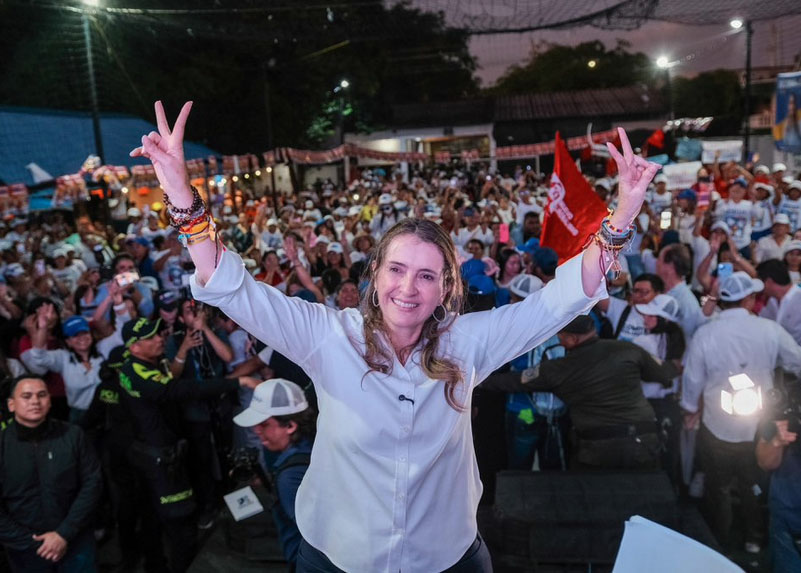
A new national survey suggests Colombia’s 2026 presidential race is shaping into a high-stakes runoff between Iván Cepeda and conservative rival Paloma Valencia, with the first round on May 31 favoring the left-wing senator, but the second round – on June 21 – projecting a narrow victory for the Centro Democratico candidate.
The latest poll by Fundación Génesis Crea places Cepeda at the top of voter intention for the first round with 35.1%, followed by Valencia with 25.4% and lawyer Abelardo de la Espriella with 21.6%, signaling an increasingly polarized contest just weeks before Colombians head to the polls.
The survey, conducted between May 4 and May 11 across 134 municipalities and 24 departmental capitals, interviewed 4,352 citizens and presents one of the most detailed snapshots yet of the country’s electoral mood ahead of what many analysts are calling the most decisive presidential vote in years.
Despite Cepeda’s strong lead in the opening round, the numbers suggest a dramatic reversal in a hypothetical runoff. In a second-round scenario against Valencia, the senator from the Democratic Center would secure 48.3% of the vote, compared to 45.6% for Cepeda, while blank votes would account for 6.1%.
The findings indicate that while Cepeda commands a consolidated progressive base, Valencia could benefit from a broader anti-government coalition in a runoff, uniting conservative, centrist and undecided voters wary of continuity with President Gustavo Petro’s political project.
Against other rivals, Cepeda performs more strongly. He would defeat De la Espriella with 46.5% to 41.4%, and also surpass former Bogotá mayor Claudia López with 47.2% to 40.2%, though blank voting would remain unusually high at around 12% in both matchups.
The poll also reflects the deep national divide over Petro’s presidency. Some 51.2% of respondents reported an unfavorable image of the president, while 44.6% viewed him positively. By contrast, former president Álvaro Uribe Vélez registered a 50.4% favorable rating, with 48.3% holding an unfavorable view.
These figures reinforce the enduring political influence of Uribe, whose legacy continues to shape right-wing mobilization, while Petro faces growing criticism over security concerns, economic uncertainty and the faltering progress of his “Total Peace” agenda.
Beyond the top three contenders, voter preference remains fragmented. López registers 3.6%, followed by Sergio Fajardo at 2.9%, while other names such as Roy Barreras, Mauricio Liscano and Carlos Caicedo remain below 1%.
Blank voting stands at 3.2%, while 5.4% of respondents said they remain undecided — a figure that could prove decisive in an increasingly volatile campaign season.
The study reports a margin of error of ±1.485% and a 95% confidence level, with data weighted according to official demographic indicators from the Dane and the National Civil Registry. The sample covered all major regions of Colombia, including the Caribbean, Pacific, Coffee Region, Llanos and Amazon basin.
With just two weeks before the first decisive round, the poll confirms that Colombia is heading toward an electoral confrontation defined less by ideological persuasion than by rejection: a battle between those seeking continuity with Petro’s leftist administration and those determined to stop it.
For now, Cepeda leads the first charge. But if the runoff materializes as projected, Paloma Valencia may be waiting at the finish line.