Beyond “Africans sold Africans”: What Ghana’s UN slavery motion demands
Almost immediately after the vote, critics in Ghana and beyond have argued that Africans, having participated in the slave trade, cannot frame it as the gravest crime against humanity and seek reparations without first confronting their own complicity
 Black News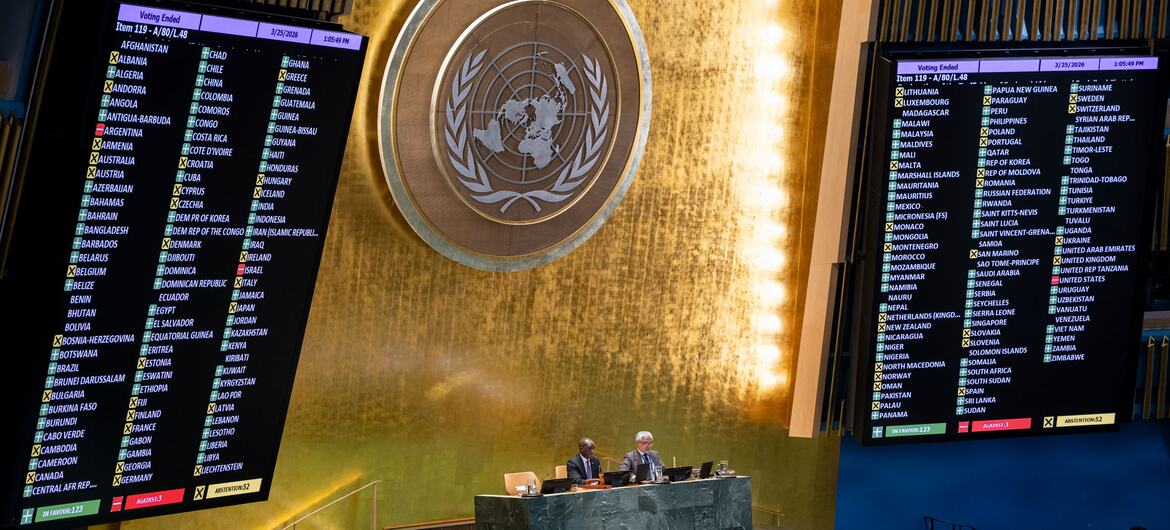


On 25 March 2026, Ghana tabled a motion at the United Nations (UN) seeking to declare the transatlantic slave trade and slavery as the “gravest crime against humanity”. The resolution, which passed with 123 votes in favour and 52 abstentions, with only Argentina, Israel and the United States voting against, marks a decisive, if non-binding, shift in international accountability architecture.
Commenting on the resolution, Ghana’s President John Dramani Mahama, who is leading the push for reparations as mandated by the African Union in 2023, described the moment in both solemn and urgent terms: “The adoption of this resolution serves as a safeguard against forgetting. Let it be recorded that when history beckoned, we did what was right for the memory of the millions who suffered the indignity of slavery.” His statement reflects both the historical significance of the resolution and the beginning of a more difficult conversation about what comes next. One of the areas where this conversation is unfolding is the question of African complicity in the slave trade. While this question carries some intuitive appeal, because African participation appears to complicate the assigning of responsibility to external actors alone, its weaknesses become evident when closely interrogated and contextualised.
The resolution in legal and moral context
The UN resolution stressed the trafficking and racialised chattel enslavement of Africans as the gravest crime against humanity “by reason of the definitive break in world history, scale, duration, systemic nature, brutality and enduring consequences that continue to structure the lives of all people through racialised regimes of labour, property and capital”. This language is a considered legal designation grounded in fundamental principles of international law. Ghana’s foreign minister, Samuel Okudzeto Ablakwa, pointed to the 2002 Rome Statute of the International Criminal Court (ICC), which classifies enslavement as a crime against humanity, and argued that addressing it is a responsibility owed to the global community, not just one between individual states. This framing shifts the conversation from sentiment to obligation.
The UN resolution urges member states to engage in dialogue on reparations, including formal apologies, the return of stolen artefacts, financial compensation and guarantees of non-repetition. While the General Assembly’s resolutions are non-binding, they carry persuasive weight and reflect prevailing international consensus. In the context of justice for mass atrocities, such moments of recognition often come before binding legal actions, as seen in earlier global responses to apartheid, the recognition of genocide as a crime against humanity, and the eventual establishment of the International Criminal Court.
African “complicity”?
Almost immediately after the vote, critics in Ghana and beyond argued that Africans, having participated in the slave trade, cannot frame it as the gravest crime against humanity and seek reparations without first confronting their own complicity. Indeed, some kingdoms and merchants on the African continent participated in the capture and sale of people to European traders and profited from the process. Yet assigning equal moral culpability to African intermediaries and European states is a grave misrepresentation. The UN resolution neither denies African involvement in slavery nor rests on claims of moral innocence. Rather, it asks us to recognise the transatlantic slave trade as a historically specific system of organised, racialised and global violence. Responsibility in this regard requires three important considerations.
The first is scale and structure. Pre-colonial African societies practised forms of slavery that, while morally indefensible by contemporary standards, differed fundamentally in character from the transatlantic system. Enslaved persons in many African societies retained certain rights, could earn freedom, and were not subjected to the hereditary, racialised, biological theory of permanent subhuman status that defined chattel slavery in the Americas. The transatlantic system did not merely export enslaved bodies: it exported and industrialised a racist ideology that reclassified an entire continent of people as private property.
The second is power asymmetry. European demand for enslaved labour was insatiable and was backed by military, commercial and naval dominance that profoundly shaped the conditions under which African actors operated. For more than 400 years, millions of people were stolen from Africa, put in shackles and shipped to the Americas. The African states and merchants who supplied captives to European traders were responding to — and were often destabilised by — a demand they did not create and a system they did not design, finance or ultimately control. To treat these actors as equivalent is to overlook the asymmetries that made the system possible in the first place.
Additionally, as the trade evolved, most African kingdoms were drawn into and eventually subordinated within expanding European imperial structures as colonies. This further complicates any straightforward attribution of responsibility to modern African states that did not exist in their current form at the time. It is not that African involvement disappears under this lens. Rather, the form and scale of responsibility cannot be mapped neatly onto contemporary political entities without attending to these historical transformations.
The third is the institutional focus of the UN resolution. Related to the second point, the resolution’s target is not the guilt of individuals or even of communities but of states and their successors. Therefore, the reparations conversation is directed at governments such as those of the United Kingdom, France, Portugal, the Netherlands, Spain, Sweden, Denmark and the United States, among others, whose state institutions accumulated capital, enacted slave codes and used law and force to build and sustain the system across generations. No African kingdom built the legal infrastructure of chattel slavery nor created the plantation economy and the financial instruments that capitalised it.
Why this debate persists
The persistence of the “Africans sold Africans” argument reflects unease on both the African and European sides, though the sources of that unease differ. On the African side, it reflects a struggle with the moral implications of historical participation, while on the European side, it often operates to deflect attention from the structural organisation of the system and the responsibilities that arise from it. The voting patterns at the United Nations reflect a version of this unease, especially among the European powers. While the resolution secured broad support, the pattern of abstentions and the states that opposed it suggest that recognition, even at the level of principle, carries implications that many governments remain hesitant to confront.
After the resolution, what next?
The African Union has designated 2026 to 2036 as the Decade of Action on Reparations. The resolution provides the multilateral framework upon which concrete mechanisms must now be built. Ghana’s foreign minister, Samuel Ablakwa, put it plainly: “History does not disappear when ignored, truth does not weaken when delayed, crime does not rot … and justice does not expire with time.” This resolution has provided the institutional and international backing for conversations around apology, restitution and the possibility, however contested, of compensation to follow.
The question of African participation in the slave trade is part of these conversations and deserves its own reckoning within African societies. However, this reckoning must not be weaponised to delay or deflect the far larger and more consequential accounting owed by the states that built their wealth and power on the bodies of enslaved Africans. Any attempt to equate the African and European actors in the transatlantic slave trade is a historical distortion and, in itself, constitutes further injustice.
The UN resolution was not justice delivered. It was justice named. The hard work of actualising it begins now.
Dr Kofi Bediako is a senior researcher/postdoctoral research fellow at the University of Pretoria’s Centre for the Advancement of Scholarship.