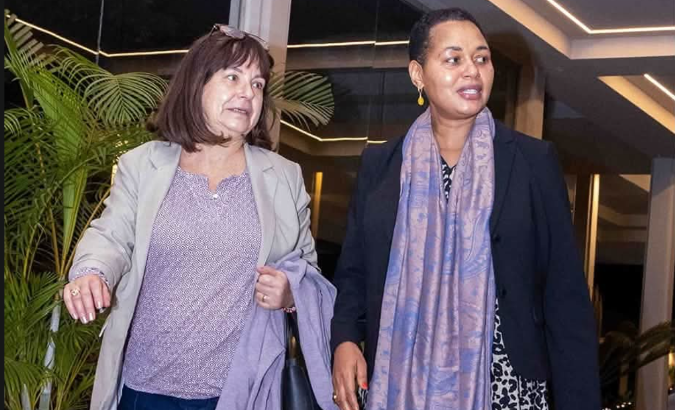
Beyond Ambition: The DIB-Chericoco Walk And APC Unity
By Cornelius Oguntola Melvin Deveaux Last weekend’s community health walk organized by the Brookfield Veterans Organization may have seemed like an ordinary civic event. Yet beneath its modest appearance lay a political message of considerable significance for the All People’s Congress (APC), a party whose prospects for 2028 depend as much […]
 Black News

By Cornelius Oguntola Melvin Deveaux
Last weekend’s community health walk organized by the Brookfield Veterans Organization may have seemed like an ordinary civic event. Yet beneath its modest appearance lay a political message of considerable significance for the All People’s Congress (APC), a party whose prospects for 2028 depend as much on internal unity as on electoral strategy.
In a presidential flagbearer race increasingly shaped by competing camps and rival loyalties, the public display of solidarity between presidential flagbearer aspirants Dr Ibrahim Bangura and Hon. Chernoh Ramadan Maju Bah (Chericoco) offered a powerful reminder of the cohesion the party must cultivate if it hopes to return to power in 2028.
Their appearance side by side was more than a symbolic gesture. It represented a visible demonstration of mutual respect, political maturity, and a shared commitment to the long-term unity and strength of the APC.
At a time when discussions about the party’s future are increasingly dominated by questions of succession, strategy, and internal cohesion, their camaraderie provided a refreshing glimpse of the collective spirit many party faithful have long advocated.
More importantly, it underscored a fundamental political truth: ambition and unity need not be mutually exclusive.
Leadership contests are an essential feature of democratic politics, but they must not come at the expense of party cohesion. If the collaborative spirit exhibited by Dr Bangura and Chericoco is embraced and replicated by other aspirants, it could help foster the solidarity, discipline, and sense of common purpose necessary to position the APC for a stronger and more credible challenge in 2028.
Indeed, the question of unity among prospective flagbearers continues to dominate discussions within APC circles and among political observers. Electoral success is influenced by numerous factors, including policy alternatives, campaign organization, voter mobilization, public perception, and prevailing national conditions. Nevertheless, few would dispute that internal cohesion remains one of the most critical ingredients for any political party seeking national power.
To be sure, electoral outcomes are rarely determined by a single factor. Economic realities, incumbency advantages, campaign effectiveness, electoral administration, and voter sentiment all play significant roles in shaping political outcomes. Yet history consistently demonstrates that internal divisions can undermine even the most competitive political movements, while unity often enhances a party’s ability to persuade, mobilize, and govern effectively.
The APC’s recent electoral history illustrates this reality. In 2018, Dr Samura Kamara lost the presidential runoff by fewer than 100,000 votes, securing 48.2 percent of the vote against Julius Maada Bio’s 51.8 percent. Five years later, the party again entered a highly contested election amid widespread concerns regarding internal cohesion. In both electoral cycles, the APC entered the contest confronting perceptions of fragmentation rather than projecting itself as a unified political movement bound by a common purpose.
For many within the party, those experiences reinforced the belief that electoral competitiveness alone is insufficient without organizational discipline and collective resolve.
The aftermath of both elections prompted considerable introspection. Questions were raised about whether a more united front among party leaders, stakeholders, and supporters could have altered the political landscape. Many members concluded that internal rivalries and factional tensions diminished the party’s ability to fully harness its extensive support base across the country.
Political history offers a consistent lesson: opposition parties rarely prevail when internal competition eclipses collective ambition. Electoral victories are not secured solely through popular candidates, persuasive manifestos, or sophisticated campaign machinery. They also depend on the willingness of party leaders, aspirants, and supporters to subordinate personal interests to broader political objectives.
This reality makes the APC’s internal dynamics particularly consequential as preparations for 2028 gather momentum. Should the divisions that characterized previous electoral cycles persist, the party risks entering another national contest burdened by the very challenges many supporters believe contributed to its past disappointments. A fragmented organization invariably struggles to project confidence, discipline, stability, and readiness for governance.
Against this backdrop, last weekend’s community health walk assumes even greater significance.
The importance of the event was heightened by developments in the days preceding it. Following a public opinion poll conducted by the Campaign for Human Rights and Development International (CHRDI), spirited exchanges emerged on social media among supporters of both aspirants regarding their respective popularity and electoral prospects. Although such debates are common in political contests, they also exposed the potential for factional tensions to overshadow the broader interests of the party.
It was therefore particularly encouraging to witness Dr Ibrahim Bangura and Chericoco participating together in a community service initiative. Their interaction generated positive commentaries across sections of the party and sent a reassuring message to supporters that healthy competition need not descend into hostility.
While some may regard such appearances as routine, their political significance should not be underestimated. In an era in which leadership contests frequently breed suspicion, entrenched camps, and unnecessary acrimony, the public demonstration of collegiality between two prominent aspirants served as a timely reminder that competition and cooperation can coexist.
Their interaction reflected the maturity, restraint, and mutual respect that many APC supporters believe are essential if the party is to rebuild confidence and prepare effectively for the challenges ahead. It conveyed a simple but powerful message: aspirants can vigorously pursue leadership while remaining steadfastly committed to preserving the stability and cohesion of the party.
More importantly, it offered a model worthy of emulation. The APC’s future cannot depend solely on who ultimately emerges as flagbearer. Rather, it will depend on whether aspirants and their supporters embrace a culture of cooperation before, during, and after the National Delegates’ Conference.
The party’s greatest strength has always been its collective capacity, and preserving that strength requires deliberate and sustained efforts to bridge divides, reduce tensions, and foster a genuine sense of common purpose.
The camaraderie demonstrated by Dr Ibrahim Bangura and Chericoco should therefore serve as an example to other aspiring flagbearers and their supporters. At a moment when the party requires bridge-builders rather than factional champions, such gestures can help cultivate trust, strengthen relationships, and reinforce the unity that is indispensable to electoral success.
As the road to 2028 gradually unfolds, the real test for the APC will not be whether its aspirants can share a platform or participate in a community walk. It will be whether they can maintain the same spirit of mutual respect when the contest intensifies and the political stakes become higher.
The real measure of leadership is not how aspirants behave when unity is easy, but how they conduct themselves when competition becomes intense. The lesson from the DIB-Chericoco walk is simple: a divided APC may remain a formidable opposition force, but only a united APC can convincingly present itself as a government-in-waiting and, ultimately, a governing party once again.