Egypt, Elsewdy moves to fast-track $1 billion phosphate fertiliser complex as global supply tightens
Egypt is moving to accelerate a $1 billion phosphate fertiliser complex that could strengthen the North African country’s position in the global fertiliser market as supply disruptions push importing countries to seek new sources.
 Black News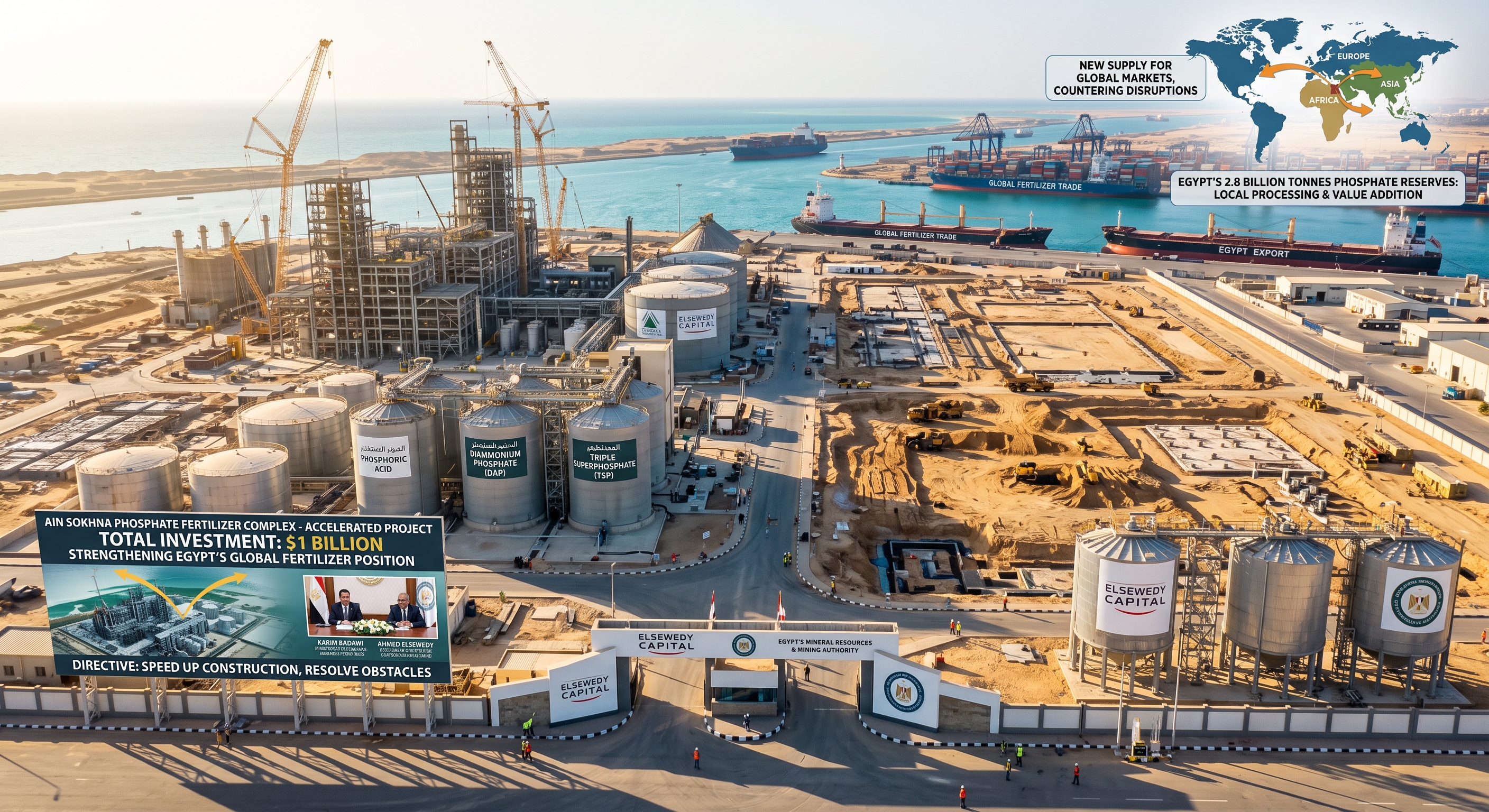
![Egypt and Elsewedy Capital are accelerating a $1 billion phosphate fertiliser complex designed to increase local processing and strengthen the country’s exports. [Gemini Generated Image]](https://ocdn.eu/pulscms/MDA_/89a9ca3d6892f33d9be08acfd3a3e275.jpg)
Egypt is moving to accelerate a $1 billion phosphate fertiliser complex that could strengthen the North African country’s position in the global fertiliser market as supply disruptions push importing countries to seek new sources.
- Egypt is accelerating work on a $1 billion phosphate fertiliser complex in the Suez Canal Economic Zone.
- The project is expected to produce 300,000 tonnes each of phosphoric acid and phosphate fertilisers annually during its first phase.
- Egypt wants to process more of its phosphate locally instead of exporting the mineral in its raw form.
- The push comes as restrictions on Chinese fertiliser exports and disruptions around the Middle East tighten global supply.
Petroleum and Mineral Resources Minister Karim Badawi ordered the companies and government agencies involved in the project to speed up outstanding procedures and resolve obstacles that could delay construction.
Badawi issued the directive during a meeting with Ahmed Elsewedy, chairman of Elsewedy Capital Holding, according to a statement published by Egypt’s State Information Service.
The integrated complex will be located in Ain Sokhna within the Suez Canal Economic Zone, giving it direct access to one of the world’s most important maritime trade corridors.
It is being developed by Elsewedy Capital, Egypt’s Mineral Resources and Mining Industries Authority and the New Valley Company for Mineral Resources and Oil Clay, commonly known as WadiCo.
The three partners signed a shareholders’ agreement in July to establish the company that will develop, construct, manage and operate the plant.
Egypt did not announce a revised construction deadline following the latest meeting. Badawi, however, directed the partners to strengthen coordination and keep the project within its planned implementation schedule.
A $1 billion industrial project
The Ain Sokhna project is planned as a three-phase industrial complex with total investment estimated at $1 billion.
Its first phase is expected to produce about 300,000 tonnes of phosphoric acid annually and another 300,000 tonnes of diammonium phosphate and triple superphosphate fertilisers.
The second phase, scheduled for between 2029 and 2031, is expected to focus on high-purity and specialised phosphate chemicals.
DON'T MISS THIS: Egypt to inject $4 billion into oil refinery overhaul to cut fuel import bill
A third phase, planned for 2032 to 2034, would expand the complex into materials used in electric battery components, according to earlier project information.
The location in Ain Sokhna could help Egypt reach buyers in Africa, Asia and Europe while lowering the cost of moving finished products to international markets.
The project is also expected to meet part of Egypt’s domestic fertiliser demand, with surplus production sold abroad to generate foreign currency.
For Cairo, that foreign-exchange potential is particularly important as the government seeks more export revenue and private investment to support an economy that has faced repeated currency shortages in recent years.
DON'T MISS THIS: Middle East conflict tightens fertiliser exports as Africa’s food security wavers
Egypt wants more value from its phosphate
Egypt holds an estimated 2.8 billion tonnes of phosphate reserves, placing it behind only Morocco and China globally, according to figures previously presented by the petroleum ministry.
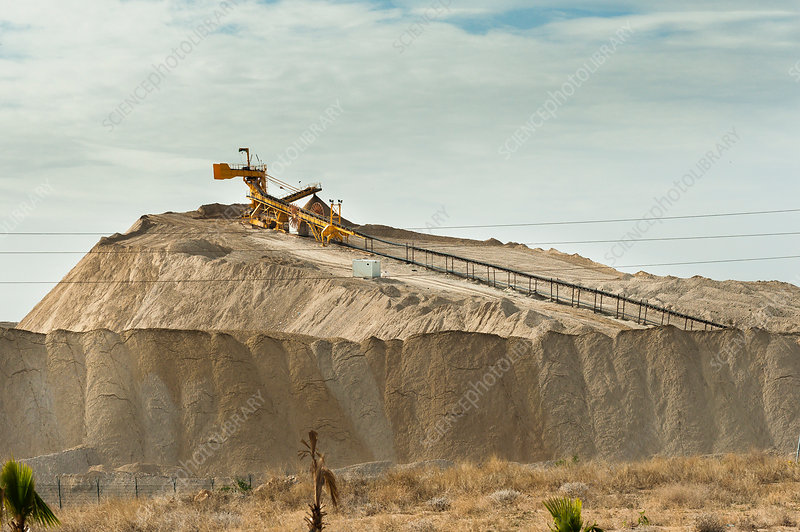
Large deposits are concentrated in the Red Sea, Nile Valley and New Valley regions. The Abu Tartour deposit in the New Valley alone is estimated to contain about one billion tonnes.
Despite these resources, much of the value historically left the country in the form of unprocessed or partly processed phosphate rock.
The government is now trying to change that model by directing more raw material into domestic plants capable of producing phosphoric acid, fertilisers and specialised chemicals.
Egypt produced about 16 million tonnes of phosphate ore between July 2024 and April 2025, compared with 11 million tonnes during the entire 2023/24 financial year, according to figures discussed at an Egyptian cabinet meeting.
Badawi said processing the mineral locally would increase its economic value and strengthen Egypt’s production and export capacity.
The government is pursuing other downstream projects alongside the Elsewedy complex. These include the Abu Tartour phosphoric acid project and a separate $525 million fertiliser complex being developed by Misr Phosphate and Singapore-headquartered Indorama in the Suez Canal Economic Zone.
Global fertiliser supply remains under pressure
Egypt’s investment push comes at a strategically important time for the global fertiliser market.
China, one of the world’s biggest suppliers, has tightened exports of several phosphate fertilisers and other agricultural inputs to protect its domestic market. Shipping and production disruptions linked to tensions in the Middle East have placed additional pressure on supply.
DON'T MISS THIS:Singapore-based corporation invests $525m in Egypt fertiliser plant, targets global markets
Several importing countries have consequently sought alternative producers and longer-term supply arrangements.
New Egyptian capacity could help meet some of that demand while strengthening Africa’s fertiliser production base. The continent possesses large phosphate reserves, particularly in Morocco and Egypt, but many African farmers still face high prices and limited access to fertilisers.
Morocco has already built a major global business around processing phosphate into higher-value fertilisers. Egypt’s latest projects signal an attempt to follow a similar value-addition strategy, although on a smaller scale.
For the government, the Ain Sokhna complex is therefore more than a new factory. It is part of a wider attempt to move Egypt’s mining sector from extracting and exporting raw mlklkaterials towards manufacturing products that command higher prices in international markets.