‘No shutdown on June 30’— vows South African government as xenophobia against migrants, including Zimbabweans, surges
The Saturday Star THE Government of South Africa has moved to calm fears of escalating unrest linked to anti-illegal immigration protests, insisting there will be no “shutdown” as tensions continue to rise ahead of a June 30 deadline for undocumented foreign nationals to leave the country. The planned national shutdown linked to March and March […] The post ‘No shutdown on June 30’— vows South African government as xenophobia against migrants, including Zimbabweans, surges appeared first on NewZimbabwe.com.
 Black News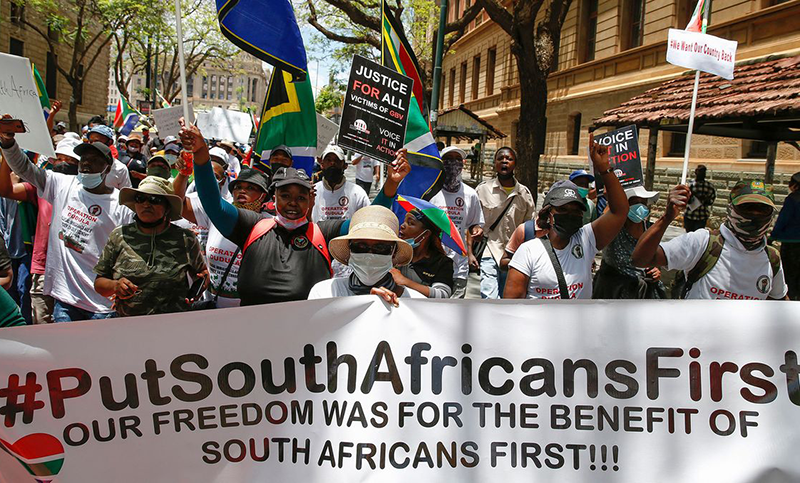
The Saturday Star
THE Government of South Africa has moved to calm fears of escalating unrest linked to anti-illegal immigration protests, insisting there will be no “shutdown” as tensions continue to rise ahead of a June 30 deadline for undocumented foreign nationals to leave the country.
The planned national shutdown linked to March and March is a protest action set for June 30 calling for the removal of undocumented foreign nationals from South Africa.
Minister in the Presidency Khumbudzo Ntshavheni has warned anti-illegal immigration protesters against taking the law into their own hands.
Minister in the Presidency Khumbudzo Ntshavheni has warned anti-illegal immigration protesters against taking the law into their own hands.
During a recent post-Cabinet briefing, Minister in the Presidency Khumbudzo Ntshavheni said President Cyril Ramaphosa would soon address the nation on the government’s response to the migration crisis, following Cabinet approval of a new national approach.
“Cabinet received and approved a comprehensive approach to managing migration in South Africa, developed by the IMC Inter-Ministerial Committee on Migration, and approved the National Action Plan (NAP), a country report on migration in South Africa,” she said.
The announcement comes as political pressure mounts over illegal immigration, with government, business and regional states all responding to growing public tension and sporadic protest activity.
A coordinated operation involving the BMA, Home Affairs, SAPS and Mozambican authorities facilitated the departure of Mozambican nationals, while seven individuals were stopped pending further verification.
Border crossings and enforcement gaps under scrutiny
Parliament also received fresh detail this week on how undocumented migration is being facilitated across South Africa’s borders, with the Border Management Authority (BMA) outlining cases involving intercepted transport operations and alleged illegal crossings.
BMA Assistant Commissioner Balene Mkhabela told a joint sitting of the Transport and Home Affairs Portfolio Committees, that two minibus taxis intercepted in Polokwane earlier this month had left Beitbridge and re-entered South Africa without passengers before later carrying undocumented migrants.
“The buses passed through Beitbridge twice. The one bus (minibus taxi) exited South Africa for Zimbabwe. The second bus also left for Zimbabwe. The same buses came back following each other in the evening, still no one was in the buses,” Mkhabela said.
He said interviews with 54 undocumented passengers revealed they had crossed into South Africa using a makeshift boat.
“Based on interviews conducted with these individuals, all reported that they had been facilitated into the Republic of South Africa by means of a boat, with such illegal facilitation occurring during nighttime hours.”
He added that each person had reportedly paid R100 to cross.
“That confirms the responses were correct.”
Mkhabela also highlighted structural challenges contributing to illegal migration, including weak border infrastructure, limited surveillance capacity, and corruption.
“There was also corruption by some border officials, a lack of sufficient resources to allow aerial surveillance and deterrence, and a lack of CCTV coverage at strategic points.”
The BMA said it was rolling out 24-hour roadblocks between the border and Baobab Plaza in an effort to tighten enforcement.
Political and enforcement response
Lawmakers have called for tighter internal enforcement, with DA MP Adrian Roos arguing that migration control cannot rely only on border management.
“It is important when we deal with illegal migration that we consider internal enforcement,” he said.
Calls were also made for biometric tracking systems linked to the Department of Home Affairs to improve monitoring of foreign nationals in the country.
Regional repatriations intensify pressure
The domestic debate is increasingly being mirrored across the continent, with Nigeria confirming plans to repatriate more than 1 000 of its nationals from South Africa amid rising tensions.
“Total figure not out yet,” said foreign ministry spokesman Kimiebi Ebienfa.
“We are expecting over a 1 000 persons.”
Nigeria’s High Commission in Pretoria said arrangements had been made to allow those with immigration-related offences to leave voluntarily rather than face detention.
The move follows similar action by Ghana, which has already repatriated hundreds of citizens in response to anti-immigrant unrest in South Africa.
South Africa remains a major destination for regional migration, with more than three million foreign nationals living in the country, according to official statistics.
Rising street-level tension and public anxiety
At community level, incidents of profiling and confrontation have added to unease around migration debates.
A South African man, Mngadi, said he was left shaken after being questioned about his nationality during a taxi rank encounter and felt compelled to show his identity document.
“I am a South African,” he said.
“This is my ID,” he added.
“I’m very worried now,” he said, describing concern over increasing assumptions being made about people’s nationality in public spaces.
Labour federation leader Zwelinzima Vavi warned that such incidents reflected deeper systemic failure.
“If we had a functioning criminal justice system, these individuals attacking people in the streets would have long been arrested and charged with public violence and inciting hatred.”
The South African Police Service in KwaZulu-Natal has urged restraint in online discourse, warning against inflammatory content.
“Police have issued a stern warning to residents to refrain from posting, distributing and/or sharing voice notes or social media posts… that promote violence or the destruction of property,” police said.
Authorities warned that such conduct may fall under cybercrime legislation.
Business warns of economic fallout
With tensions rising, organised business has warned that instability linked to migration debates could begin to affect economic activity and investor confidence.
Business Unity South Africa (BUSA) and Business Leadership South Africa (BLSA) said they were “concerned” about escalating public discourse on immigration and called for “strong, steady leadership”.
“At a time of heightened economic pressures, unemployment, high crime levels and social challenges, it is understandable that citizens seek solutions regarding economic inclusion, service delivery, border management and the rule of law,” the organisations said.
They warned that targeting foreign nationals could harm the economy and strain diplomatic relations.
“When individuals target foreign nationals, they directly harm South Africa’s economic interests,” the statement said.
SAHRC warns against misinformation
The South African Human Rights Commission has also raised concern about misinformation and rising hostility in communities, warning that only state authorities are mandated to enforce immigration law.
It said violence, intimidation or vigilante action against foreign nationals “cannot be justified under any circumstances”, and cautioned against false narratives circulating online.
Jacinta Ngobese-Zuma, in an interview with Saturday Star, said March and March is not calling for violence but for the removal of undocumented foreign nationals and insists the movement has been misrepresented in the public debate.
The post ‘No shutdown on June 30’— vows South African government as xenophobia against migrants, including Zimbabweans, surges appeared first on NewZimbabwe.com.