Research Paves Way For Turtle Protection Plan
Sea Turtles have long received little attention in Namibia, often being associated with warm, tropical waters. This changed in 2020 when a green sea turtle was observed laying eggs at the Kunene River mouth for the first time. This remote estuary on the Namibia-Angola border is known to host large numbers of these turtles. Four […] The post Research Paves Way For Turtle Protection Plan appeared first on The Namibian.
 Black News
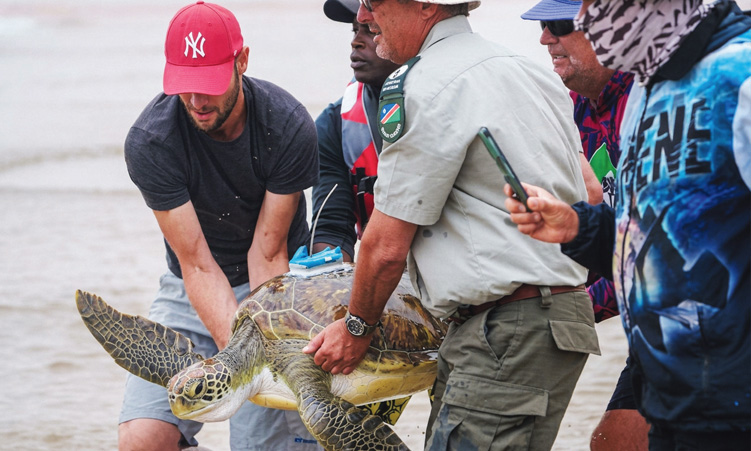
Sea Turtles have long received little attention in Namibia, often being associated with warm, tropical waters.
This changed in 2020 when a green sea turtle was observed laying eggs at the Kunene River mouth for the first time.
This remote estuary on the Namibia-Angola border is known to host large numbers of these turtles.
Four other sea turtle species also occur in the Benguela Current, highlighting the region’s importance for sea turtle conservation and the need for further research.
Although the green turtle’s nesting attempt was unsuccessful as the sand was too cold for the eggs to develop, the event raised new interest in sea turtles in Namibia.
Together with a short survey in 2015 and informal observations, it motivated scientists to begin Namibia’s first scientific study on sea turtles.
Observations show that green turtles move to the Kunene mouth seasonally, but the exact number and the reason for their gathering there remains unclear.
In November last year, the Namibia Nature Foundation (NNF), through the Blue Benguela Partnership (BBP) project, conducted Namibia’s first study to collect baseline data on green turtle behaviour and population patterns at the Kunene River mouth.
Researchers recorded more than 2 100 turtle sightings and 10 confirmed mating events over 21 days.
The results provide direct evidence that the area is an important aggregation site and may also be a seasonal breeding ground.
In February this year, NNF supported the Ministry of Environment, Forestry and Tourism in tagging two adult green turtles with satellite transmitters.
This first-of-its-kind tracking in Namibia will show where sea turtles travel when they leave Namibian waters.
So far, both turtles have remained close to the river mouth, again highlighting the area’s importance for green turtles.
Phase two, funded by the BBP, is now underway. To build upon the initial baseline visual survey, quarterly drone surveys will be conducted to determine seasonal variations in turtle abundance.
Despite the studies’ clear importance, funding continues to be the main challenge.
The area is extremely remote and difficult to access, meaning research trips require careful planning and strong financial support. In addition, a single satellite transmitter costs US$3 000 or more, plus monthly satellite fees.
Phase three could expand the programme. Proposed activities include drone surveys of all five sea turtle species, deploying eight to 12 more satellite tags, reducing accidental turtle catches in fisheries and strengthening cooperation with Angola.
In the long term, the findings could inform a national sea turtle management plan and the expansion of marine protected areas.
All activities remain proposals, subject to funding, partner commitments and the results of earlier research.
Cooperation with Angola is essential as the turtles that mate and feed in national waters are most likely the same ones that nest just north of the Namibian border in Namibe Province.
Namibia can also learn from South Africa’s 60 years of sea turtle protection.
Namibia’s sea turtles face serious risks from bycatch, pollution, climate change and the proposed Baynes Hydropower Dam upstream on the Kunene, which could affect environmental conditions at the river mouth.
Since sea turtles help keep oceans and coastal ecosystems healthy, their decline can disrupt marine food webs and the functioning of vital habitats.
Research in Namibia is essential to understand the impact of threats on sea turtle populations.
Its outcomes could help attract critical funding by positioning Namibia as a recognised conservation contributor, while building local capacity and supporting the international target of protecting 30% of the world’s oceans by 2030.
Most importantly, without research, effective conservation and advocacy for their protection would not be possible.
– Damian Schreiber is a marine conservation communications, field and research officer at Ocean Conservation Namibia. He is involved in seal rescues, bird rehabilitation, education outreach and conservation advocacy. He has a master’s in ecology and society from Costa Rica’s University for Peace.
The post Research Paves Way For Turtle Protection Plan appeared first on The Namibian.