Ruben Santiago-Hudson is passionate about ‘Joe Turner’s Come and Gone’
There is one actor on Broadway who always brings his A-game; a veteran actor of the highest caliber for 50 years. The post Ruben Santiago-Hudson is passionate about ‘Joe Turner’s Come and Gone’ appeared first on New York Amsterdam News.
 Black News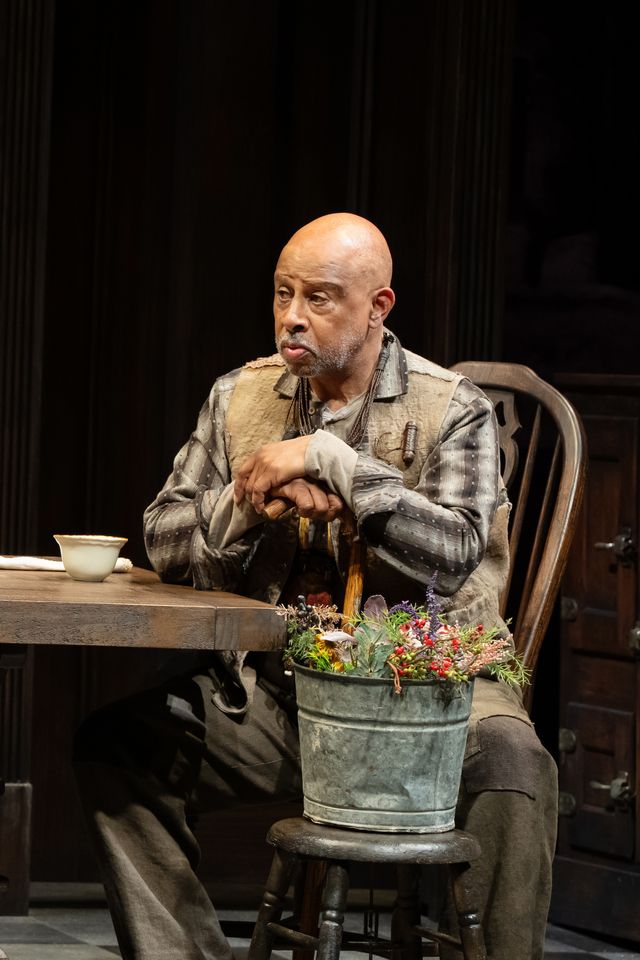

There is one actor on Broadway who always brings his A-game; a veteran actor of the highest caliber for 50 years; who is also a playwright, director, and is currently featured on Broadway in August Wilson’s “Joe Turner’s Come and Gone.” This actor delivers such a phenomenal performance that he is currently nominated for Tony, Drama Desk, Drama League, and Outer Critics Circle Awards for featured actor in a play.
The actor is the one and only Ruben Santiago-Hudson (RSH). He recently took the time before a Sunday matinee to speak with the AmNews about his role as Bynum in this classic drama, candidly sharing his thoughts about the work, his role, and the reason this play is important.
AmNews: Ruben you have a unique connection to August Wilson and his plays — you’ve acted in “Seven Guitars,” “Gem of the Ocean,” “How I Learned to Drive,” “Joe Turner’s Come and Gone,” and “Jitney” and directed “Ma Rainey’s Black Bottom,” “Jitney,” and “Two Trains Running.” Why do you champion his work with such passion?
RSH: Because he’s the clear voice of the historical nature and integrity of our people through the migration and even before that — through the middle passage. He’s that reflection of this inner self that we don’t get to visit enough. He reminds us of our journey, who we are, and allows us that opportunity to celebrate this depth, this magnitude of our magnificence. I know it’s a big word, but we’re magnificent people. Not just people who have overcome, but have created a whole style. We set the tempo in life and we’ve been doing that forever and we come from the bare minimum to the grandest and we rarely get the acknowledgment. August gives the common man the acknowledgment that you are worthy, through all the strife and turmoil — ‘Look who I am, I’m Floyd or Caesar.’ It’s about family, life, love, vulnerability; all that stuff.
AmNews: What do you want a new generation of audience members to know about August Wilson’s work?
RSH: That there was a man that decided to do something to chronicle decade by decade the whole 20th century and there’s a place for them in this chronicling. There’s a place for them in this August Wilson world — as an actor, an observer, or a person wanting a joyful moment to celebrate who we are. There’s a place for you. August created that space, and he did it with Lloyd Richards’s guidance. He did it and opened the doors for so many others — the Lynn Nottages and Dominique Morriseaus and Christine Andersons. August was that singular voice that white American theater chose. It was Lloyd who was well-respected and when he said that August was important and attention should be paid, it was. August then opened the door for people to walk in as writers [and] artists, and it’s very important.
AmNews: When you look in that audience and you see generations of Black families sitting together to experience this brilliant classic, what is going through your mind?
RSH: It hits me when I see that 80% audience of color, because we will come out in numbers to support our people. We can be the life blood of the theater.
AmNews: When you portray Bynum in “Joe Turner’s Come and Gone,” what was your process to prepare for this very emotional role?
RSH: Information, research, just continue to look. A lot of that information and research is not in books; it’s in the life that I’ve lived — coming up in a rooming house in Lackawanna, New York, with these people; people who were root workers, people who were hobos, people who in society’s eyes were malcontents, but they were hard-working, God-fearing people. That research was vital, as well as the research I did … about the years, the time, what happened in 1911 specifically and what did that mean in America and what did that mean to Black people in America, which was always extremely important. The life lived to be around those people that August Wilson talked about was also very important.
AmNews: August Wilson’s plays always carry such a heavy spiritual component. What is it like to play the character that has that spiritual connection to the ancestors and that deeply rooted part of who we are as a people, especially post-slavery?
RSH: The Emancipation Proclamation, which took Black people out of chains, out of bondage, didn’t stop what our country needed in us, which was free labor and to continue to have us under their rules. They found ways to continue what had been the heart blood of America’s economy: our labor for free or cheap. This play reminds us of the cost of freedom, what it cost us to be free, that everybody was not happy with that and continued not to be happy with that. The spirituality in this play is what we as people of color have always relied on, as something that in a different sense would be mystical to people who don’t understand that our ancestors have fortified our mission. This play reminds us of that. If you are not familiar with your ancestors, get in tune with them. If they weren’t here, we wouldn’t be on Broadway right now … Putting this play together is a reminder of what happened to Black people and who we are as human beings.
AmNews: What are the layers of Bynum that you are exposing to the audience?
RSH: One thing that is clear in my interpretation of Bynum is that he is about love, he’s about helping. There’s nothing in this play that Bynum does to destroy or tear down anything. Anything Bynum does is to build, to connect. He’s finding a daughter for a mother, he’s bringing a lover back for a loved one to a woman who’s distraught after losing the loved one. Everything I do in this play is Bynum. I want to make sure that my Bynum is someone you want to be afraid, not someone you’re afraid of. Someone you want to talk to, break bread with. I bring the love, wisdom, intellect, and the integrity of who he is — the joy of Bynum.
AmNews: How do you rejuvenate emotionally after taking on this character, performance after performance?
RSH: I just say thank you — thank you to God, thank you to the Ancestors, and thank you to my mother, and August is included. I’m saying thank you as I walk off that stage and back into the dark, into my dressing room, and I sit there and have a drink of water because my throat is parched and wipe my red eyes, and just be like, wow, the dreams a little boy had in Lackawanna, New York, sitting in a rooming house when the world was telling me I was disposable, that I would be nothing. The world would tell me that. They said literally ‘you will be nothing.’ Teachers would say that. Then I look and I say thank you, ’cause God’s plan was different and the footsteps that were ordered for me disrupted the footsteps they thought were going to be mine. Now I stand there with a lot of pride, knowing that those that helped me, that I can stand up on that stage and do them proud.
AmNews: You deliver a master class in acting on that stage. How do you make it appear so effortless?
RSH: Firstly, it’s the life I want to share with them; that’s what Ruben wants to do. I want to show them who we are. How gentle, how poetic, how witty and loving we are, but secondly, I’m a very well-trained actor and I’ve been doing this since I was 19 years old and had my first regional theater job, so all that’s in me. I don’t have to conjure up technique. I let it flow. I don’t always have to demonstrate what I’m saying; the language is so beautiful, sometimes I just stand there and talk. Just let the words do the work … The words are so colorful [and] beautiful, and you can paint pictures.
AmNews: Why is this play so relevant today?
RSH: It’s important that people of color get to see us and see that we have a continuum. It’s important that white people and Asian people come and see us, and see the integrity that a Seth has in his household, the love that a Bertha has for people in her community with her hot biscuits. It’s important that white people see that we want the same thing that anybody wants: clean water, the finest schools, a mate you can believe in, children you are proud of. The same things: love.
AmNews: How did the cast develop the engaging chemistry that you all have on that stage? Was there a lot of give and take during the rehearsal process with director Debbie Allen?
RSH: It all starts from the top, with Debbie. Debbie said she’ll have no less than a family on the stage, giving and gracious and generous to each other. That’s what she expects and you got to get in line. As Ruby Dee used to always say to me, ‘Do you know your assignment?’ and I would say ‘Yes, ma’am, I know my assignment.’ Debbie gave it to us and we took it with both hands and arms and we embraced it. We became a family and we worked in there, eight hours of rehearsal a day, and then we came home and went to bed.
AmNews: Why should people come to see this stunning play?
RSH: People should come to see this play because not only is it one of the favorite plays of America’s greatest writer of the past for 50 years — he’s accomplished things that no one else did — you should come in and see why he’s a great writer. Why this was his favorite play. Why August wrote a canon of plays and why every theater-maker, historian in this country, why they applaud him and why they put him on the Mount Rushmore of American writers. Come see this play and you will know why.
For tickets, go to http://wwwjoeturnerbway.com.
The post Ruben Santiago-Hudson is passionate about ‘Joe Turner’s Come and Gone’ appeared first on New York Amsterdam News.