Healing Through Harmony: How Yoga reconnects humanity in an age of healthy ageing
DAR ES SALAAM: In a world increasingly defined by stress, distraction, loneliness, and division, yoga offers a rare invitation to reconnect with ourselves and with one another. As humanity navigates an age of artificial intelligence, endless notifications, and accelerating technological change, the ancient wisdom of yoga remains remarkably relevant. It reminds us that while technology … The post Healing Through Harmony: How Yoga reconnects humanity in an age of healthy ageing first appeared on Daily News. The post Healing Through Harmony: How Yoga reconnects humanity in an age of healthy ageing appeared first on Daily News.
 Black News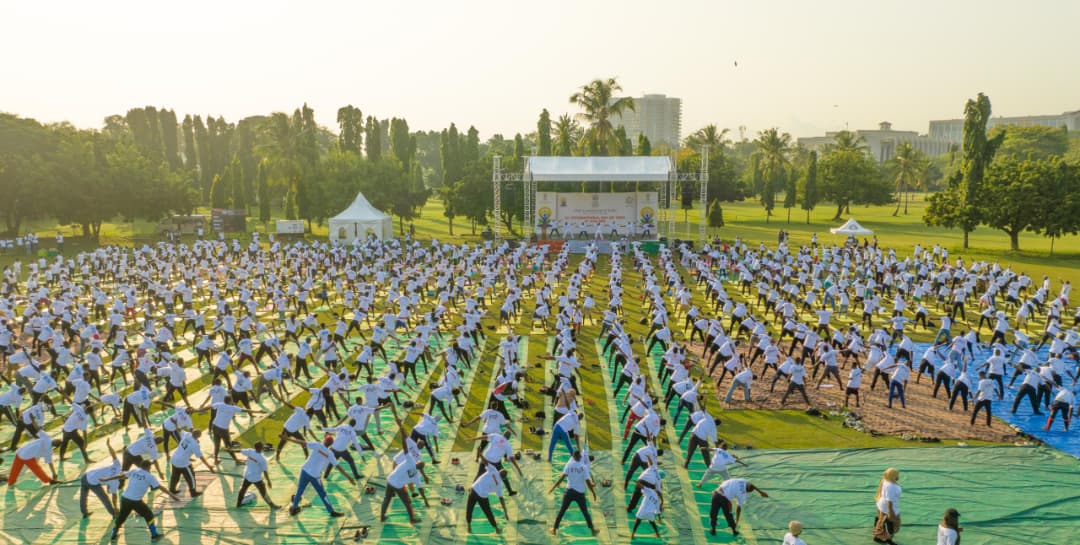
DAR ES SALAAM: In a world increasingly defined by stress, distraction, loneliness, and division, yoga offers a rare invitation to reconnect with ourselves and with one another. As humanity navigates an age of artificial intelligence, endless notifications, and accelerating technological change, the ancient wisdom of yoga remains remarkably relevant. It reminds us that while technology can connect devices, only human consciousness can truly connect people.
Today, India stands as a shining example of a civilization that continues to share the benefits of a yogic way of life with the world. I do not write as a scholar of yoga, nor do I claim mastery of its profound philosophical traditions. Rather, I write as someone fortunate enough to have witnessed its living practice and its subtle influence on everyday life.
My understanding of yoga was once largely theoretical and confined to books. That changed during my time at Rashtriya Raksha University (RRU) in India.
As dawn broke across the campus of Rashtriya Raksha University, students began arriving in small groups carrying yoga mats beneath their arms. Some came laughing with friends, others arrived in contemplative silence. By sunrise, the open spaces around Anna Purina, the university’s bustling canteen square had become something more than a meeting place. It had become a community united by breath, movement, and a shared pursuit of inner balance.
At Anna Purina, the campus’s vibrant and larger-than-life canteen square, yoga was not merely an exercise; it was a way of life. Curiosity drew me closer. What began as observation gradually became appreciation. I saw people from different backgrounds brought together by a common pursuit of balance, discipline, and wellbeing.
Commemoration of International Day of Yoga in 2026:
Under United Nations General Assembly Resolution 69/131 adopted in 2014, the international community designated June 21 as the International Day of Yoga. Since its first observance in 2015, the day has been celebrated annually across the world to raise awareness about the physical, mental, and spiritual benefits of yoga.
Each year is marked by a unique theme. The theme for International Day of Yoga 2026 is “Yoga for Healthy Ageing,” a timely reminder that as people live longer, societies must also focus on helping individuals live healthier, more meaningful, and more dignified lives.
From India to the International Community and the Global Society:
Originating in India thousands of years ago, yoga has evolved into a universal practice embraced by people of diverse cultures, religions, and nationalities. It has transcended geography and become a shared human heritage. Today Yoga has become a universal practice that subsumes in different cultures and lifestyles. A key figure in advancing yoga on the global stage has been the Indian Prime Minister Narendra Damodardas Modi. Following his proposal at the United Nations General Assembly in September 2014, the International Day of Yoga was formally adopted by the General Assembly on December 11, 2014. Since then, yoga has emerged not only as a health practice but also as an instrument of cultural diplomacy and international understanding.
And during his maiden address to the United States in June 2016, he mentioned Yoga as the cultural connection that binds the United States and India. he did not speak of yoga merely as an Indian tradition. He spoke of it as a bridge between civilizations, a cultural language capable of connecting people across borders, faiths, and political systems. In many ways, that observation remains as relevant today as it was then.
Tanzania Cultural inclusivity and connection on Yoga International day under a global theme for Healthy Ageing:
At its essence, yoga means “to unite” or “to join.” It is a philosophy that seeks harmony between body and mind, individual and community, humanity and nature.
For Tanzania, the theme of healthy ageing carries important lessons. As urbanization expands and lifestyles change, societies increasingly face challenges related to stress, non-communicable diseases, and mental wellbeing. Healthy ageing is not merely about extending life expectancy. It is about preserving dignity, mobility, resilience, purpose, and connection throughout the human journey.
Yoga offers a framework through which individuals can cultivate these qualities. It teaches patience in an impatient world, reflection in a distracted world, and balance in a world often defined by extremes.
Under the leadership of President Samia Suluhu Hassan and in the spirit of the growing partnership between Tanzania and India, yoga serves as a reminder that cultural exchange can contribute meaningfully to public health, social wellbeing, and mutual understanding.
According to yogic philosophy, everything that exists in the external universe also exists within the human body and consciousness. This understanding is expressed through the five elements: Earth, Water, Fire, Air, and Space.
Earth represents stability and groundedness. Fire symbolizes transformation and energy. Water embodies adaptability and nourishment. Air reflects movement and vitality. Space reminds us of openness and possibility.
These elements offer more than symbolism; they invite us to reflect on the interconnectedness of human existence.
Yoga and the India–Tanzania Partnership:
“Yoga leads us on a journey towards oneness with the world. It teaches us that we are not isolated individuals but part of nature.” His Excellency Naendra Modi Prime Minister of India.
Long before nations exchanged trade agreements, humanity exchanged ideas, wisdom, and culture. The growing observance of International Day of Yoga in Tanzania reflects more than the global reach of an ancient Indian tradition. It demonstrates the enduring power of cultural diplomacy to build bridges where geography creates distance.
As India Prime Minister his excellency Narendra Modi once observed, “Yoga leads us on a journey towards oneness with the world. It teaches us that we are not isolated individuals but part of nature.”
This message resonates deeply with the relationship between Tanzania and India. The two nations are connected not only by diplomatic ties but also by history, commerce, culture, and the vast Indian Ocean. Consider water, one of the five elements of yoga.
Tanzania and India are linked by the same and vast Indian ocean that has facilitated trade, migration, cultural exchange, and economic opportunity for centuries. Water sustains life, shapes civilizations, and connects communities. In yogic philosophy, it also represents adaptability and nourishment.
As human beings, our existence depends upon water. It nourishes our bodies just as cooperation nourishes relationships between nations. It is therefore fitting that Tanzania’s efforts to expand access to clean water reflect the broader principles of health and wellbeing that yoga seeks to promote.
The Government of Tanzania has completed more than 3,700 water projects while hundreds more remain under implementation. These investments improve public health, strengthen communities, and support human development. In many ways, they also reflect a fundamental truth embedded in yogic philosophy: the health of a society begins with the wellbeing of its people.
The International Day of Yoga 2026 arrives at a moment when humanity possesses unprecedented technological power yet struggles with rising loneliness, anxiety, chronic illness, and social fragmentation. Under the theme “Yoga for Healthy Ageing,” the world is invited to consider a profound question: how do we add life to our years, not merely years to our lives?
In an era preoccupied with longevity, yoga reminds us that the true measure of health is not the number of birthdays we celebrate but the vitality, dignity, purpose, and inner balance with which we experience them.
A Path Toward Human Attunement:
One of the most compelling aspects of yoga is its capacity to foster attunement, a deeper awareness of ourselves, others, and the world around us.
The French philosopher Pierre Teilhard de Chardin famously wrote, “We are not human beings having a spiritual experience; we are spiritual beings having a human experience.” Whether one interprets these words spiritually or philosophically, they invite reflection on the deeper dimensions of human existence.
Today, humanity faces a choice. We can allow technology to dominate our attention, fragment our relationships, and accelerate our lives beyond healthy limits, or we can seek practices that restore balance and perspective.
Yoga offers one such path. Across Tanzania, particularly in Dar es Salaam, an increasing number of citizens are embracing yoga as part of a global community of practitioners who view health not merely as the absence of disease but as the cultivation of harmony between body, mind, and spirit.
The Swami Vivekananda Cultural Centre near Gymkhana Club continues to play an important role in promoting yoga and cultural exchange, welcoming participants from diverse backgrounds to experience its benefits firsthand.
Why should someone who has never practice Yoga even care?
Perhaps yoga’s greatest lesson is not flexibility of the body but flexibility of perspective. In a digital age that rewards speed, reaction, and constant stimulation, yoga invites us to pause. It teaches that strength can coexist with gentleness, that ambition can coexist with reflection, and that progress is most meaningful when it advances not only our economies but also our humanity. In our modern experiences, we have seen people running marathons, as part of a health living and motivation.
How many parents hope simply to grow old with dignity? How many grandparents wish only to remain strong enough to walk, laugh, and share stories with their grandchildren?
Healthy ageing is often discussed in policy papers and demographic reports, yet at its heart it is profoundly human. It is about preserving the small moments that give life meaning, and all this is a question of Yoga, the external attributes and internal elements of our time on Earth.
Healing Through Harmony:
Ultimately, yoga heals through harmony. It reconnects humanity in an age increasingly characterized by disconnection. We live in a time that teaches us to conquer distance, accelerate time, and master machines. Yoga teaches a different wisdom. It asks us to master ourselves.
In the quiet space between breath and movement, humanity discovers something increasingly rare in the digital age: not escape from the world, but reconnection with it.
Like the earth, yoga grounds us. Like fire, it renews us. Like water, it nourishes us. Like air, it energizes us. Like space, it expands our awareness.
Perhaps that is why, thousands of years after its birth, yoga continues to speak to one of humanity’s oldest aspirations: The desire to live longer, healthier, and more meaningful lives.
As the world commemorates International Day of Yoga 2026, the central question is not whether yoga can help us live longer. The deeper question is whether modern societies can preserve human dignity, purpose, connection, and wellbeing across the entire span of life.
Healthy ageing is not merely a medical objective. It is a civilizational challenge. The future will undoubtedly bring new technologies, new discoveries, and new forms of human achievement. Yet no innovation can replace the timeless human need for connection, purpose, and wellbeing. That is why the message of International Day of Yoga 2026 extends far beyond exercise or physical fitness. It is a reminder that amid the noise of modern life, there remains extraordinary power in stillness. Amid division, there remains healing in harmony. And amid the uncertainties of the digital age, there remains hope in the simple act of reconnecting with ourselves, with one another, and with the humanity we all share.
And in a world searching for balance, yoga continues to offer one of humanity’s most enduring answers.
Novatus Igosha is an Advocate of the High Court and a seasonal columnist on international affairs. Mobile: 0747130688 | Email: norvum728@gmail.com
The post Healing Through Harmony: How Yoga reconnects humanity in an age of healthy ageing first appeared on Daily News.
The post Healing Through Harmony: How Yoga reconnects humanity in an age of healthy ageing appeared first on Daily News.