Somalia’s Southwest president returns to Baidoa, defying federal travel ban and cutting ties
MOGADISHU (Somaliguardian) – Southwest State President Abdiasis Laftagaren slipped back into Baidoa on Tuesday aboard an Ethiopian military helicopter, evading what appeared to be a coordinated effort by Somalia’s federal government to block his return. The timing was striking: only hours earlier, his administration had announced a complete suspension of cooperation with Mogadishu, making Southwest […]
 Black News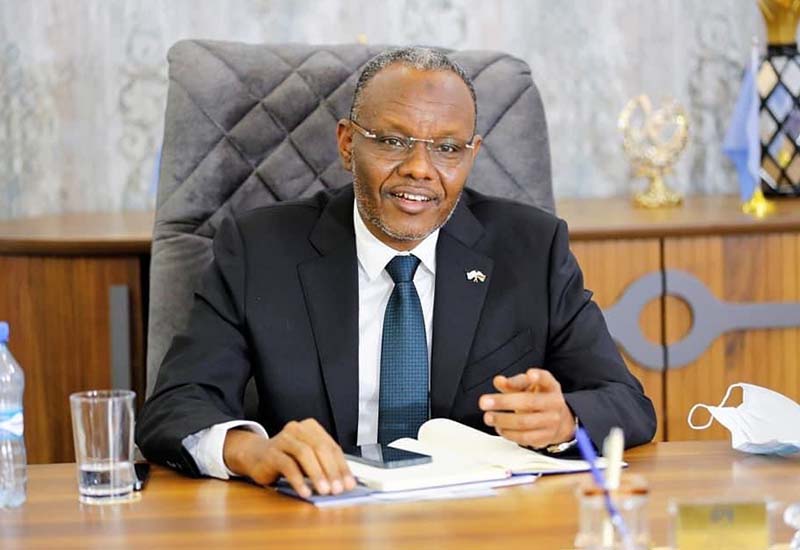

MOGADISHU (Somaliguardian) – Southwest State President Abdiasis Laftagaren slipped back into Baidoa on Tuesday aboard an Ethiopian military helicopter, evading what appeared to be a coordinated effort by Somalia’s federal government to block his return. The timing was striking: only hours earlier, his administration had announced a complete suspension of cooperation with Mogadishu, making Southwest the third federal member state to take that step.
For days, federal authorities had been closely monitoring Laftagaren’s movements. Reports indicated he had departed Saudi Arabia abruptly, leaving behind members of his government and family, before resurfacing in Ethiopia. There, he held meetings with Ethiopian security officials as his rift with the federal leadership deepened.
Mogadishu responded decisively. On Tuesday, it grounded all flights bound for Baidoa in what amounted to an almost total shutdown of air traffic to the regional capital. Local media reported that only United Nations humanitarian flights were allowed through, underscoring the severity of the measure.
The reaction from Southwest State was swift and uncompromising. Officials declared a halt to all engagement with the federal government, aligning themselves with Puntland and Jubaland, both of which had already distanced themselves from Mogadishu in recent years. The fracture within Somalia’s federal system now appears wider – and more entrenched – than at any point in recent years.
At the heart of the dispute lies a volatile mix of political rivalry and armed confrontation. Southwest authorities accuse the federal government of actively stoking conflict in the region, where local forces are battling opposition fighters believed to have backing from Mogadishu. The accusations reflect a deep erosion of trust, with each side increasingly viewing the other not as a partner, but as a direct threat.
Despite mounting pressure, Laftagaren remains firmly in control. His position is reinforced by Ethiopia’s backing, with Ethiopian troops maintaining presence across key cities in the state. That support has proven decisive, blunting efforts to dislodge him even as opposition forces gain ground in certain areas.
Earlier this week, those opposition fighters captured Qansah-dhere in Bay region following a gun battle, marking a significant, if localized, shift in the balance of power. Their continued mobilization in Burhakabo suggests the confrontation is far from contained.
Against this backdrop, Southwest authorities are preparing to chart their own political course. Plans are underway for an indirect election in which Laftagaren is expected to seek another term. The move represents a clear break from President Hassan Sheikh Mohamud’s push for a one-person, one-vote electoral model – a reform Laftagaren himself had once championed as a key ally of the president.
That reversal speaks volumes. What was once a partnership built on shared political ambition has hardened into a contest defined by mistrust, strategic maneuvering and competing visions for Somalia’s future.
For now, neither side appears willing to yield. Each step taken by one is met with a calculated response from the other, tightening a cycle of escalation that leaves little room for compromise. In this shifting landscape, former allies have become adversaries, locked in a high-stakes struggle where the outcome remains uncertain, but the consequences are already unfolding.
Contact us: info@somaliguardian.com