Trump Admin Proposes Pumping the Brakes on Work Visa Extensions
The Department of Homeland Security has proposed ending the rule that tells USCIS officers to defer to earlier approvals, which would put every H-1B extension under the same scrutiny as a first-time petition. The notice, published October 14 in the Federal Register, is a proposal only and is not in effect. Today, officers generally defer [...]
 Black News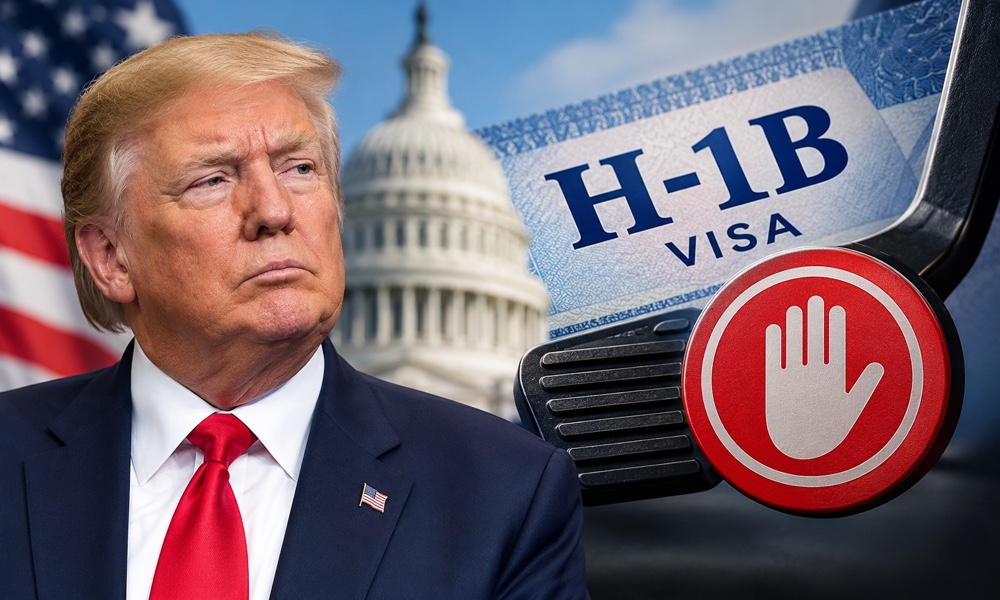
The Department of Homeland Security has proposed ending the rule that tells USCIS officers to defer to earlier approvals, which would put every H-1B extension under the same scrutiny as a first-time petition. The notice, published October 14 in the Federal Register, is a proposal only and is not in effect.
Today, officers generally defer to a prior approval when an employer files to extend a worker’s stay and the parties and underlying facts have not changed. They can depart from it only for a material error, a material change or new adverse information. DHS wants to delete that instruction, which sits at 8 CFR 214.1(c)(5).
The proposal does not single out any nationality, and the notice gives no breakdown by country. For African professionals, the largest group is Nigerian-born workers, who held 2,423 approved H-1B petitions in fiscal 2025, the most of any African country. Public comments are due November 13.
ALSO READ: 3 New Immigration Rules Just Blindsided Sponsors and H-1Bs
What the H-1B Extension Proposal Changes
The change covers Form I-129 petitions, the filing used for H-1B, L-1 and other employment-based classifications. DHS says the deference provision matters most when an employer asks to extend a worker’s stay under the same classification.
By DHS’s count, an average of 208,429 petitions a year from fiscal 2022 through 2025 qualified for deference. That is about 30 percent of all Form I-129 filings.
Deference has moved back and forth. USCIS adopted it as policy in 2004, rescinded it in October 2017, reinstated it in April 2021 and wrote it into regulation in December 2024 through the H-1B modernization rule.
DHS says the proposal would not change who is eligible. The notice states that removing deference “does not substantively change eligibility,” and that workers can keep working and living in the country if they show they still qualify.
What It Means for African H-1B Workers
The DHS notice does not say which nationalities are affected, so the closest guide is USCIS’s own count of H-1B approvals by country of birth. In fiscal 2025, USCIS approved 406,348 H-1B petitions. African-born beneficiaries accounted for about 7,800 of them, or roughly 1.9 percent, by AV’s tally of the agency’s tables.
Nigeria is the only African country in the global top ten, at No. 10 with 2,423 approvals. Ghana follows with 1,129, then Egypt (842), Kenya (672), South Africa (439), Ethiopia (349) and Zimbabwe (309). Morocco, Cameroon and Uganda round out the top ten African countries.
For comparison, India accounts for 69.9 percent of all approvals and China for 12.1 percent.
The more telling number is how many of those approvals were for workers already past a first petition. USCIS sorts approvals into initial employment and continuing employment. Across all countries, 72 percent were continuing. For African-born workers, only about 39 percent were, or roughly 3,000 approvals.
By country, the continuing share was 48 percent for South Africa, 43 percent for Egypt, 42 percent for Zimbabwe, 39 percent for Nigeria, 38 percent for Ethiopia, 32 percent for Kenya and 30 percent for Ghana. For India it was 80 percent.
In plain terms, most African-born H-1B workers are earlier in their H-1B journey than Indian-born workers. That likely means fewer of them face an extension this year, and more of them will meet the new review as their first approvals come up for renewal. That last point is AV’s reading of the data, not a USCIS finding.
These figures count approved petitions by country of birth, not people, citizenship or current residence. The rule also reaches L-1, O-1, TN, E and other classifications, and the sources reviewed here have no African breakdown for those.
Why DHS Says Deference Has to Go
DHS argues that deference shifts the burden of proof from the petitioner to the officer, who must justify departing from a prior approval. The notice says that pushes officers to prioritize consistency and speed over a full second look at the facts.
It leans on USCIS site-visit data. For H-1B extension cases from fiscal 2022 through 2025, USCIS found non-compliance or fraud at 22.39 percent of the sites it visited. In fiscal 2018 through 2020, when USCIS had no deference policy, the figure was 16.77 percent.
For L-1A cases, the figures were 24.46 percent and 18.37 percent. DHS acknowledges that other factors may have contributed to the gap, but concludes deference was one of them. It also says the change supports its priority of protecting U.S. workers.
What DHS Expects the Rule to Cost
DHS estimates the change would raise the rate of Requests for Evidence on affected petitions by 2.9 percentage points, or roughly 6,044 additional requests a year. It puts the added cost to petitioners at $133,987 a year, based on an assumed 10 minutes of preparation time per response.
That figure covers only the time spent answering the extra requests. The notice also says the rule would lengthen adjudication times, increase “uncertainty regarding continued employment” and add to USCIS’s own workload.
DHS considered the reliance interests of employers and workers who built plans around expected renewals and judged them limited. It says petitioners have no legitimate expectation that an erroneous or unsupported prior approval will keep producing approvals.
What H-1B Workers and Employers Can Do Now
Nothing changes until DHS issues a final rule, so the current deference regulation stays in force for now. The notice does not give an effective date.
Erickson Immigration Group advises treating extension filings much like initial ones: document eligibility in full even when nothing has changed, and expect more Requests for Evidence and longer processing times.
Because DHS itself projects longer adjudications, workers with an H-1B extension coming up may want to ask their employer or immigration attorney now how it will be handled and when the filing will go in.
The proposal lands in a busy stretch for H-1B holders. AV reported earlier that DHS expanded H-1B and L-1 extension fees for some employers starting September 9. A separate proposal published September 11 would end the discretionary 60-day grace period that workers in certain classifications get after a job ends. Comments on that one are due November 10.
Kenyan outlet Mwakilishi reports that Kenyan and other African professionals in the United States could face more scrutiny and documentation demands.
Anyone who wants to weigh in can file a comment at regulations.gov under docket USCIS-2026-0529. DHS says comments sent by email or mail will not count.