Understanding Tooro’s throne and its defiant women
In the misty shadow of the Rwenzori Mountains, behind the pristine white walls of Karuziika – a Royal Palace that has stood for over a century – a high-stakes historical drama is unfolding. It is an elegant, tense standoff that perfectly mirrors a 200-year-old cycle of royal wills, bloodlines, and matriarchal forces in Tooro. Since […] The post Understanding Tooro’s throne and its defiant women appeared first on The Observer Media Ltd.
 Black News

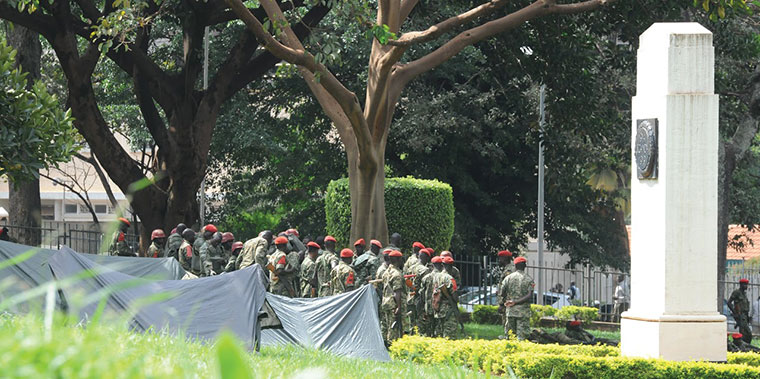
In the misty shadow of the Rwenzori Mountains, behind the pristine white walls of Karuziika – a Royal Palace that has stood for over a century – a high-stakes historical drama is unfolding.
It is an elegant, tense standoff that perfectly mirrors a 200-year-old cycle of royal wills, bloodlines, and matriarchal forces in Tooro. Since King Oyo Nyimba Kabamba Iguru Rukidi IV succumbed to cancer at 34, the kingdom he led for three decades has been without an anchor.
Fort Portal, the main city in Tooro, has filled that vacuum with rumour, ritual and, increasingly, suspicion. On one side are the elders of the Babiito clan, who have moved to install television anchor Prince Edward Rukidi Kijanangoma as king, setting aside what is reported to be the late king’s written will.
On the other are the women of the palace Queen Mother Best Kemigisa, Princess Elizabeth Bagaya and Princess Ruth Nsemere Komuntale, who say they are shielding an infant heir alluded to in that same 2022 will.
To an outsider, it reads as a modern power struggle: clan elders against a widow, tradition against a will, ambition against grief. But to anyone who has followed Tooro’s history, the shape of this fight is unmistakably familiar.
In this kingdom, the crown has repeatedly been rescued not by its kings, but by their mothers and matriarchs. The modern Tooro itself exists because of one.
When Prince Kaboyo Kasunsunkwanzi Omuhundwa Olimi broke away from the Bunyoro kingdom around 1822 to found his own kingdom, he did not do it alone. His mother used her standing inside the imperial court to divert cattle, muster fighters loyal to her son, and clear his path to escape.
Besides the Queen Mother, two of his sisters are said to have known about the plan and kept it hidden from their father. One of them is said to have accompanied Olimi to the new kingdom. The plot involved more women still. He told his father that one of his wives, in Mwenge county (present-day Kyenjojo), was expecting twins, and that he needed to be there for the birth.
Without that cover of women, historians say, the secession collapses before it starts. Women are not bystanders in Tooro’s founding; they were part of its architects. The clearest precedent for today’s crisis, though, comes from the late 1800s, when Bunyoro’s King Kabalega invaded and effectively erased Tooro from the map.

The kingdom’s survival came down to one woman, Queen Mother Vikitoliya Kahinju. As Bagaya recounts in her autobiography, Elizabeth of Toro, Kahinju fled into exile around 1875 at the peak of Tooro’s succession wars.
After the death of her husband, she, alongside several princes, sneaked out of the kingdom with her three young children, including a one-year-old future King Kasagama Kyebambe IV.
Bagaya writes that the queen mother “escaped in 1875 to the kingdom of Ankole, where they were granted asylum.”
The year 1875 was a turbulent one, as Tooro was contending with rival claimants to the throne. That year alone, the kingdom had three kings. Those many wars of succession and the foreign intervention from Bunyoro, Ankole and Buganda so weakened Tooro that by 1880, they could not fight anymore.
Bunyoro’s Kabalega, with a superior army, the Abarusuura, overrun Tooro and finally brought it back under Bunyoro’s control. This meant more time in exile by Kahinju and her children.
In Ankole, the royals in exile settled in Sheema, but this too proved short-lived. Kabalega sent a stern warning to Ankole, declaring that if they continued to host Tooro’s princes, he would not hesitate to invade. Ankole, too, had its own Queen Mother, Kibooga, one who, like Kahinju, was determined to protect the throne of her teenage son, Omugabe Ntare.
Kibooga was incidentally herself a princess from Busongora, a territory of Tooro at the time. She ordered the princes be killed. The murders were to take place at a feast Kibooga had arranged, to which the princes were invited.
Sensing the danger, Vikitoliya Kahinju snatched her youngest son by the hand and slipped away unnoticed.
“Queen Victoria herself, however, with her infant son and her entourage walked through the jungle, finally reaching the kingdom of Buganda where they were given asylum by the king… In Buganda they stayed at Kabula near Masaka about a hundred miles from Kampala,” she added.
From Kabula and Buddu, they eventually made their way to the capital, Mengo. There they found Yafesi Byakuyamba, who would prove influential in the restoration of Tooro. He was a cousin of the future young king, who had earlier been captured during the succession wars in which Buganda had an interest.
It is noted that Byakuyamba was the one who helped link the Queen Mother to Baganda chiefs and eventually to Captain Frederick Lugard of the Imperial British East Africa Company (IBEAC).
For years, Kahinju bided her time, shielding the young prince until the geopolitical winds shifted. In 1891, the opportunity arrived in the form of Lugard. The future Queen Mother sent a messenger bearing a special wooden vessel containing a sample of salt from the crater lakes of Tooro, along with a message: if Lugard helped restore her son to his kingdom, he could have a share in Tooro’s salt and other mineral wealth.
Lugard is said to have been swift to grasp the economic potential. At this point in time, Kahinju knowing or otherwise, was venturing into international diplomacy. Leveraging her political wit, Kahinju and her allies negotiated a strategic alliance with Lugard.
Armed with British Maxim guns and Sudanese troops, Lugard marched west, repelled Bunyoro’s forces, and dramatically restored the sovereign kingdom. On 14th August 1891, the boy she had carried through the jungle in Tooro, Ankole, and Bugansa was crowned King Daudi Kasagama Kyebambe IV.
Prior to the enthronement, Bagaya describes the drama: Lugard, who had described Tooro as a land of ‘almost terrible beauty,’ decided to test the people to see if they could recognise their king.
“…he dressed up a Tooro prince called Yafesi Byakuyamba and presented him to the crowds, saying, ‘Behold your king.’ The crowds looked on with contempt and began to wander away.
“So they know their king,” said Lugard, and presented Kyebambe, simply dressed, with a cloth tied round his head like a turban.
“Behold your king,” he said. Immediately, the crowds broke into a dance, singing, ‘Niye, yenka Omwingane wa Kasagama Kajwerire Orutege,’ meaning “Truly he is his father’s son.”
On Christmas Day 1891, according to James FM Wilson in his book titled; A history of Tooro in western Uganda, the new Omukama finally appointed his chiefs.
As noted in Emma Wild-Wood’s The Mission of Apolo Kivebulaya, Kahinju’s power did not end with the enthronement. Her court on Rwengoma Hill wielded power that was at least equal to her son’s, establishing the precedent that the Queen Mother was a co-architect of the state.
Years later, Omugo Damali Tibaitwa Adyeri, took the role further still. When her husband, Omukama Kasagama Kyebambe IV, was forced into exile, she did not go into hiding. She moved into his palace and held momentarily. And when Kasagama died in December 1928 and colonial officials moved, with the help of rival Babiito factions, to install a more pliable heir, Tibaitwa Adyeri fought them off.
Drawing on the same spiritual and social authority of being queen consort, and later queen mother, as documented by Emma Wild-Wood, she forced both the colonial administration and the clan elders to honour the direct line of succession, securing the throne for her son, Sir George David Matthew Kamurasi Rukidi III.
The spirit would continue. Keziah Byanjeru Abwoli is another matriarch worth examining. As Omugo (queen consort) to Omukama Rukidi III, she arrived at the palace in calmer times, but she too had her share of trouble, both as Omugo and later as queen mother.
Rather than an active battlefield or political struggle, her life was defined by guiding her family through Uganda’s turbulent political history and securing the continuity of the monarchy. Her husband passed away suddenly on the morning of December 21, 1965.
Just a year into her son’s reign, Prime Minister Milton Obote violently abolished all traditional kingdoms in Uganda, forcing the royal family into exile or hiding. Byanjeru and her children, including Princess Bagaya, endured decades of political uncertainty under both Obote and Idi Amin.
When the Ugandan government restored traditional kingdoms in 1993, her son, Kaboyo Olimi III, returned to reclaim his throne. Tragically, he died suddenly just two years later, in August 1995. Byanjeru then witnessed her three-year-old grandson, Oyo Nyimba Kabamba Iguru Rukidi IV enthroned as King.
The Princess Royal
The Batebe (Princess Royal) is Tooro’s supreme female matriarch, second, or arguably equal, only to the Queen Mother, serving as the king’s co-ruler and guardian of cultural identity. In Tooro there is a saying, “Omukama alema na Munyaanya” meaning, the king reigns with his sister, a statement that elevates the power of Batebe.
Princess Maliza Mukakijabara Bagaya Rwigirwa Akiiki took this role in 1891 when her brother, Kasagama, was restored to the throne. Earlier, her father Omukama Nyaika Kasunga Kyebambe I, had married her off to Omukama Kabalega of Bunyoro, perhaps as a strategic peace treaty, placing her in enemy territory to protect Tooro. After the overthrow of Kabalega, Maliza Mukakijabara Bagaya returned to Tooro to take on roles of Batebe.
When pro-Buganda chiefs attempted to push Luganda as the palace language, Maliza intervened, personally being among Kasagama’s Rutooro tutors to defeat an apparent cultural coup. Admired letters Kasagama wrote in Rutooro, currently making rounds on social media, showcase this truth: behind the king stood a formidable woman.
Then there is Princess Bagaya. She is one of Tooro’s most resilient modern matriarchs. When her father, Omukama George Rukidi III, died in 1965, she became Batebe to her brother, Omukama Kaboyo Olimi III. A year later, Obote’s abolition of kingdoms forced the family into exile. Bagaya trained as Uganda’s first female lawyer and used her fame as a model to champion her family’s legacy. She later served as Foreign Affairs minister under Idi Amin, surviving years of political danger.
Bagaya participated in the NRA bush war that brought President Yoweri Museveni to power. She looked out for funds using her international connections on a promise that the new government would restore the kingdoms. After kingdoms were restored in 1993, she helped rebuild Tooro, and following her brother’s death in 1995, became regent and guardian to Oyo, his three-year-old successor.
The most recent chapter belongs to the current Queen Mother herself. When Omukama Patrick David Matthew Kaboyo Olimi III died suddenly of a heart attack in August 1995, history repeated itself in Tooro with terrifying precision.
He left behind a three-year-old toddler, Oyo, and a young widow, Best Kemigisa, then aged around 26. Facing what is framed in the media as a hostile environment where some in-laws attempted to marginalise her over the management of the kingdom’s affairs, Kemigisa launched multi-front customary and legal defences.
By orchestrating a powerful, strategic alliance with President Yoweri Museveni, she secured her toddler son’s coronation. The president served as a formidable regent for 15 years, guarding the crown until King Oyo reached adulthood in 2010.
When two Queen Mothers clashed
A bitter, highly public clash erupted between two Queen Mothers of Tooro in the late 1990s. Keziah Byanjeru Abwoli, widow of Omukama Rukidi III, and her daughter-in-law, Best Kemigisa, mother of the child-king Oyo, seemed to have different visions of Tooro at the time. One was rooted in conservative tradition and the other in perceived convenience.
Tensions peaked in May 1998 when Queen Mother Keziah, with the help of her daughter Elizabeth Bagaya, occupied the palace to ensure that it remained open and active regardless of the presence of the king.

The young queen mother didn’t hesitate to have her mother-in-law evicted from the palace within a week of the latter occupying it. Days later, Queen Mother Keziah passed away at the age of 93.
At the heart of the conflict lay overlapping claims to royal authority. Keziah held traditional seniority as the late king’s widow, while Kemigisa wielded contemporary power as mother to the reigning king. Even after Kezia’s death, the fallout persisted over different visions of the future and disputes over the management of the kingdom’s assets.
As the current succession battle over King Oyo’s apparently willed but unknown heir continues to shake Tooro, the defiance of Best Kemigisa and the royal princesses – Elizabeth Bagaya and Nsemere Komuntale – is not a modern anomaly. It is the ancient, time-tested survival mechanic of two elite offices.
From the kingdom’s birth in 1822 to the tense, barricaded palace of 2026, the message from Tooro’s royal women remains unchanged: the royal clan may own the customs, but the women do not hesitate to protect the crown or those destined for it.
This is not to say that it’s only the women who have protected the crown of Tooro. Indeed, men have gone to battle, fought wars, spilt blood for and in defence of the throne. But women have not been silent observers.
The post Understanding Tooro’s throne and its defiant women appeared first on The Observer Media Ltd.