Unified justice, distinct paths: ECOWAS Court strengthens ties with Gambian Judiciary
Its human rights jurisdiction has become a cornerstone of regional accountability and a beacon of hope for victims of violations. The Court’s jurisprudence has helped consolidate regional protection standards and strengthen citizens’ trust in supranational justice. Yet the Court still faces challenges in getting member states to implement its rulings, despite treaty commitments. Hon. Justice Ricardo Claudio Monteiro Goncalves, President of the ECOWAS Court, said the Banjul mission will strengthen relations between The Gambia’s judiciary and the Community Court. “The ECOWAS Court holds The Gambia’s judicial institutions in the highest esteem, for it is upon the strength and independence of national judicial systems that the regional legal order ultimately rests,” Justice Monteiro said. “Our meeting today is not a mere formality. It is a necessity. It is an opportunity to deepen dialogue between two institutions united by a common mission: to protect human dignity, ensure access to justice, and consolidate the rule of law in The Gambia and across West Africa,” he added. Justice Monteiro announced that, for the first time, The Gambia will have a judge at the ECOWAS Court. “This development is not merely symbolic. It marks a new phase of mutual understanding, strengthened cooperation, and closer ties between the regional Court and the national judicial system,” he said. He said a Gambian judge at the Court will deepen understanding of the respective roles of both jurisdictions, strengthen institutional trust, and ensure The Gambia’s legal experience contributes directly to Community jurisprudence. “The ECOWAS Court and national courts are not rivals. They are partners. They complement one another. They form two levels of a single legal order, whose legitimacy derives from the will of our member states and the trust of our citizens,” Justice Monteiro said. In an integrated legal space, he stressed, judicial dialogue is not a luxury but a vital necessity. It ensures consistent interpretation of norms, prevents jurisdictional conflicts, and strengthens the predictability of decisions. “Through such dialogue, we learn from one another—not through subordination, but through a shared commitment to justice,” he said. Since its establishment, 14 cases have been brought against The Gambia at the ECOWAS Court. Two have been fully implemented, six remain unimplemented, five were dismissed, and one was withdrawn. “This record shows there is room to strengthen institutional cooperation and improve enforcement of regional decisions,” Justice Monteiro said. “We trust that The Gambia’s judiciary will play a central role in improving this, enhancing the credibility of the regional legal system and reinforcing the State’s commitment to its international obligations.” He described national courts as the first line of defence for human rights. “When national courts act decisively and provide effective remedies, they not only deliver justice but also protect the State from potential international litigation.” Justice Monteiro said the ECOWAS Court relies on national courts to enforce its decisions. “Without such cooperation, even the most well-reasoned judgments risk remaining theoretical.” He proposed strengthening the partnership through regular judicial dialogues, joint training programmes, exchange of jurisprudence, clear enforcement mechanisms, and institutional exchanges between judges.
 Black News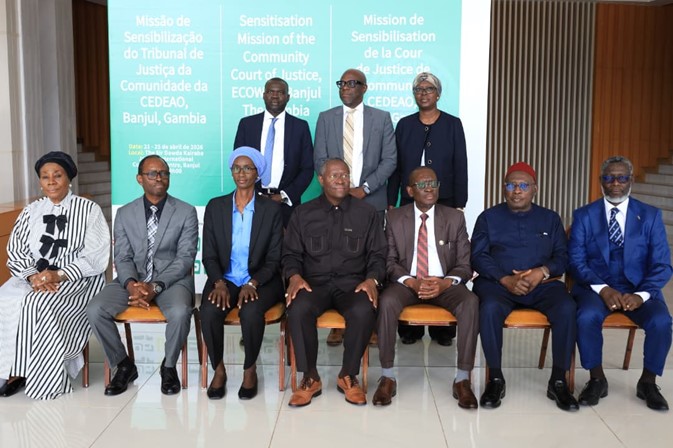
Its human rights jurisdiction has become a cornerstone of regional accountability and a beacon of hope for victims of violations. The Court’s jurisprudence has helped consolidate regional protection standards and strengthen citizens’ trust in supranational justice.
Yet the Court still faces challenges in getting member states to implement its rulings, despite treaty commitments.
Hon. Justice Ricardo Claudio Monteiro Goncalves, President of the ECOWAS Court, said the Banjul mission will strengthen relations between The Gambia’s judiciary and the Community Court.
“The ECOWAS Court holds The Gambia’s judicial institutions in the highest esteem, for it is upon the strength and independence of national judicial systems that the regional legal order ultimately rests,” Justice Monteiro said.
“Our meeting today is not a mere formality. It is a necessity. It is an opportunity to deepen dialogue between two institutions united by a common mission: to protect human dignity, ensure access to justice, and consolidate the rule of law in The Gambia and across West Africa,” he added.
Justice Monteiro announced that, for the first time, The Gambia will have a judge at the ECOWAS Court. “This development is not merely symbolic. It marks a new phase of mutual understanding, strengthened cooperation, and closer ties between the regional Court and the national judicial system,” he said.
He said a Gambian judge at the Court will deepen understanding of the respective roles of both jurisdictions, strengthen institutional trust, and ensure The Gambia’s legal experience contributes directly to Community jurisprudence.
“The ECOWAS Court and national courts are not rivals. They are partners. They complement one another. They form two levels of a single legal order, whose legitimacy derives from the will of our member states and the trust of our citizens,” Justice Monteiro said.
In an integrated legal space, he stressed, judicial dialogue is not a luxury but a vital necessity. It ensures consistent interpretation of norms, prevents jurisdictional conflicts, and strengthens the predictability of decisions.
“Through such dialogue, we learn from one another—not through subordination, but through a shared commitment to justice,” he said.
Since its establishment, 14 cases have been brought against The Gambia at the ECOWAS Court. Two have been fully implemented, six remain unimplemented, five were dismissed, and one was withdrawn.
“This record shows there is room to strengthen institutional cooperation and improve enforcement of regional decisions,” Justice Monteiro said. “We trust that The Gambia’s judiciary will play a central role in improving this, enhancing the credibility of the regional legal system and reinforcing the State’s commitment to its international obligations.”
He described national courts as the first line of defence for human rights. “When national courts act decisively and provide effective remedies, they not only deliver justice but also protect the State from potential international litigation.”
Justice Monteiro said the ECOWAS Court relies on national courts to enforce its decisions. “Without such cooperation, even the most well-reasoned judgments risk remaining theoretical.”
He proposed strengthening the partnership through regular judicial dialogues, joint training programmes, exchange of jurisprudence, clear enforcement mechanisms, and institutional exchanges between judges.