Washington Is Treating Africa as a Target, Not a Partner — and Africa Knows It
Frank Garcia has just been confirmed as Washington’s top Africa diplomat. His appointment tells African governments everything they need to know about how little they matter to this administration. Last month, the U.S. Senate confirmed Frank Garcia as Assistant Secretary of State for African Affairs, ending a vacancy that had run for more than fifteen months. Garcia is a former Navy officer and longtime staffer on the House Intelligence Committee. He has no significant published work on African affairs and is, by most accounts, unknown in Washington’s Africa policy community. One Nigerian newspaper described him as a figure ’ His […] The post Washington Is Treating Africa as a Target, Not a Partner — and Africa Knows It appeared first on African Arguments.
 Black News
Frank Garcia has just been confirmed as Washington’s top Africa diplomat. His appointment tells African governments everything they need to know about how little they matter to this administration.
Last month, the U.S. Senate confirmed Frank Garcia as Assistant Secretary of State for African Affairs, ending a vacancy that had run for more than fifteen months. Garcia is a former Navy officer and longtime staffer on the House Intelligence Committee. He has no significant published work on African affairs and is, by most accounts, unknown in Washington’s Africa policy community. One Nigerian newspaper described him as a figure ’ His own written testimony to the Senate Foreign Relations Committee traced his first contact with the continent to a port call in Mombasa as a junior naval officer — a detail he offered as evidence of a long fascination with Africa.
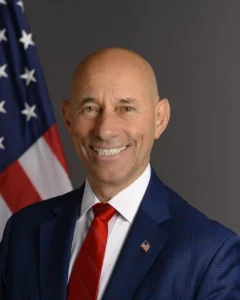
Frank Garcia is the new US Assistant Secretary of State for Africa.
The confirmation came as part of a bloc vote covering 49 Trump nominees. Africa was, in other words, one item on a list. That tells you something.
Garcia’s stated priorities are clear enough. In his March testimony, he declared that US policy had ‘for too long’ emphasised ‘aid and dependency, with open-ended commitments and a focus on spreading divisive ideologies.’ The new approach, he said, would be guided by ‘a realistic calculation of costs, risks, and benefits to U.S. interests’ — trade over aid, investment over assistance. He cited the Lobito Corridor, a 1,300-kilometre railway linking Angola’s Atlantic coast to the mineral belts of the Democratic Republic of the Congo and Zambia, as the model: infrastructure that simultaneously generates profit and secures critical mineral supply chains for the US , while also rivalling Chinese investments in the region.
It sounds coherent. The problem is that Washington has already been running this playbook for sixteen months, and the results are visible.
Shortly after taking office in January 2025, the Trump administration suspended USAID funding, which had provided African countries needs with more than $11 billion in 2023 — primarily for health and humanitarian programmes. PEPFAR, the emergency AIDS relief programme that has saved more than 25 million lives since 2003, was effectively wound down. In Malawi, HIV/AIDS services have all but disappeared. In Ethiopia, 16 million people who depend on food aid faced an immediate shortfall. The DRC, already in the grip of devastating conflict, had relied on Washington for roughly 70 percent of its humanitarian assistance. The Prosper Africa Trade and Investment programme — designed specifically to increase US-Africa trade and reduce dependence on China — lost almost $165 million in unspent funds.
Garcia’s framework calls this a reset. What it actually describes is the systematic dismantling of the institutional presence through which influence is built and maintained. Thirty-seven of the 51 U.S. embassies in Africa currently operate without a confirmed ambassador. The Bureau of African Affairs that Garcia now leads churned through three interim heads between January 2025 and his arrival. China, Russia, Turkey, and Gulf states have maintained fully staffed missions throughout, cultivating relationships while Washington’s chairs stood empty.
The administration does have genuine diplomatic activity to point to. The Washington Accords for Peace and Prosperity, signed in June 2025 and formalised in December, brokered a ceasefire between the DRC and Rwanda after more than thirty years of conflict. Trump’s personal involvement mattered, and the deal is real. But its framing — centred on a Regional Economic Integration Framework built around critical minerals trade — tells you what Washington’s primary interest actually is. Analysts at the Institute for Security Studies have described the DRC-Rwanda process as a template: peace bartered for resource access, rather than built on the institutional foundations that make ceasefires hold. Garcia’s testimony explicitly pledged to ‘hold the parties to their commitments.’ The record of the administration’s follow-through on its African engagements offers limited reassurance.
Meanwhile, the transactional pivot has generated its own backlash. Tariffs of 30 percent on South African goods and up to 50 percent on Lesotho products — combined with the expiry of the African Growth and Opportunity Act in October 2025 — have disrupted the trade relationships Garcia claims to be building. South Africa, following a public confrontation between Trump and President Ramaphosa over fabricated claims of ‘white genocide,’ is actively diversifying toward BRICS partners. Kenya has reached a preliminary agreement with China granting its exports duty-free access. Both governments drew the rational conclusion that Washington’s partnerships come with unpredictable costs attached.
The deeper problem with Garcia’s framework is what it leaves out. Trade and investment generate profit. They do not, on their own, generate influence, security, or goodwill. Those things are built slowly, through sustained diplomatic presence, genuine expertise, and a demonstrated willingness to stay engaged when there is nothing immediate to extract. They are lost quickly, and rebuilding them costs far more than maintaining them. Herman Cohen, who held this same role under President George H.W. Bush and who has watched the Africa bureau for decades, said it plainly after Garcia’s confirmation: this is a grave responsibility, and the trust that needs to be rebuilt is a direct result of the Trump administration’s own choices.
African governments are not passive observers in this. They have built real leverage — through the African Union, the G20, BRICS+, and multilateral climate and trade forums — and they are using it. They are comparing what Washington offers against what Beijing, Moscow, Riyadh, and New Delhi are offering. A United States that staffs its missions inadequately, dismantles its health programmes, imposes punitive tariffs, and then arrives with a mining railway and calls it partnership is going to find that the terms it assumed it could dictate are no longer on the table.
Garcia’s confirmation hearing lasted long enough for him to receive four questions before the committee moved on. Africa, once again, was not the main event. The continent, as ever, noticed.
The post Washington Is Treating Africa as a Target, Not a Partner — and Africa Knows It appeared first on African Arguments.