Why is the Amazon’s ‘great roar’ river wave shrinking?
Pororoca — Set in northern Brazil’s edge, a miles long tidal bore has become a destination for waveriders attempting its endless surf. But its future is uncertain, as landscape and weather changes have seen its power mellow in recent years.
 Black News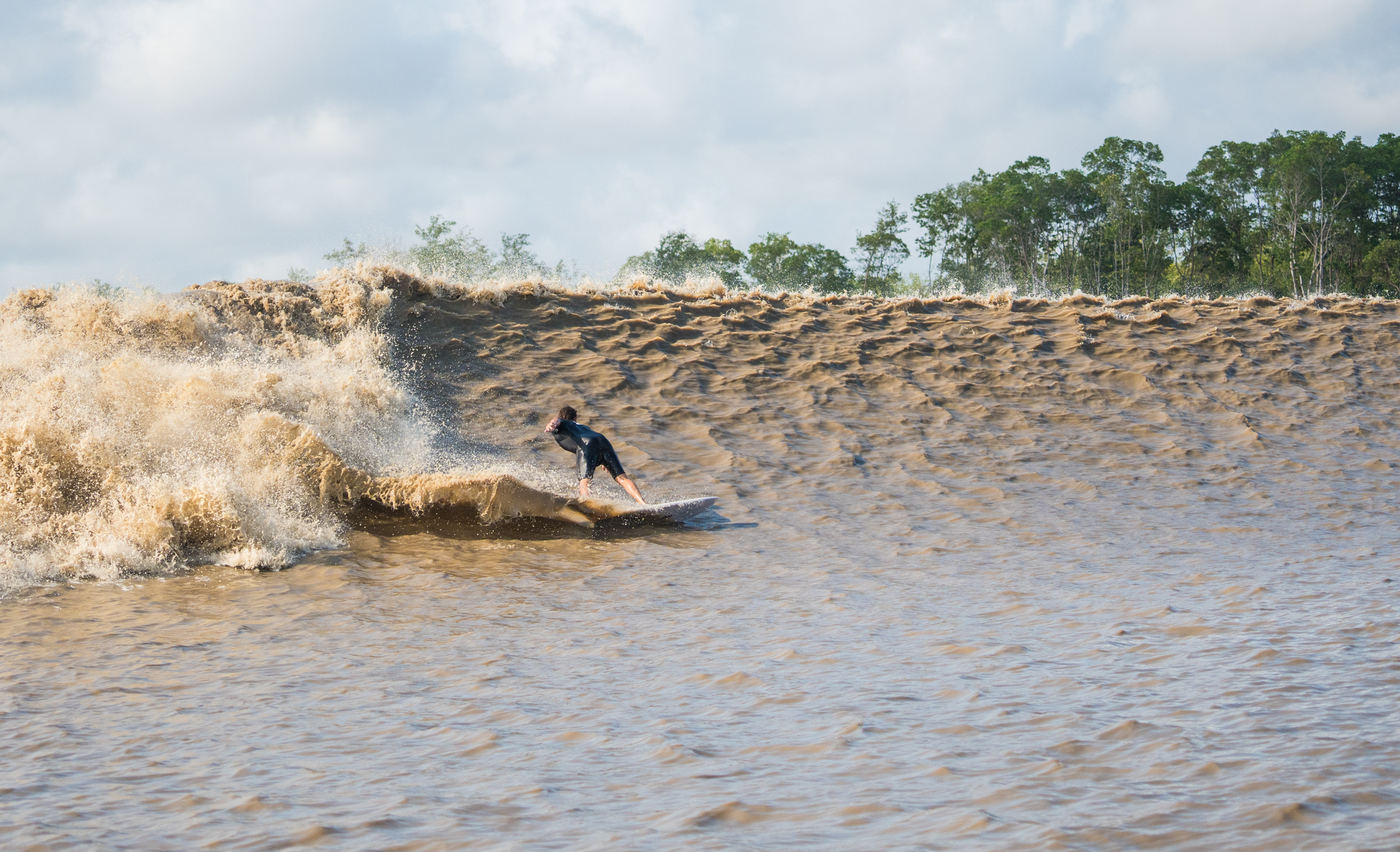
Pororoca — Set in northern Brazil’s edge, a miles long tidal bore has become a destination for waveriders attempting its endless surf. But its future is uncertain, as landscape and weather changes have seen its power mellow in recent years.
The Atlantic tide is coming in at the estuary of the world’s second largest river. Basking in the glare of its full moon, when the tide is highest, are alligators, piranhas and freshwater parasites. Mighty creatures, yet the river wave caused by the high tide – known locally as the Pororoca – is quick to send them searching for cover, as tonnes of water comes barrelling in from the sea.
It can travel up to hundreds of miles in-land, while reaching heights of up to 4 metres (13ft). The name is believed to be a translation from the indigenous Tupi language, which means ‘great roar’. Particularly prominent at the Araguari River (an offshoot of the Amazon), the Pororoca has long been revered by those residing along the Amazon’s banks in northern Brazil, but it became a source of dedicated interest once someone realised it could be surfed. Yet its future status as a destination is murky, with the river’s wave shrinking in size and power in recent years.
Serginho Laus is one of river surfing’s key pioneers – a free surfer that has spent his entire adult life surfing river bores around the world, ever since he got his first taste of the Pororoca in 2000. “That’s when a never ending adventure started for me,” says Serginho. “It’s been a whole lifetime dedicated to this. I’ve almost surfed all the river bores in the world.”
From the Amazon to India’s sacred Ganges, the UK’s southwest, Alaska, and China – “where I’ve seen the biggest Pororoca in the world” – his life’s mission has been to discover the surfing and foiling of river waves. Although some reached huge heights of up to 5 metres, he warns that measuring a river wave purely by its height underestimates its power. “The Pororoca carries thousands of cubic metres of water in one go. It’s a tsunami – an avalanche of water that overflows the river. We don’t surf a wave, we surf the face of the tide.”
The Araguari tidal bore saw the first Pororoca surf experiment in 1997 by Brazilian surf legend Guga Arruda, and was the first river wave Laus ever surfed. It’s here that Laus set record after record for longest wave surfed, once surfing for 33 consecutive minutes and 6.3 miles in 2006, and later 37 minutes and 7.3 miles in 2009. It’s the record for longest river wave surfed in the world to this day, but it looks as if that record might stay for longer, with the Pororoca’s shrinking size and force making it harder to continuously ride.
There’s no proof to explain the wave’s sudden reduction, but Sergio and many in the science community put it to human interference in the Amazon, as well as drought in recent years. The Pororoca is located near five hydroelectric plants that are believed to have disturbed its flow. Not far from them are also cattle farms, and according to Serginho: “It’s only growing. In this region, there’s more than 300,000 buffalo head.” Buffaloes are fans of swampy areas, but they’re not native to the continent that has become their stomping ground. The invasive species have created channels in the river, eventually connecting with the Amazon’s main channel and diverting the pororoca, diluting its force. Serginho says that he contacted the authorities about regulating construction and agriculture along the Araguari, but he feels that no importance was given to the issue.
Climate change has also had a part to play. According to Oceanography Professor Denilson da Silva Bezerra: “We affect the climate, and the climate can affect the Pororoca.” His studies at the Federal University of Maranhão have found a significant decrease in rain precipitation. “Without rain there’s no way to replenish the river flow the whole year long,” he says. “At the same time, the sea levels can rise aggressively, and the balance between the river and sea waters can be lost.” Along the Amazon’s coastline, the sea level is being pushed up between 6 to 8 meters above its natural limit, with Dr. Da Silva explaining that it is “the largest in Brazil, and among the largest in the world”.
Due to a scarcity of rain and an abundance of cattle stomping sediment into the river, sand banks are also forming where the Amazon’s waters meet the sea. The natural barrier that forms, aided by the growth of mangroves, will prevent the wave from entering the river. “Mangroves are extremely beneficial to the climate,” Da Silva says. “But they become a problem when there’s an environmental imbalance. It then becomes a sort of indicator of an environmental decline, growing where it should not.”
A tidal wave is formed when the combination of the shape, depth, and position of the river mouth are just right, but essentially, they occur “by coincidence, in coastal areas where the tide is astronomical” explains Dr. Eloi Melo. The Applied Ocean Science professor, now retired from the Federal University of Rio Grande, has been fascinated by this phenomenon ever since he got a call from Serginho inviting him for a surf. “I saw this wide wall of water. When it got closer, I started to hear the sound of the word ‘Pororoca’ – a certain rumbling.” He surfed until his legs gave out, for 15 minutes straight, but the strongest surfers are often carried for double that time.
Read next: Inside Liberia’s nascent surf scene
“I took Brazilian surf champ Gabriel Medina with me, and even he found it to be a challenge. It’s like a Nazaré wave, you wouldn’t go there if you were a beginner.”
After experiencing “a surfer’s dream”, Dr. Melo went on to study it. He found three conditions necessary for the wave to form, starting with an open estuary at the river’s mouth. “Imagine, a wave coming from the ocean that finds an open space for it to propagate in,” he says, remembering the absurdity of a river split so wide between two lands, that standing on one bank of it would prevent you from seeing the other.
“The second condition is that the estuary must be like a funnel,” a shape unique to only some of the world’s rivers, with a wide mouth at its opening but a narrowing body going inland. The wave travels from the sea up against the river’s stream, its current flowing up to 500 miles upstream. Thirdly, Dr. Melo explains that “the depth of the river has to have a very slight slope, almost flat, so that when the tidal wave that’s coming from the ocean enters this funnel, it can propagate up the river.”
Unique as the experience may be, Serginho’s visitors have often underestimated its power. “I took Brazilian surf champ Gabriel Medina with me, and even he found it to be a challenge,” he says. “It’s like a Nazaré wave, you wouldn’t go there if you were a beginner.” Like in the Portuguese big wave surfing hotspot, Serginho is equipped with jet-skis and rescue assistance, so he can perform a swift pickup for anyone falling off the Pororoca. “In normal tides, the sea level rises in about six hours, reaches a maximum, and then starts to go down for another six,” says Dr. Melo. “In a river that has a Pororoca, this wall of water is the tide, and it rises in minutes.” The tide comes in at light speed, sometimes even reaching 25 miles per hour, taking away trees, river bank structures and animals. Anyone who fails their takeoff won’t be able to catch up once the wave goes rumbling past.
The amplitude of the tide grows and shrinks throughout the month, and with it the size of the wave. Since he started taking tourists to surf, Serginho has recommended surfers to visit on full or new moons to be met with the full power of the unique phenomenon. Better still to come on the later end of the rain season when the river is fuller. After the Araguari wave dried up, he started taking his daring visitors to shred the Mearim river swell in the northeastern state of Maranhão, somewhere around the town of Arari. The wave only passes through certain branches of the Amazon – the Guajará, Guamá-Capim, Macapá, Marajó, Moju, Cassiporé, and the Araguari river.
As of today, any explanation for the Amazon wave’s reduction is theoretical. “We have a pattern of decrease and alteration of the Pororoca, but we still have no certainty as to its causes,” says Dr. Da Silva. What is certain is that the Araguari is an example of what could likely happen to other phenomena of its kind, if no protection is prioritised. “With everything that was discussed during the recent COP30 here in Brazil, I have hope for the question of coastal ecosystems, blue carbon, and the implementation of nature-based solutions,” says the oceanographer, although recent political developments licensing oil exploration in the Amazon’s river mouth imply otherwise.
Until now, it has been the surfers who have been quietly bearing witness to the shift, but their efforts to call attention to these issues have failed. Serginho worries that corruption contaminates the business carried out along the river, including investigations on the part of authorities. Yet the surfing community continues to thrive despite the adversity, far from trendy surf town culture and its audience, authentically playing on their glorious wave with no one to watch but the birds. The river’s natives discovered surfing before they knew what equipment was in order, using wooden planks and fridge doors as boards. Serginho’s work seeks to preserve this innocence, this simple love of nature: “Those living deep in the Amazon Rainforest help each other without monetary incentive, and if everyone had this perception, we could be living in a world with less indifference.”
Gaia Neiman is a freelance journalist. Follow her on LinkedIn.
Buy your copy of Huck 82 here.
Enjoyed this article? Follow Huck on Instagram for more from the cutting edge of sport, music and counterculture.
Support stories like this by becoming a member of Club Huck.