African airlines face mounting losses as Iran war drives global fuel crisis
Africa’s aviation industry is facing mounting pressure as the economic fallout from the war in Iran drives up fuel costs, disrupts flight routes, and threatens the financial stability of several carriers.
 Black News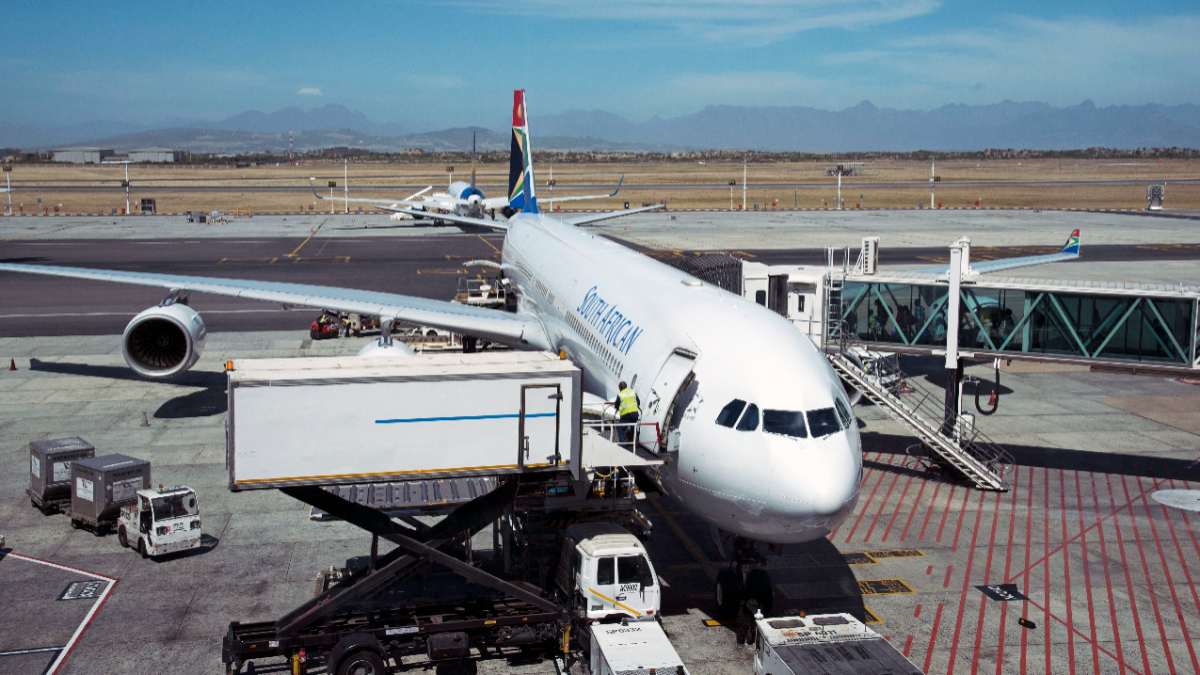
![Catering supply truck supply an passenger jet aircraft at Cape Town International Airport. [Photo by: Education Images/Universal Images Group via Getty Images]](https://ocdn.eu/pulscms/MDA_/54c4099be3410cdb14fc49fb90a769b3.jpg)
Africa’s aviation industry is facing mounting pressure as the economic fallout from the war in Iran drives up fuel costs, disrupts flight routes, and threatens the financial stability of several carriers.
- Africa’s aviation sector is under pressure as the war in Iran drives a sharp rise in global oil and jet fuel prices.
- Airlines face mounting losses from higher operating costs and widespread flight disruptions.
- Major carriers such as Ethiopian Airlines report significant weekly financial losses due to cancellations.
- The crisis is also spilling into tourism, with businesses reporting declining bookings and revenue losses.
Jet fuel prices, a critical component of airline operating expenses, have surged sharply since the conflict began. Brent crude was trading near $98 per barrel in early Wednesday trading, reflecting a rise of more than 30% since the onset of hostilities, according to Reuters.
The increase has been linked to concerns over energy security and uncertainty surrounding a fragile ceasefire between the United States and Iran.
Dominick Andoh, managing partner of AviationGhana, said the spike has already altered how African airlines procure fuel.
“It has affected how much African carriers purchase aviation fuel for their operations,” he told DW, adding that higher costs are being passed on to passengers through increased ticket prices.
“The prices of tickets have gone up. Fuel surcharges on tickets sold since the war broke out, especially in April, have risen by various percentages,” Andoh said.
Beyond higher fuel costs, airlines are also grappling with operational disruptions. Airspace restrictions around parts of the Middle East have forced carriers to reroute or cancel flights, increasing journey times and reducing efficiency.
The scale of the challenge has raised concerns among industry leaders. Nigerian billionaire Aliko Dangote warned that many carriers may not withstand the financial strain.
“The majority of African airlines won’t be able to survive” the current spike in fuel costs, he said at the Semafor World Economy summit in Washington, DC.
Ethiopian Airlines losses $137 million
![An Ethiopian Cargo Boeing 777-F prepares for takeoff from Adolfo Suarez Airport in Madrid, Spain, on October 12, 2025. [Photo by Joan Valls/Urbanandsport/NurPhoto via Getty Images]](https://ocdn.eu/pulscms/MDA_/82e3da181622671dc2c55b89090b4b2a.jpg)
Ethiopian Airlines has been among the hardest hit. The carrier reported weekly losses of about $137 million as a direct result of the crisis, driven largely by widespread cancellations.
“The airline has cancelled more than 100 flights a week… and we have lost about $137 million in a week,” said Lemma Yadhecha, the airline’s business manager.
Although a recent ceasefire announcement briefly raised hopes of stabilisation, uncertainty persists. Industry executives warn that even if key shipping routes reopen, recovery will take time. Willie Walsh, head of the International Air Transport Association, said restoring fuel supply chains could take months due to disruptions in Middle Eastern refining capacity.
Airlines are now adjusting their strategies to cope with the shifting landscape. Kenya Airways, for example, is rerouting more European passengers through its Nairobi hub, bypassing traditional Gulf transit points. Chief executive George Kamal said the airline is leveraging the disruption to reposition its network.
Analysts say further measures, including fuel hedging and stockpiling, could help airlines manage volatility if the conflict continues.
The impact is also spilling into tourism, a sector heavily dependent on air connectivity. In South Africa, Cape Town-based tour operator Emraan Roode said the downturn has already affected business.
“I’ve lost between $21,000 and $30,000 over the past few months due to the war,” he said, citing cancellations and reduced bookings from international clients.
Despite the challenges, some industry observers remain cautiously optimistic. Andoh pointed to the sector’s resilience during the COVID-19 pandemic as evidence that it can recover.
“The aviation sector, the tourism sector, would remain in business. People would still travel,” he said.