Almost Creaturely in Here
A conversation with Ian Hall about his debut poetry collection 'Creekwater Mansions.' The post Almost Creaturely in Here appeared first on Deep South Magazine.
 Black News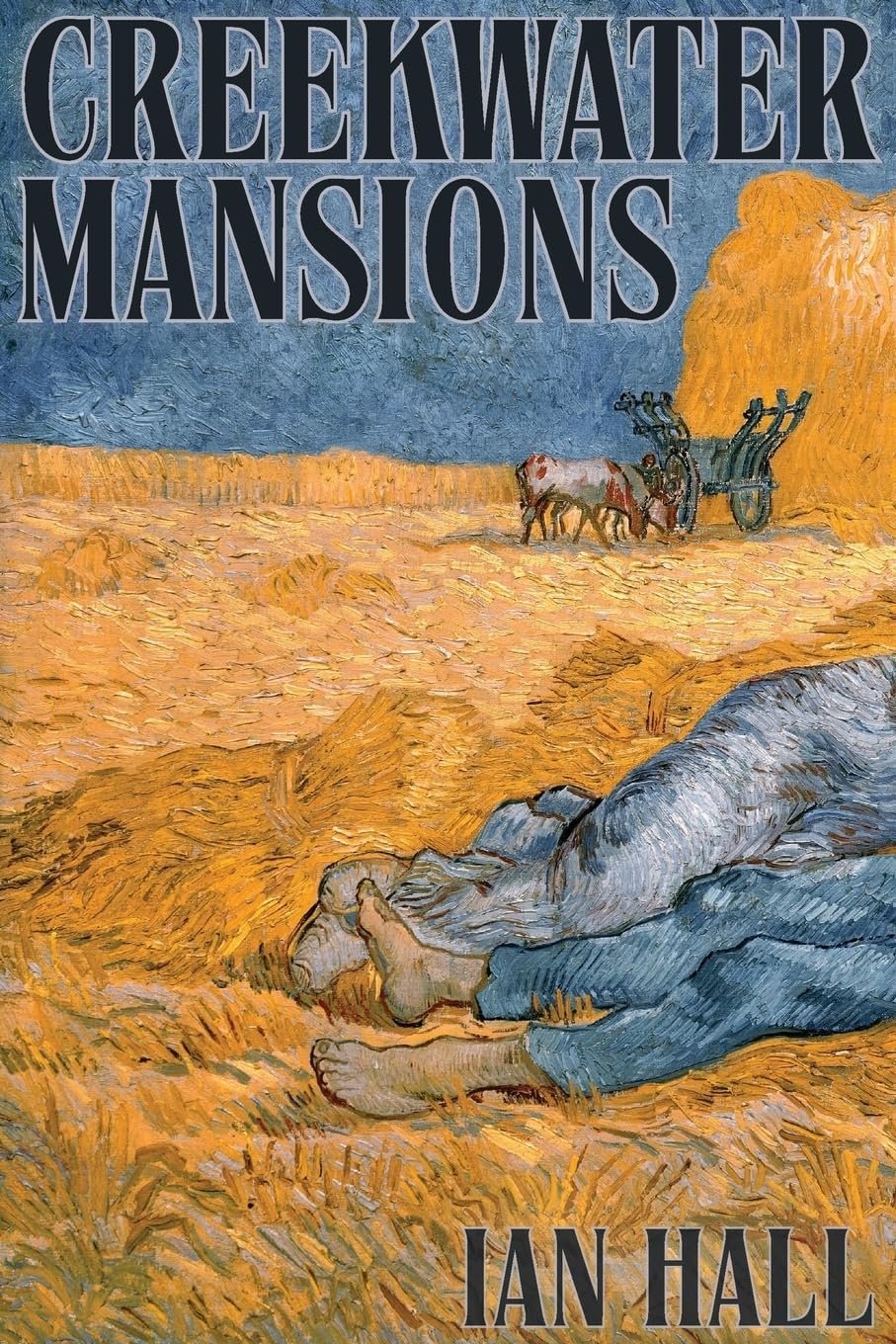
A conversation with Ian Hall about his debut poetry collection Creekwater Mansions.
by Dan Leach

In April of this year, Ian Hall cut a path into American poetry, and his arrival was not a quiet one. Kirkus Reviews called Creekwater Mansions “A gripping collection that’s as complex, musical, and engaging as the region it documents.” Publishers Weekly compared him to Bukowski and described the collection as a “bile-soaked” book where “hard-edged realism and surprising beauty meet.” And Joy Harjo—yes, that Joy Harjo—said, “There is no one else rendering poetry like Ian Hall. His poems are gnarly gardens of deep appreciation of what this tangled, earthly world offers.” None of these reviewers are overselling his book, which I read in a single white-hot sitting (not that his language leaves you any other option) and then returned to many times as my spring semester wound down. Creekwater Mansions is a not just a brilliant book—it’s a timely one—and it was pure thrill to sit down with its author.
Dan Leach: Let’s start with influences. I think every poetry collection is secretly (or sometimes apparently) backed by a creative lineage. What are the books—poetry or otherwise—that made Creekwater Mansions possible?
Ian Hall: I could prattle on ’til the cows come home about the collections, monographs and movies that I feel my own book is in dialogue with, or was influenced by in one way or another, but I’ll just list a few here. Frank Stanford’s collected poems What About This, Joe Bolton’s The Last Nostalgia, Yusef Komunyakaa’s Neon Vernacular, Derek Walcott’s Sea Grapes and Larry Levis’s Winter Stars are foundational texts for me. Finally, Wendell Berry’s collection The Mad Farmer Poems.
DL: I love The Mad Farmer Poems. “Go with your love to the fields. / Lie down in the shade. / Rest your head in her lap.” Berry’s register is so pure in those.
IH: That book was absolutely crucial for me. It might well be my favorite poetry collection of all time.
DL: What about non-poets? Any of those folks on your mind as you were working on Creekwater Mansions?
IH: Absolutely. On the fiction side, James Still, Cormac McCarthy, Barry Hannah, Katherine Anne Porter, Giuseppe Lampedusa, Knut Hamsun, Joris-Karl Huysmans, Stefan Zweig, James Salter and Breece Pancake. Of the more antique persuasion, while I was writing the book I was reading—for both academic and creative reasons—Enheduanna’s Akkadian fertility hymns, Theocritus’s Idylls and Virgil’s Georgics and Eclogues, and these almost certainly seeped into my own poems, heightening their throughline obsession with the political and cultural implications of rurality.
DL: We’re going to come back to the “implications of rurality” a bit later. As two writers from the American South, I think we’re contractually obligated to at least acknowledge the “place” question. But before we get there, you mentioned this tension between academic work and creative work. It’s worth noting that, while you wrote this book, you were also working on a Ph.D. That’s impressive. How did you strike a balance between those two different modes of thought?
IH: I feel like my critical and creative projects are just naturally in conversation with one another, so academic texts inform my creative work just as richly and incisively as other poetry collections do. I was very heartened to learn (from Michael Crews’s great book on Cormac McCarthy’s literary influences) that Cormac was a big fan of Michel Foucault’s work (particularly Madness and Civilization), and that he took inspiration from Foucault’s writing style and not just his ideas. I have always had a very syncretic approach to both academic and aesthetic writing.
DL: Cormac and Foucault. That’s wild. Can’t say I would’ve made that connection on my own, but I’ll keep it in mind when I do my annual reread of Blood Meridian. Speaking of critical texts, maybe throw out a few that someone might sense as they read Creekwater Mansions.
IH: Mark Fisher’s Ghosts of My Life, Barbara Tuchman’s A Distant Mirror, J. Wayne Flynt’s Dixie’s Forgotten People, Richard Gray’s Writing the South, Keri Leigh Merritt’s Masterless Men, Jeff Forrett’s Race Relations at the Margins, Michael Hudson’s Killing the Host, Richard B. Drake’s A History of Appalachia, Ronald Eller’s Uneven Ground, Steven Stoll’s Ramp Hollow and Harry M. Caudill’s Theirs Be the Power: The Moguls of Eastern Kentucky.
DL: One of the things I appreciated about Creekwater Mansions was how it opened up philosophical and intellectual dimensions while also leaving some room for humor. I’m thinking here of your poem “We Still Kill the Old Way.” That poem contains these wonderfully heady lines like “the soul is no custodian” and “within your skull there is a trampling / like Exodus.” And yet, it also contains hilarious moments like “no one has to teach you to read / the braille of the nipple” and “even the measliest of us / is his own paterfamilias—every fart confected in house.” Another example would be “Bellyaching,” which is about being stuck in an outhouse with the “drizzling shits.” The situation is funny on its own terms, and the voice can pose a raucous question like “What to blame / for this bloodletting this hot soda / fizzling out of my ass?” but also compare his small intestine to a “tombstone” and his liver to “a potter’s field.” Personally, as much as I laughed through “Bellyaching,” I found its ending quite poignant. I’m thinking of the part where he passes his father on the road and describes their “hands steepled in prayer / on our paunches / pregnant with regret.” Wonderful work there, blending (as Henry James put it) “the close connection of bliss and bale, of the things that help with the things that hurt.”
IH: Back home, people are always cutting up. Through the good, the bad and the downright gruesome, humor abides. “Laugh to keep from crying” is an overdone phrase nowadays, but there’s truth behind it. If you can crack a joke about something painful, it smarts a little less. Commiserative joking also makes your hurt communal. I want this very thing to come through in my work—the “all hands on deck, all in this together” nature of mountain humor. An example: My dad’s brothers are very handy and very capable; they can fix pretty much anything. Growing up, when stuff was on the fritz around my house (as it so often seemed to be), my dad would call his brothers (and his nephew, Josh). And, without fail, they would show up and help set things right. Before tucking into whatever was wrong, before they had even had a chance to really scope things out, dad would announce what he thought was amiss and ask them if they knew what the immediate fix might be. One of my uncles would often reply: “I’m not sure yet, but I’ll surely stand here in a bind with you till we figure it out.” That line always stuck with me. Besides the sheer poetry therein, it just seems like the perfect bite-sized distillation of what I want humor to do in my own writing: make someone feel less alone, less daunted, less flocked upon by these huge, cosmic, existential things that they can’t make heads or tails of. Because, trust me, I can’t make any sense out of them either.
DL: “Stand here in a bind with you till we figure it out.” That’s not a bad description of the editor-writer relationship, you know? Speaking of editors, I understand that you worked with Stephen Hundley on this project. He’s a longtime friend of mine and first-rate poet in his own right. How was that experience?
IH: I really don’t believe I could overstate how much of a boon Stephen has been. His editorial insights have strengthened this book immeasurably, and it has been an absolute pleasure working with him. Last spring, when the book was first under contract with EastOver, Denton Loving (EastOver’s head poetry editor) said that they were thinking about bringing Stephen on to be the primary point man/editor for my book specifically, and I jumped at the opportunity.
DL: Stephen also got his Ph.D. from Florida State. He was down there from 2021 to 2025, and he speaks pretty glowingly about the folks down there. You two must have crossed paths, yeah?
IH: We did. We started at Florida State at the same exact time, and, as cohort-mates, we took several classes and workshops together. Because we already knew each other, we had a really solid working rapport, and I was eager to see how that translated to this book-length project. A year has gone by, and I couldn’t be happier with our creative partnership.
DL: Rapport is crucial, especially with poetry collections. When Texas Review Press put out Stray Latitudes back in 2024, they set me up with J. Bruce Fuller, who was absolutely incredible to work with. J. Bruce didn’t pull any punches when it came to critiques, but also he approached my work on its own terms and really tried to figure out what I was trying to do. I’m assuming you and Stephen had a similar dynamic.
IH: Correct. Early in the process, he and I met several times to just talk holistically about what I wanted out of the book—how I wanted it to look, how I wanted it to flow, how I wanted it to scale, how I wanted readers to experience it, etc. From day one, he said that ultimately this was my book and that, more than anything, he wanted the final product to correspond to my vision, which really put me at ease. He was always receptive and attentive to my overarching conception of how the book should come across, and he tried to make sure that the poems themselves were oriented and architected in a way that best befitted the whole.
DL: Did any of the poems that made it into Creekwater Mansions undergo radical changes based on Stephen’s editing?
IH: The global/exoskeletal features of the book, its tectonic “movements,” so to speak (e.g., how the poems are ordered, how they are grouped in particular sections, and so on), have essentially stayed the same from the jump. I had that worked out, for the most part, before I ever started submitting to publishers. What did change drastically as a result of my collaboration with Stephen, however, was the format of the individual poems.
DL: I’m curious about that, mainly because I’m fairly obsessive about formatting in my own work. What did those changes look like?
IH: Well, roughly 75-80 percent of the poems in the book, I’d wager, were originally written as couplets. To their credit, Stephen and Denton were fine with maintaining that arrangement—as long as the poems met the margin limitations set by the printers—but I knew I wanted to experiment with some alternative forms. Problem was, I had been working in couplets for so long that I didn’t really know where to begin. During one of our spring meetings, I mentioned to Stephen that I really liked the staggered, saw-toothed, Caesura-heavy line that Charles Wright utilized in his ’80s and ’90s collections, and I wondered how some of my own poems might look in that style. A couple days later, Stephen sent me a few mock-ups he had done that reimagined my poems in this vein—I think “Nocturne for August, Ailing Things” and “Rite” were the initial two poems he gave this treatment to—and it was off to the races.
DL: I really appreciate your willingness to tinker. As a teacher and as an editor and even just as a beta reader, I’ve worked with so many writers who can’t see past their initial conceptions. They might be open to some cosmetic tweaks, but the “bones” of the work cannot be touched. I can respect this attitude, since it reflects a certain confidence in your own vision, but it also tends to limit what might happen to writing via collaboration and outside insight.
IH: Well, seeing my poems in a new light, seeing their potential under new guises, flipped a switch for me, really gave me the confidence to cut loose and try some things. After Stephen sent those mockups, I spent the next two months reworking, reformatting and reimagining the vast majority of the poems in the book. By the time I was finished, it was a much more mature, much more multifaceted entity. Without Stephen, I truly do not think I would have felt comfortable taking that first leap, and my book would have been less rounded as a result.
DL: That’s awesome. Well, let’s talk about the book itself. I think in truly wonderful collections such as yours there’s usually one poem (sometimes even one line) that encapsulates the thematic core of the collection. What, for you, is that poem/line?
IH: For me, the emotional heartwood of the collection is, without equivocation, a triumvirate of poems from very early in the book: “Recoil,” “Aesthete” and “Pilgrim.” These poems are likely the most personal, the most one-to-one mimetic of real life experience. That’s not to say that the usual distancing conceit of the speaker isn’t in play here, or that I don’t take a lot of creative license, but, even still, these particular poems are the infrastructural soul of the book. You could also probably add “Love in the Time of Company Towns,” which appears toward the end of the first section, to this same group.
DL: “Love in the Time of Company Towns” was a real standout for me. I loved lines like “I’m too gummed up / in everydayness to appreciate this / claptrap idyll.” Or: “We are close enough to know each other / biblically.” That whole first section really sings. But the third and final section has some stunners too.
IH: I think the topical/implicitly political nucleus of the book is in the third section, in particular the trio of “The Redneckery,” “We Were Put on This Earth to Fart Around,” and “Elegy for JOANN Fabrics.” In my opinion, these poems do the deftest job of setting the material stakes, identifying the outward antagonists and conflict flashpoints, and laying out the logistics/”Inside Baseball” of the fiscal and cultural battlefield.
DL: I thought “The Redneckery” had some of the most personal lines of the collection. There’s that brutally honest (and brutally funny) part towards the end: “I hate fiddle music. I don’t have a taste / for tater candy. & I’d rather pore over / Sanskrit in a cloistered abbey than blast / Tannerite on some bumfuck mountaintop.” There’s also the shot-gun blast final stanza: “This is about who gets to eat their fill / from the fat of the land. This is for anyone / who’s ever punched &/or kissed me.” You mentioned Frank Stanford as a north star, and it’s poems like these where I think that influence really comes through.
IH: You’re spot on—those sections in particular are cribbed from real experience. I don’t think it’s uncommon to feel out-of-step with where you come from at times (I certainly do), but “the narcissism of small differences,” as Freud called it, does not really hold much significance when you feel like your people and your patrimony are under ecological and extractive attack from all sides. I won’t harp too much on the politics of the book, but suffice to say: something is indeed rotten midst its geographical backdrop, and it’s not the cast of loveable losers trying to make their way in a wider world that so often views them as economic write-offs, as endemically low human capital. Also, as you mentioned, I think politics and the political work this way in a lot of Frank Stanford’s poetry too. His political messaging can be oblique and almost always subordinates to the aesthetic and aural needs of the poem, but it is there nonetheless, waiting to be excavated.
DL: Well I guess, in the interest of time, we’d better circle back to the pickled question of the South and what it means to write about the South. But if it’s okay with you, I’d like to slip in through the side door of that issue and ask you in what sense you feel outside of (or just plain irrelevant to) that categorical distinction? That is, what here came from somewhere distinctly unSouthern?
IH: Obviously, it goes without saying, the mise en scène of the Mountain South is my bread and butter. I couldn’t deny it if I tried —my accent would out me right off the bat. Likewise, the literary tradition of the upland and lowland South(s) more broadly are nearer and dearer to my heart than any other. With those disclaimers out of the way, I honestly find that the more I try to adhere to some abstract Southern gothic ideal, or the more I try to shoehorn in grit-lit pyrotechnics, the more my own work suffers. Over time, and through a whole lot of frustrating trial and error, I have found a viable antidote to my literalist, full-throttle inclinations: Southern-tinged surrealism.
DL: The temptation of a good pyrotechnic–is anyone really immune? You avoid that in this book in a way that made me pretty jealous. It’s very much a book about the South; and yet, your interests are eclectic and universal.
IH: Though most of my life has been steeped in hillbilly-ness, I myself am not in any way, shape or form a rugged mountain man of the recognizable type. My interests do not easily map onto the stereotypically Southern. Echoing what my speaker says in “Redneckery,” I truly have spent most of my time in libraries. Rilke’s Duino Elegies can make me a little moist around the crow’s feet, and my favorite film of all time, bar none, is Whit Stillman’s Metropolitan (assuredly in the running for the absolute least Southern film in the history of motion pictures).
DL: There’s a nice blend in your work of the “high” and the “low” (if we can use those terms in a non-gross, non-problematic kind of way).
IH: That’s the goal. In my work, I want to converse and contend with philosophy, metaphysics, high cinema, 17th century Dutch portraiture, etc. Yet, for all that, the metaphor system I know best and cherish most is colloquial hill-talk. How do I square this circle? How do I write about such mandarin and hifalutin concepts in such a lowly, earthy rhetorical register? That is why the surrealist stylistics of writers like Barry Hannah and Frank Stanford have been so crucial for my own development. They lit a guide path, demoed how to credibly and kinetically interweave the sacred and the profane. And this harmonious balance between the low and the high you mentioned is something I am still trying to wrap my head around. Tellingly, the Ur-image I always write toward is a hard bitten old hill farmer, holed up reading Rilke in his outhouse, teary-eyed, warring with a hemorrhoid.
DL: Let’s talk opener, and let’s talk closer. Why invite us into this world with “Recoil” and usher us out with “Thanks-Giving”?
IH: Wonderful question, and one I myself spent a whole lot of time wrestling with. From pretty much the outset, I knew “Recoil“ was going to be the “show-starter,” so to speak. I wrote it nearly a decade ago, so I’ve had quite a bit of time to mull over its ideal place within the larger architecture of the collection. It’s a deeply personal poem—not exactly autobiography, there’s still some artifice and dramatization taking place, but pretty close to it—and sometimes the effectiveness and caliber of a really cherished poem is hard to gauge. But, all things considered, I think it does a solid job of setting the emotional and thematic stakes in a very interpersonal, I-driven way. The book is very much about the (often maladjusted and misunderstood) ways and means by which poor, provincial people show affection to one another. “Recoil” is, in a very immediate sense, about fathers and sons and the hard-to-articulate things that linger between them, which aligns nicely with the purview of the book at large.
DL: Agreed. I think a good opener also introduces us to the collection’s predominant idiom (or is “register” a better term?), which I think you were right to call “Southern-tinged surrealist.” You hear it in lines like this one: “In this vinegared hush, my stomach / trebles.” Or, later in the poem: “I feel empty / headed from the sensuous particulars / of penny loafer.” After hitting language like this, I’ll be honest–I couldn’t put the book down. What about your closer, “Thanks-Giving”? What was the intention there?
IH: It took me a lot longer, and several imbalanced book drafts, to decide on the placement of “Thanks-Giving.” That poem has also been around a while, and I am very fond of it. I think it is one of the best-paced poems in the book. It unfolds in a way that is lively and engaging, but hopefully not too overbearing or frantic. I have adored the line level technics of the poem from the get-go, but I don’t think I really understood its thematic significance until I started collating and sequencing poems with a book in mind. Originally, “Thanks-Giving” was slotted in at the end of the first section. But, after much consideration, I realized it was a pretty powerful capstone. The book itself is very Aristotelian in the sense that it has a clearly-demarcated beginning, middle and end, each of which corresponds to one of the three enumerated sections. The narrative and thematic arc of the book, as it travels through these sections, concerns the speaker/set of speakers coming to terms with where they come from—the eternal homeplace—and learning to love and treasure it on its own terms, warts and all. To “dance with the one that brung ya,” as the old idiom goes. Weighing the big- picture implications of “Thanks-Giving,” I realized it encapsulated that exact sentiment almost to a T. Plus, the half-humorous tone that the poem lands on—very wry, winking and layered, earnest yet guileful—felt like a fitting sentiment for the book’s finale.
DL: The one that got me from “Thanks-Giving” was this: “Hell, it’s almost creaturely in here / in this house that’s evermore triaged me & mine.” Logically and sonically, “Thanks-Giving” definitely gives that sense of “arrival” or “acceptance” that most readers, including me, tend to look for when finishing a book. I’m glad it found its true place there at the end. Can you say a bit about the relationship between those two poems—“Recoil” and “Thanks-Giving”?
IH: For me at least, starting with “Recoil” and closing with “Thanks-giving” was a full-circle fulfillment. “Recoil” features characters who are chock full of unvoiced feelings; so much so, their every action and utterance is freighted with what’s left unsaid. Love and loss are permanent, but beyond language, which is dissonance-inducing for the speaker. Conversely, the speaker in “Thanks-Giving” is much more verbose and self-assured, almost Charles Portis-esque in his wryness, especially at the end. There is a much warmer, more homeostatic tone, which I think is a result of the speaker’s journey toward self-acceptance. By book’s close, the speaker sees a crooked beauty in the offbeat norms, customs, and traditions of the place that made him, whereas these same peculiarities caused confusion and disconcertion earlier in the collection.
DL: I think you stir up those feelings and many more good ones. Thanks for writing such an unforgettable book. Now that folks like Portis (not to mention Stanford and Hannah, etc.) have moved on, we need books like Creekwater Mansions to keep the whole weird Southern dream from coming unglued. This book was a high joy to read, and I’ll be looking forward to your next one.
IH: Thank you for the kind words, Dan, and for taking time out of your uber-busy schedule to conduct this interview. I’ve long been a fan of you and your work, so it is an absolute treat to get this opportunity to talk shop. I hope we have occasion to do it again in the not-too-distant future.
DL: Here’s hoping.
Dan Leach has published work in The Sun, Copper Nickel and The Massachusetts Review. He is the recipient of Texas Review Press’s Southern Poetry Breakthrough Award, and his collection Stray Latitudes was released in February 2024. His debut novel Junah at the End of the World was published in 2025 and won the South Carolina Novel Prize. He lives in the lowcountry of South Carolina where he teaches creative writing at Charleston Southern University. Read an interview with him here.
The post Almost Creaturely in Here appeared first on Deep South Magazine.