Ancient Sudanese workshop sheds light on Kushite royal power
While ancient Egypt dominated the northern Nile Valley, a powerful kingdom emerged farther south in what is now Sudan. Known as Kush, it eventually extended its influence into Egypt, ruling the country during the eighth century BC. Yet despite its political and cultural importance, Kush has received far less archaeological attention than Egypt, and its […]
 Black News
While ancient Egypt dominated the northern Nile Valley, a powerful kingdom emerged farther south in what is now Sudan. Known as Kush, it eventually extended its influence into Egypt, ruling the country during the eighth century BC. Yet despite its political and cultural importance, Kush has received far less archaeological attention than Egypt, and its achievements have often been portrayed as imitations of Egyptian civilisation.
Now, archaeologists have uncovered an ancient workshop producing faience, a brightly coloured glazed material, within a major temple complex in the ancient Nubian capital of Napata. The discovery provides new evidence of how Kushite rulers used specialised craft production to reinforce royal authority and control the manufacture of valuable goods.
In a study published in the journal Antiquity, researchers from Durham University in the UK and New York University in the US report that the Temple of Sanam, built by Kushite king Taharqo in the seventh century BC, was not simply a place of worship. It also served as a production centre for objects associated with royal power and funerary traditions.
“Recent scholarship has increasingly challenged older views that portrayed Kush simply as a copy of Egypt, but important questions remain about how the Kushite state controlled resources, labour, production and the distribution of prestige goods,” said Rennan Lemos, an archaeologist at Durham University and the study’s lead author.
A workshop inside a royal temple
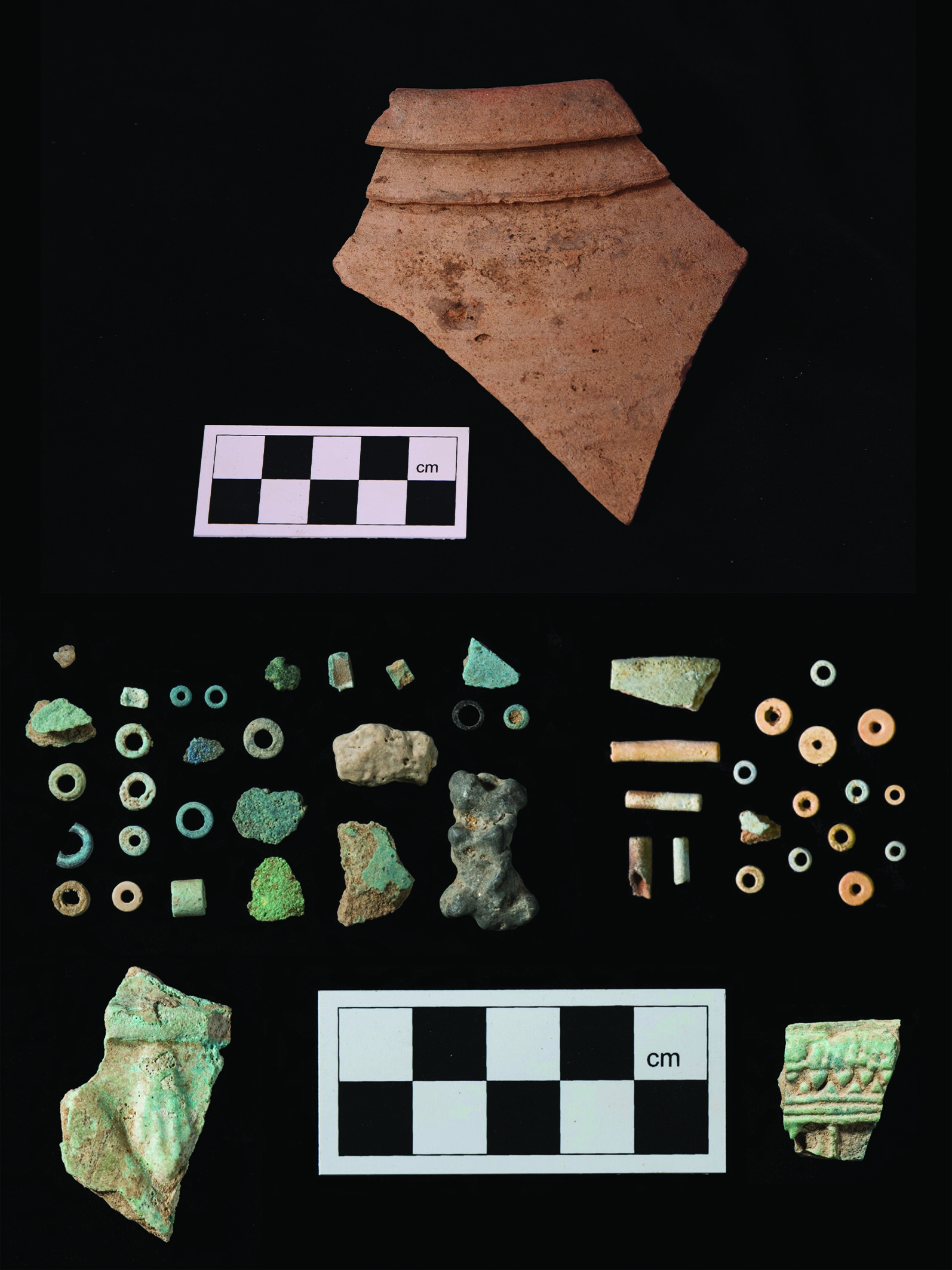
During excavations at the Sanam temple complex, the research team, working with Kathryn Howley of New York University, discovered the remains of a workshop specialising in faience production, alongside hundreds of faience beads and a small funerary figurine known as a shabti.
Shabtis were commonly placed in tombs in ancient Egypt and Nubia. According to funerary beliefs, these small figures could perform work on behalf of the deceased in the afterlife.
Faience was also widely used to make jewellery, amulets and decorative objects because of its bright colours and glossy surface, typically in shades of blue, green and white.
The material was produced by mixing silica-rich ingredients with other substances and heating the mixture until a glassy layer formed on its surface. In ancient Egypt, faience was associated with brilliance and brightness, reflecting both its appearance and its value.
But what particularly interested the researchers was not simply the presence of these objects. It was the location of the workshop itself.
Producing faience involved heating materials in a process that generated smoke and unpleasant fumes. In ancient Egypt, workshops carrying out this activity were generally located on the edges of settlements, away from important central areas.
At Sanam, however, production took place within a major religious complex, suggesting that the manufacture of valuable objects was closely connected to the institutions supporting royal authority.
“This evidence demonstrates that Sanam Temple was not simply a religious monument but also a centre of state-controlled production,” Lemos said.
“The workshop produced faience objects associated with royal power, including shabtis destined for the royal cemetery at Nuri.”
Nuri was one of the most important royal burial sites in the Kushite kingdom, containing the tombs of several rulers, including Taharqo, who ruled Egypt and Nubia during the Twenty-fifth Dynasty.
The discovery therefore offers an unusual glimpse into the economic activities taking place within a royal religious institution and the role of specialised craftspeople in supporting the Kushite state.
Nubian innovation rather than Egyptian imitation
The workshop also revealed an important difference between the manufacturing techniques used in ancient Egypt and Kush.
Egyptian craftspeople commonly used limestone as a source of lime in faience production. But the researchers found evidence suggesting that Kushite artisans may have used crushed seashells instead, an adaptation that made sense because limestone is scarce across much of Sudan.
“The workshop reveals Kushite craftspeople adapted Egyptian-inspired technologies to local conditions,” Lemos explained.
“Instead of relying on limestone, which is scarce in much of Sudan, they appear to have used crushed seashells as a source of lime in the faience recipe. This points to technological innovation rather than simple imitation.”
This finding challenges the long-standing tendency to interpret Kushite material culture primarily through its similarities with ancient Egypt.
Although Kushite craftspeople were familiar with Egyptian technologies and artistic traditions, they did not necessarily reproduce them unchanged. Instead, they selected techniques that suited their needs, modified production methods and created objects carrying meanings specific to Kushite society.
The researchers argue that the workshop also offers rare physical evidence of how the Kushite state exercised economic and political control.
By organising the production of prestigious objects within a royal temple, the authorities may have controlled not only the finished goods but also access to raw materials, skilled labour and the specialised knowledge required to manufacture them.
This suggests a possible difference between the economic foundations of royal authority in Egypt and Kush.
In ancient Egypt, political and economic power was strongly associated with control over agricultural land and production. The new findings suggest that Kushite rulers also placed considerable importance on controlling the manufacture and distribution of luxury and ceremonial objects.
However, the discovery provides direct evidence from one royal temple complex rather than a complete picture of the Kushite economy. It does not establish that all craft production across the kingdom was organised in the same way.
For Lemos, the significance of the findings extends beyond the workshop itself. “This highlights the creativity and agency of ancient Nubian societies,” he said.
Rather than simply adopting Egyptian cultural practices, the Kushites adapted foreign technologies to local circumstances, developed their own production methods and created objects with distinct political and social meanings.
The discovery at Sanam adds an important dimension to the history of Kush, showing that temples could function as centres of economic production as well as religious worship. It also reveals how the artisans who made beads, ornaments and funerary figures contributed to the political authority of one of the Nile Valley’s most influential ancient civilisations.