Black Alabama Voters Lose Again as Supreme Court Greenlights Map
The U.S. Supreme Court on Tuesday allowed Alabama to use a map that eliminates a district where Black voters had the opportunity to elect the candidate of their choice. “The Supreme Court’s decision gives cover to Alabama and others to deliberately and openly discriminate against Black voters without fear of any consequence,” Deuel Ross, the […] The post Black Alabama Voters Lose Again as Supreme Court Greenlights Map appeared first on Capital B News.
 Black News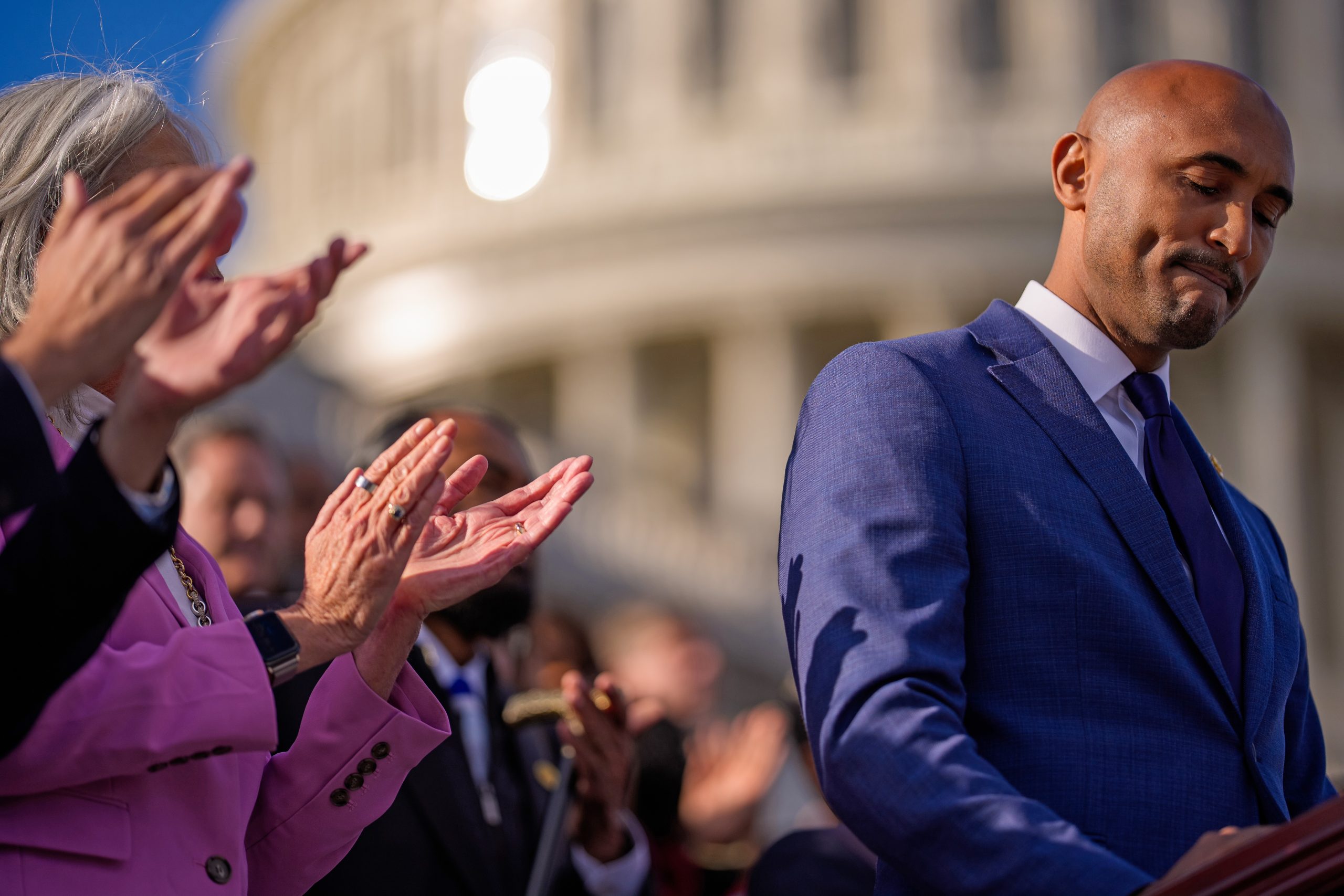


The U.S. Supreme Court on Tuesday allowed Alabama to use a map that eliminates a district where Black voters had the opportunity to elect the candidate of their choice.
“The Supreme Court’s decision gives cover to Alabama and others to deliberately and openly discriminate against Black voters without fear of any consequence,” Deuel Ross, the director of litigation at the NAACP Legal Defense Fund, said in a statement.
“The Court’s shameless decision to reinstate a racially discriminatory map defies any thoughtful or consistent application of the law,” he added. “We will continue to throw all of our resources into the fight to ensure that Alabama voters have the fair representation that they deserve in Congress.”
Tuesday’s order is the latest development since the Supreme Court’s April 29 decision eroding a vital provision of the Voting Rights Act of 1965. The 6-3 decision struck down a majority-Black district in Louisiana. In just weeks, Alabama and several other states rushed to redraw their own maps, as Republicans attempt to deepen their majority in the House in this fall’s midterm elections by limiting the influence of the backbone of the Democratic Party.
Black voters in Southern states fear that the Louisiana decision weakened protections at the ballot box, setting the stage for a return to the 1950s and ’60s in terms of representation and attacks on Black voting power.
“The court has essentially put the death knell into our nation’s most singularly important federal civil rights law,” Kristen Clarke, general counsel of the NAACP, told Capital B, adding that the decision has emboldened lawmakers in former slaveholding states to dismantle majority-Black districts. “They will do so with the blessing of this court.”
Most Black Americans reside in the South, and such a shift, advocates caution, could change the balance of power and the complexion of leadership in this country.
Which states are trying to redraw their maps?
Alabama
To Democrats, the redistricting effort in Alabama is nothing short of a death sentence to Black political power in the state.
Alabama joined the redistricting effort spreading across the South a few days after the April 29 Supreme Court decision, when the governor, Kay Ivey, a Republican, called a special legislative session that began on May 4.
Black residents make up more than a quarter of the state’s population and, since 2024, have voted under a congressional map with two heavily Black districts (in a state with seven districts).
But during the session, lawmakers voted to repeal that map and use a map that would reduce the number of heavily Black congressional districts in the state to one.
“This attempt at voter suppression is an affront to all those who have fought so hard for voting rights in Alabama and across America,” former U.S. Sen. Doug Jones, who’s competing for the governorship, said in a statement this month. The Louisiana decision “has emboldened those who are too afraid to compete for votes to gerrymander their way into even greater power.
Alabama’s congressional map has been the subject of a yearslong legal battle in federal court. A three-judge panel issued a ruling in May against Republicans’ new map.
U.S. Rep. Shomari Figures of Alabama, a Democrat, represents the largely Black district that Republicans are now likely to reclaim. Figures was first elected in 2024, after a special master drew the map without considering race.
Tennessee
On May 7, Tennessee enacted a map that fractured majority-Black Memphis into three separate congressional districts, likely making it a near impossibility for residents to elect a Democratic representative.
Nearly every member of the Tennessee Black Caucus in the state House was stripped of their committee assignments for protesting the map.
“I was here when we first fought with the Department of Justice to get this district drawn so that the African American minority could win it,” Memphis resident Fred Dorse, 81, told MLK 50. “It hurts my heart, at almost 81 years old, to see us lose this again. The same fight we had then, back in the late ’60s and ’70s, now we’re fighting it in 2026, and we have to preserve it.
Days after the Tennessee legislature changed state law and redrew congressional districts, the new 9th District seat is drawing a race between two legislative Republicans.
South Carolina
Gov. Henry McMaster, a Republican, said that it would be “appropriate” for the General Assembly to review whether South Carolina’s map complies with the law, given the Supreme Court’s decision. Any changes to the map could affect the heavily Black district whose seat U.S. Rep. Jim Clyburn has held since 1993.
On Tuesday, just hours after early voting started, the Republican-led state Senate rejected a measure to redraw the state’s map, despite pressure from Trump.
Louisiana
Louisiana Republicans on May 29 approved a map that guts a majority-Black district established in 2024.
Cleo Fields, a Black Democrat and the representative of the voided Louisiana district, made plain the sweeping ramifications of the Supreme Court’s April 29 decision, saying that the “practical effect” is that it will become far more difficult for Black voters to challenge racially discriminatory maps.
Virginia
On May 8, The Virginia Supreme Court struck down the state’s April 21 redistricting ballot measure that voters had approved. The measure would have helped Democrats pick up four additional seats and bolstered Black political power in Congress.
The 4-3 ruling came just two days after the FBI raided the offices of Democratic state Sen. L. Louise Lucas, a vocal proponent of the measure.
Florida
Gov. Ron DeSantis, a Republican, was moving to redraw the state’s map before the Supreme Court’s decision, but he viewed the development as further justification for signing a new map into law.
Why are conservative justices undercutting Black voting power?
Alito wrote in the decision that it was necessary to revisit Section 2, a provision created to combat racially discriminatory map-drawing. He cited gains in ending racial discrimination, the ease with which plaintiffs can “exploit” Section 2 by “dressing their political-gerrymandering claims in racial garb,” and the ability to use technology to draw lines that balance partisanship and race.
Now, he wrote, plaintiffs must demonstrate, using only “current” conditions, that minority groups faced intentional discrimination in the redistricting process.
“Section 2 of the Voting Rights Act of 1965 was designed to enforce the Constitution — not collide with it,” Alito wrote. “Unfortunately, lower courts have sometimes applied this Court’s [Section] 2 precedents in a way that forces States to engage in the very race-based discrimination that the Constitution forbids.”
This decision breaks with decades of precedent holding that Congress designed Section 2 to address not only intentional discrimination but also maps that lead to discrimination, regardless of whether intent could be proved.
Joining the majority opinion, which has significantly raised the bar for Voting Rights Act plaintiffs, were Alito’s fellow conservative justices, including Chief Justice John Roberts. He wrote the majority opinion in the landmark 2013 Shelby County v. Holder decision, which gutted a separate Voting Rights Act provision and led to an increase in the racial turnout gap, according to an analysis by the Brennan Center for Justice. Roberts has been critical of the Voting Rights Act since he was a young attorney in the U.S. Department of Justice.
Justice Elena Kagan delivered a muscular rebuke of Alito’s opinion. In her dissent, which was joined by her fellow liberal justices, she denounced the court’s decision as the “latest chapter in the majority’s now-completed demolition” of the Voting Rights Act and the law’s deeper goal of expanding democracy.
“It is the rare legislature, as the history of voting discrimination shows, that cannot camouflage racial targeting with race-neutral justifications,” she wrote, criticizing Alito’s new requirement that plaintiffs prove racially discriminatory intent.


What are liberal justices saying about the decision?
Justice Elena Kagan delivered a muscular rebuke of Alito’s opinion. In her dissent, which was joined by her fellow liberal justices, she denounced the court’s decision as the “latest chapter in the majority’s now-completed demolition” of the Voting Rights Act and the law’s deeper goal of expanding democracy.
“It is the rare legislature, as the history of voting discrimination shows, that cannot camouflage racial targeting with race-neutral justifications,” she wrote, criticizing Alito’s new requirement that plaintiffs prove racially discriminatory intent.
Kagan also warned that representation of Black communities in elected office could drop — and precipitously so.
“The consequences are likely to be far-reaching and grave,” she wrote. “[This] decision renders Section 2 all but a dead letter. In the States where that law [the Voting Rights Act] continues to matter — the States still marked by residential segregation and racially polarized voting — minority voters can now be cracked out of the electoral process.”
Kagan was pointing to familiar — and controversial — redistricting tactics: “cracking” Black voters across multiple districts to minimize their influence, and “packing” them into as few districts as possible to contain that influence.
Which districts could be next for redistricting?
While finding a definitive number is difficult, groups have offered estimates of which districts might be affected by the kind of decision that was delivered April 29.
In an October report, Fair Fight Action and Black Voters Matter said that 33 House districts could be targeted in midcycle redistricting, and that 27 of them could become safe for Republican candidates. Of those districts, 19 would result from overturning Section 2.
“It’s enough to cement one-party control of the U.S. House for at least a generation,” according to the report.
But Janai Nelson, the president and director-counsel of the NAACP Legal Defense and Educational Fund, cautioned following the decision against focusing only on Congress.
“State legislatures, city councils, school boards, water boards, any entity that requires redistricting will be impacted by the decision,” she said. “We don’t have the numbers across the board for every district in this country — because there are so many that have benefited from the protections of Section 2 — but we do know that it will have a direct and potentially immediate impact on some of the upcoming elections, and certainly on elections going forward.”
Where are advocates focusing efforts to protect Black voters?
Some advocates are attempting to create state-level alternatives to what they consider the now-defanged federal Voting Rights Act.
“At the LDF, we’re pushing for state Voting Rights Acts across the country,” Nelson said. “We’ll use that tool where possible and be as aggressive as we can in trying to get them passed in even the most unlikely states, like Louisiana, Mississippi, and other states known for their rampant racial discrimination.”
Nine states have their own Voting Rights Acts: Colorado (2025), Minnesota (2024), Connecticut (2023), New York (2022), Virginia (2021), Oregon (2019), Washington (2018), Illinois (2011), and California (2002). Louisiana state Sen. Royce Duplessis recently introduced similar legislation for the Bayou State, but it never made it out of committee.
Ambrose Sims, who lives in Louisiana’s West Feliciana Parish and has also challenged the state in court over its maps, shared Nelson’s enthusiasm for pushing back. He described the court’s April 29 decision as at once disappointing and reinvigorating.
“This ruling should really be a call to order,” said Sims, who grew up during the era of segregation and underscored that he doesn’t want to return to that time. “We’ve got to be vigilant. We have to look at what’s happening at the local level, in the state legislature, and in Congress. We have to let our voices be heard at the voting booth. We just need to fight — and not give up.”
Read More:
- The Voting Rights Act Turns 60. Its Future Has Never Looked More Fragile.
- Why Voting Is Becoming Harder for Black Americans in Southern States
This story has been updated.
The post Black Alabama Voters Lose Again as Supreme Court Greenlights Map appeared first on Capital B News.